Introduction
Galley kitchens have a reputation problem. Narrow, enclosed, occasionally dim — they're the layout homeowners apologize for when guests lean in the doorway. But here's what those same homeowners often discover mid-remodel: the galley is actually one of the most efficient kitchen configurations ever designed.
The challenge is knowing what to do with it — and that starts with understanding what the layout can realistically deliver.
Whether you're working with a 1930s Los Angeles bungalow, a Ventura County condo, or a compact older home, a well-planned galley remodel can deliver serious storage, better flow, and a look that rivals any open-concept kitchen — without tearing down walls or expanding the footprint.
This guide covers 20 actionable, design-forward remodel ideas across layout, style, storage, and finishing details. Some cost almost nothing. Others require a licensed contractor and a permit. Either way, knowing your options before you plan saves time, money, and mid-project regret.
Key Takeaways
- A galley kitchen features two parallel counter runs separated by a walkway — typically 4–6 feet wide — making it one of the most ergonomically efficient layouts available
- LA midrange minor kitchen remodels recoup 139.9% of their cost, making targeted upgrades a smart financial move
- Smart design choices — open shelving, two-tone cabinetry, pass-throughs — can dramatically expand a galley's feel without touching its footprint
- Cosmetic upgrades — hardware, paint, lighting — deliver the highest ROI per dollar; structural changes require permits and licensed contractors
- Plan every upgrade around clearance first: NKBA recommends a 42-inch minimum work aisle for one cook, 48 inches for two
What Is a Galley Kitchen and Why Is It Worth Remodeling
A galley kitchen is defined by two parallel runs of counters and cabinets separated by a central aisle. The name comes from ship galleys, where space efficiency wasn't optional — and that same logic translates well to residential kitchens.
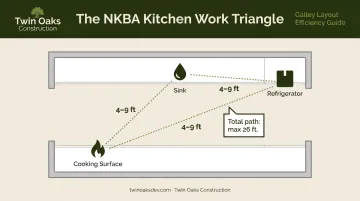
The layout naturally supports the NKBA's work triangle, which positions the cooking surface, sink, and refrigerator within a total path of no more than 26 feet. Each leg runs between 4 and 9 feet. In a galley, those three elements fall almost automatically into an efficient arrangement.
Why remodel one? Two reasons stand out:
- Older LA and Ventura County galley kitchens often carry outdated cabinets, poor lighting, and wasted vertical space — a targeted remodel fixes all three
- A midrange minor kitchen remodel in LA recouped 139.9% of its cost, per JLC's 2024 Los Angeles Cost vs. Value data; a midrange major remodel returned 70.6%
The galley's compact footprint is an advantage here. Fewer linear feet of cabinetry and countertop means lower material costs compared to larger layouts, making a quality remodel achievable achievable without a room addition.
Things to Consider Before Starting Your Galley Kitchen Remodel
Before selecting tile or cabinet hardware, four decisions will shape everything else.
Layout Type
Know what you're working with. A single-wall galley puts all appliances and storage on one wall — common in studio apartments or very small homes. A double galley has counters on both sides with a central aisle, offering more storage and a true work triangle. Each requires a different renovation approach.
Structural Constraints
Walls in older LA and Ventura County homes are frequently load-bearing, and identifying them before finalizing any layout changes is non-negotiable. Per LADBS, online combined kitchen permits are limited to repairs and replacements — any wall or opening changes require separate permit review through Construction Services.
Twin Oaks Construction has spent over 20 years navigating LA and Ventura County building codes, and their integrated design-build process includes permitting support from the start.
The Big Three Design Decisions
Make these calls early:
- Color palette — light colors expand perceived space; dark tones add sophistication but need balanced lighting
- Materials — quartz, butcher block, tile, stone; match the home's broader aesthetic
- Lighting layers — plan task, ambient, and accent lighting together, not as afterthoughts
Appliance Placement
Whirlpool confirms counter-depth refrigerators measure 24–30 inches deep (excluding handles), making them a significant clearance consideration in narrow aisles. The NKBA also requires 15 inches of landing space on the refrigerator's handle side. Plan appliance positions before ordering cabinets — not after.
Budget and Priority List
Set a clear hierarchy before spending anything:
- Structural changes and countertops — highest long-term value; prioritize these first
- Appliances — lock in placement early to avoid costly cabinet revisions
- Hardware, paint, and lighting — lower-cost upgrades that can be phased in without disrupting function
20 Gorgeous Galley Kitchen Remodel Ideas
Layout & Space Ideas (Ideas 1–5)
Idea 1 — Add a Pass-Through Window
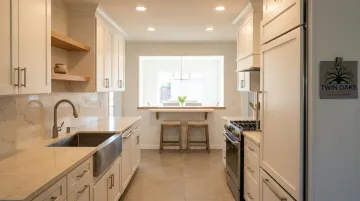
Opening a wall between the galley and an adjacent dining or living room creates borrowed light, visual depth, and a casual serving ledge without full demolition. The result feels less like a corridor and more like a connected part of the home. Note that if the wall is load-bearing, a structural header is required, and LADBS requires a separate permit for opening changes. A licensed contractor should assess the wall before any demo begins.
Idea 2 — Relocate the Refrigerator
A full-depth refrigerator positioned mid-corridor blocks aisle flow and forces awkward sideways movement. Moving it to an end wall, or replacing it with a counter-depth model (24–30 inches deep), immediately widens the usable aisle. This is one of the higher-impact layout adjustments, though relocation involving electrical or plumbing moves adds scope and cost.
Idea 3 — Convert to U-Shape or L-Shape
Removing or relocating one wall (when structurally feasible) can expand the galley into a U-shaped or L-shaped layout, nearly doubling usable counter space. This is a significant structural project requiring professional assessment, permits, and potentially engineering review. Not right for every floor plan, but the payoff in counter space and flow is significant.
Idea 4 — Install a Compact Rolling Island or Butcher Block Cart
When a fixed island would violate NKBA's 42-inch minimum aisle clearance, a rolling cart solves the problem. Architectural Digest recommends slim rolling carts specifically for small kitchens that can't accommodate built-in expansion. You get flexible prep space without permanently narrowing the walkway ; roll it aside when you don't need it.
Idea 5 — Add a Pass-Through Breakfast Bar
Extending the counter into an adjacent space creates a casual eat-in ledge for one or two stools. It's efficient for everyday family use and ideal for entertaining, since guests can be nearby without crowding the kitchen corridor itself. Works best when the adjacent wall allows an opening.
Style & Aesthetic Ideas (Ideas 6–13)
Idea 6 — Two-Tone Cabinetry
Darker lower cabinets paired with lighter uppers ground the space visually and add depth without crowding the room. It breaks the monotony that all-white or all-dark cabinetry can create in a narrow space. A popular choice in California-style interiors right now.
Idea 7 — Bold Backsplash as a Focal Point
A statement tile (zellige, hexagon mosaic, textured ceramic, classic subway, or handmade terracotta) draws the eye down the length of the galley and adds personality to an otherwise neutral palette. Architectural Digest's 2025 kitchen trends report notes that expressive, warmer finishes are replacing the all-white kitchen across the board.
Idea 8 — Statement Pendant Lighting
A row of pendants over the countertop or pass-through pulls the eye through the space and makes the kitchen feel designed rather than incidental. Scale matters: avoid fixtures that crowd low ceilings. Slim pendants spaced evenly down the corridor work particularly well in galley layouts.
Idea 9 — Warm Wood Accents Against Neutral Cabinets
Butcher block countertops, floating wood shelves, or wood-toned lower cabinets against white uppers create visual warmth that resonates with California design sensibilities. The contrast adds depth without making the space feel busy.
Idea 10 — Dark, Moody Color Scheme
Deep navy, forest green, or charcoal cabinetry can make a galley feel sophisticated and purposeful. Balance it with light countertops, a reflective backsplash, and strong layered lighting to keep the space from feeling closed in.
Idea 11 — Arched Architectural Details
A rounded arch over a doorway, open shelf unit, or niche softens the linear tunnel quality of a galley and adds architectural character. Better Homes & Gardens identifies arches as a continuing trend that introduces a playful, residential touch while breaking up harsh angles.
Idea 12 — Open Shelving to Replace Upper Cabinets
Swapping some or all upper cabinets for open shelves reduces visual bulk and creates an airy quality. Houzz reports open shelving appears in 16% of accent cabinet choices. The tradeoff: everything on those shelves is visible, so organization matters more than it does behind closed doors.
Idea 13 — Flat-Panel Cabinetry for a Modern Look
Slab or flat-front cabinet doors create a sleek, seamless look that amplifies the galley's natural linear aesthetic. According to NKBA's 2026 Kitchen Trends release, 69% of respondents identified flat/slab cabinet door style as their preferred choice. Pairs well with integrated appliances and handleless hardware for a fully minimal result.
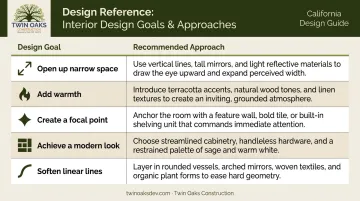
Quick comparison: style approaches by effect
| Goal | Recommended Idea |
|---|---|
| Open up a narrow space | Open shelving (Idea 12) or two-tone cabinets (Idea 6) |
| Add warmth | Wood accents (Idea 9) or warm tile backsplash (Idea 7) |
| Create a focal point | Bold backsplash (Idea 7) or pendant lighting (Idea 8) |
| Achieve a modern look | Flat-panel cabinetry (Idea 13) or moody color scheme (Idea 10) |
| Soften linear lines | Arched details (Idea 11) |
Storage & Function Ideas (Ideas 14–17)
Idea 14 — Floor-to-Ceiling Cabinetry
Extending cabinets to the ceiling eliminates the dead space above standard upper cabinets and maximizes vertical storage. The NKBA recommends 1,400 inches of total shelf and drawer frontage for kitchens under 150 square feet. In a galley, going floor-to-ceiling is one of the fastest ways to reach that benchmark without expanding the footprint.
Idea 15 — Pull-Out Pantry and Specialty Storage Inserts
Converting a narrow cabinet gap or broom closet into a pull-out pantry, and adding interior organizers (lazy Susans, drawer dividers, spice pull-outs), dramatically improves the usability of existing cabinet space. Houzz reports pullout waste and recycling bins at 67% adoption, cookie sheet organizers at 59%, and pantry cabinets at 45% in recent kitchen renovations.
Idea 16 — Shallow Cabinets on One Wall
Installing wall-mount cabinets at roughly 12 inches deep on one side (Home Depot carries 12-inch-depth residential wall cabinets) opens up walkway width without eliminating storage entirely. A practical option for very narrow galleys where even standard-depth uppers eat into usable aisle space.
Idea 17 — Under-Cabinet Lighting
LED strip lighting beneath upper cabinets eliminates task-surface shadows and makes the kitchen feel larger. Houzz reports 71% of renovating homeowners upgrade under-cabinet lighting, and the U.S. Department of Energy confirms LEDs use at least 75% less energy and last up to 25 times longer than incandescent products. For the investment involved, it's consistently one of the most chosen upgrades in small kitchen renovations.
Finishing Touch Ideas (Ideas 18–20)
Idea 18 — Upgrade Hardware and Fixtures
Swapping cabinet pulls, drawer knobs, and the faucet to a cohesive metal finish (brushed brass, matte black, or polished chrome) can refresh the entire look of a galley for a fraction of what cabinets cost. Angi notes cabinet hardware installation averages around $300, with variation based on quantity and product. Few other changes deliver this much visual impact at that price point.
Idea 19 — Patterned or Large-Format Floor Tile
A thoughtful floor choice (black-and-white checkerboard, large-format neutral tile, patterned encaustic, or wood-look porcelain) turns the galley floor into a design feature. Large-format tiles also create fewer grout lines, which the Tile Council of North America notes is a primary driver of their popularity. Fewer grout lines means a cleaner look and less maintenance.
Idea 20 — Folding or Pocket Doors
Replacing a solid door at the galley's end with a pocket door, sliding barn door, or folding panel dramatically improves sightlines and light flow. It's a particularly popular upgrade in California homes oriented around indoor-outdoor living, where connecting interior spaces visually matters as much as connecting them physically.
How Much Does a Galley Kitchen Remodel Cost?
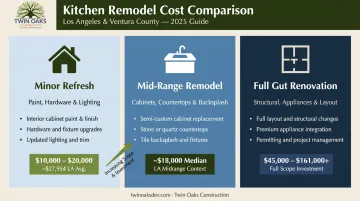
Cost varies significantly depending on scope, materials, and the extent of any structural or layout changes. Here's a practical framework for LA-area homeowners:
| Scope | Typical Cost Range | LA Context |
|---|---|---|
| Minor refresh (paint, hardware, lighting) | $10,000–$20,000 nationally | LA labor costs run higher than national averages |
| Mid-range remodel (cabinets, countertops, backsplash) | ~$18,000 median for kitchens under 250 sq. ft. | LA midrange minor: ~$27,954 avg. job cost |
| Full gut renovation (layout changes, appliances, structural) | $45,000–$161,000+ | LA upscale major: ~$161,329 avg. job cost |
Sources: Houzz 2025 Kitchen Trends Study; JLC 2024 LA Cost vs. Value data.
Which upgrades offer the best return?
- Minor remodels deliver the highest ROI — JLC data shows midrange minor kitchen remodels recoup 113% nationally, climbing to 139.9% in LA
- Hardware, lighting, and paint offer the strongest dollar-for-dollar impact — cosmetic updates that modernize the space without major labor costs
- Layout modifications and full gut renovations return a lower percentage of cost but deliver meaningful lifestyle upgrades
The galley's compact footprint works in your favor. Fewer linear feet of cabinetry and countertop translate to lower material quantities compared to larger kitchen layouts. Wall modifications, appliance relocation, and plumbing or electrical work can offset those savings quickly — so the less structural the scope, the better the budget outcome.
Conclusion
A well-designed galley kitchen can be one of the most functional and beautiful spaces in your home. The right layout, material choices, and design details make the difference — and the ideas in this guide show just how far a narrow footprint can go.
Whether you're planning a cosmetic refresh or a complete structural transformation, the 20 ideas in this guide give you a clear roadmap. Start with what will have the most impact within your budget, and build from there.
If you're in LA or Ventura County and ready to move from inspiration to action, Twin Oaks Construction has spent over 20 years helping homeowners reimagine their kitchens — managing everything from design and permitting to structural work and finish selection in a single, coordinated process. Call (833) 621-7251 or visit twinoaksdev.com/contact to request a free consultation.
Frequently Asked Questions
How much does it cost to remodel a galley kitchen?
Costs range from roughly $10,000–$20,000 for a minor refresh up to $45,000+ for a major remodel in kitchens under 250 square feet. In LA specifically, labor costs run above national averages — JLC data puts the average midrange minor kitchen remodel at about $27,954. Because galley kitchens are compact, material quantities are lower, but structural or plumbing changes can offset those savings.
How do you modernize a galley kitchen?
Start with flat-panel cabinetry, updated lighting layers, and a cohesive hardware finish — these three changes alone dramatically shift the look. Add a fresh countertop and statement backsplash for more impact. Paint and new fixtures alone can modernize an outdated galley for under $5,000.
What is the ideal width for a galley kitchen?
The NKBA recommends a minimum 42-inch work aisle for one cook and 48 inches for two cooks, with at least a 36-inch walkway. That 4–6 foot range between parallel counters allows comfortable movement, appliance door clearance, and an efficient workflow.
Can you open up a galley kitchen to make it feel more spacious?
Yes — a pass-through window, removed non-load-bearing wall, or pocket doors can significantly open a galley layout. Any wall modification needs a licensed contractor's assessment first, since load-bearing walls require structural headers and LADBS permits before work begins.
What are the pros and cons of a galley kitchen layout?
Pros:
- Highly efficient workflow with a natural work triangle
- Compact footprint that reduces material costs
- Minimal layout planning required
Cons:
- Limited room for multiple cooks working simultaneously
- Can feel enclosed without deliberate lighting choices
- Requires creative storage to compensate for the narrow floor plan
How long does a galley kitchen remodel typically take?
A cosmetic refresh — paint, hardware, lighting — takes 1–2 weeks. New cabinets and countertops generally run 4–8 weeks, while a full structural renovation can stretch 3–6 months depending on permit requirements and contractor scheduling in the LA area.