Introduction
Most garages in Southern California are holding a fortune in unused square footage — buried under boxes, forgotten tools, and clutter that's been there for a decade. For homeowners in LA and Ventura County, where Los Angeles home values average around $951,000 and Ventura County's 2024 median existing-home price hit $921,520, that's an expensive storage closet.
Converting an existing garage is one of the most practical ways to add functional square footage without building a full addition. The structure is already there — foundation, walls, roof — which cuts both cost and construction time considerably. You're not starting from scratch.
This guide covers five conversion ideas that work particularly well for LA and Ventura County homeowners, along with what each type costs, what permits you'll need, and how to choose the right fit.
Key Takeaways
- Garage conversions add livable space using an existing structure, avoiding costly foundation and framing work
- Conversion scope ranges from a basic home office (no plumbing needed) to a full permitted ADU with kitchen and bath
- California law has supported garage-to-ADU conversions on single-family lots since 2017, with significant updates effective 2020
- Studio and one-bedroom apartments in LA run $1,965–$2,538/month (RentCafe, June 2026), useful context when evaluating ADU rental income potential
- Unpermitted conversions create real problems at resale — work with a contractor experienced in local permitting
Why Your Garage Is Worth More Than You Think
The core advantage of a garage conversion over a room addition is structural: the foundation, exterior walls, and roof already exist. You're not starting from zero — you're finishing what's already there. That distinction alone accounts for a substantial portion of the cost difference between the two approaches.
Flexibility is the other underrated advantage. A converted garage doesn't lock you into a single use forever — the home office you need now could become a guest suite in five years and a rental ADU later. Few remodeling investments offer that kind of adaptability without requiring a complete rebuild.
In practice, that means one space can deliver across multiple life stages:
- Immediate use: home office, gym, or playroom
- Mid-term shift: guest suite or in-law quarters
- Long-term value: income-generating ADU rental
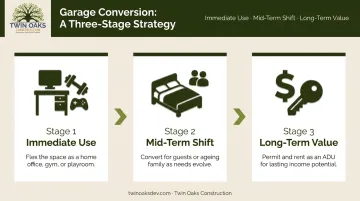
Twin Oaks Construction, which has been serving LA and Ventura County homeowners for over 20 years, positions garage conversions exactly this way: as an opportunity to turn underused space into something that genuinely works for how you live — and how that might change over time. For a market where every livable square foot carries real monetary weight, that's a compelling case.
5 Garage Conversion Ideas to Consider
Guest Suite or In-Law Quarters
This is the most common conversion request for a reason. Southern California has a high proportion of multigenerational households, and a properly converted garage gives family members private, comfortable accommodations without requiring a separate structure.
A well-executed guest suite typically includes:
- Proper wall and ceiling insulation (garages are not insulated by default)
- Real flooring — hardwood, LVP, or tile — replacing concrete
- A dedicated closet
- A ductless mini-split for climate control
- An attached bathroom to make the space self-contained
Design details matter here more than in other conversion types. A private exterior entrance, soundproofing from the main house, and finishes that feel residential rather than utilitarian are what separate a guest suite from a renovated storage room.
Home Office or Remote Work Suite
For anyone working remotely or on a hybrid schedule, the garage-to-office conversion solves a real problem: the kitchen table isn't a workspace, and the spare bedroom isn't much better. Physical separation from household noise changes how effectively you can work.
Garages are well-suited for office conversions. They're detached enough to feel like a different environment, and because they start as utility spaces, there's room to design specifically for productivity.
Key features to build in:
- Task lighting and ambient lighting for long work sessions
- Dedicated circuits for computers, monitors, and equipment
- Proper cable management built into the walls
- A separate entrance for clients if needed
This conversion type is also the most affordable entry point. No plumbing means a simpler permit path and lower build costs. For homeowners newer to renovation projects, it's a reasonable starting point that delivers immediate quality-of-life improvement.
ADU (Accessory Dwelling Unit) for Rental Income
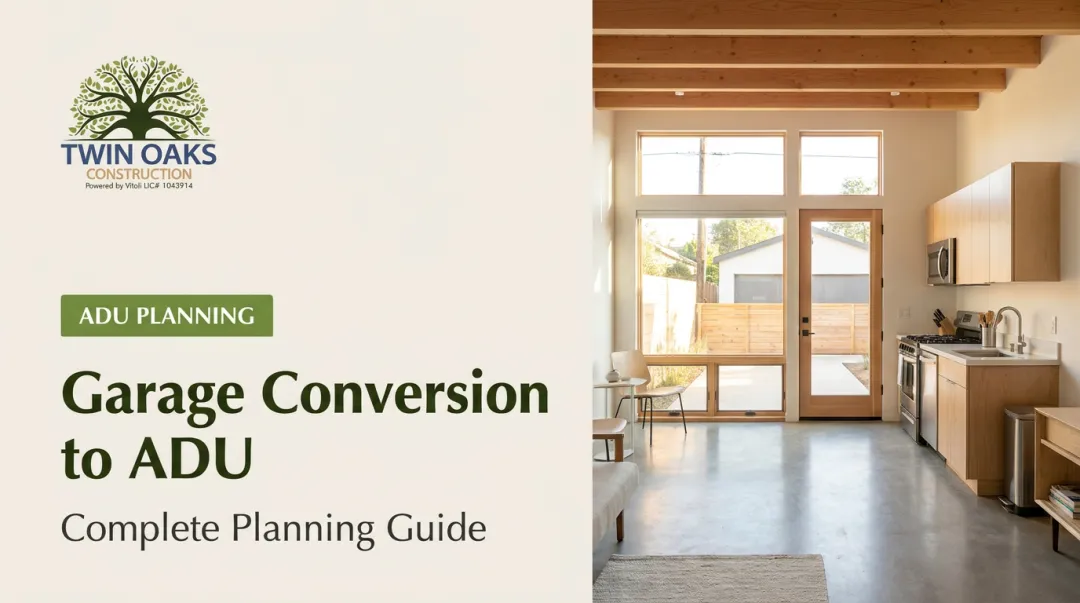
A garage qualifies as a full ADU when it includes independent living facilities: a kitchen or kitchenette, a bathroom, a sleeping area, and its own entrance.
California began its modern statewide ADU reforms in 2017, with the key garage-conversion-friendly rules taking effect January 1, 2020 — including ministerial (by-right) review, no replacement parking requirements when a garage is converted, and setback flexibility for existing structures.
The rental income case: According to RentCafe's June 2026 data, studio apartments in Los Angeles average $1,965/month and one-bedrooms average $2,538/month. Ventura studios come in at $2,084 and one-bedrooms at $2,535. ADU rents depend on location, unit quality, and amenities — but these apartment-market figures give a reasonable reference point for what a permitted, well-finished unit might command.
This is the most complex and permit-intensive conversion type. It requires plumbing, electrical upgrades, and typically HVAC work — and navigating the distinct requirements of LA City, LA County unincorporated areas, or Ventura County takes local knowledge. Twin Oaks Construction handles permitting and planning support as part of their ADU projects, managing the process on behalf of homeowners so they're not left sorting through bureaucratic requirements independently.
Home Gym or Wellness Studio
The garage is a natural fit for a home gym. Concrete floors handle heavy equipment without modification, ceiling heights are typically more generous than standard rooms, and the physical separation from living areas means a 6 AM workout session doesn't wake everyone up.
Key upgrades for a functional gym conversion:
- Rubber flooring or interlocking gym tiles over the concrete slab
- Insulation in walls and ceiling (Southern California summers turn uninsulated garages into ovens)
- A mini-split for year-round comfort
- Adequate electrical circuits for cardio machines and sound systems
This conversion also adapts well. The same space can serve as a yoga studio, pilates room, meditation space, or dance studio depending on how it's finished. Keeping the design flexible — good flooring, clean walls, proper ventilation — means the space evolves as fitness routines change.
Creative Studio or Hobby Room
For woodworkers, painters, photographers, musicians, or anyone who builds and makes things, the garage offers spatial advantages that no interior room can match. High ceilings accommodate large work surfaces or shelving. The floor can handle paint, sawdust, and workshop mess. The separation from the main house creates the mental shift that creative work often requires.
What makes a well-designed creative studio different from a converted garage with a workbench:
- Natural light — replacing the garage door with glass panels, French doors, or adding skylights transforms the quality of the space
- Layered lighting — task lighting for detailed work, ambient lighting for evenings
- Purpose-built storage — for tools, materials, instruments, or photography equipment
- Soundproofing — essential for musicians, optional for most other uses
The flexibility here is real. The same design that works for a watercolor painter also works for a podcast studio. Getting the fundamentals right — light, storage, climate control — makes the space genuinely useful rather than a compromise.
What Does a Garage Conversion Cost?
Costs vary significantly based on conversion type, garage size, and whether plumbing is required. National data from HomeAdvisor and Angi puts general garage conversion costs in the range of $6,000–$27,000 for non-ADU conversions — but LA-area labor, permit fees, and energy code requirements typically push total costs well above those national averages.
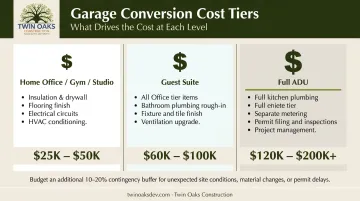
A practical tiered view for Southern California:
| Conversion Type | Relative Cost Range | Key Cost Drivers |
|---|---|---|
| Home office, gym, creative studio | Lower (no plumbing) | Insulation, flooring, electrical, HVAC |
| Guest suite | Mid-range | Above + bathroom plumbing |
| Full ADU | Highest | Full plumbing, kitchen, permits, inspections |
Factors that influence your final number:
- One-car vs. two-car vs. three-car garage (square footage changes everything)
- Whether plumbing needs to be extended from the main house
- Electrical panel capacity and whether an upgrade is needed
- Finish quality — basic functional vs. high-end residential
- Structural issues uncovered during demo (uneven slab, outdated wiring)
Once you have a sense of your conversion tier, two practices keep budgets from going sideways. First, set aside a 10–20% contingency for unexpected conditions — uneven slabs and outdated wiring show up more often than homeowners expect. Second, get at least three quotes with a detailed scope of work, not just ballpark estimates. That detail protects against cost overruns when the project is underway.
What to Know Before You Start
Permits Are Non-Negotiable
In LA and Ventura Counties, converting a garage to habitable space requires building permits. LA County has a dedicated Garage Conversion to ADU program through Public Works; Ventura County routes ADU applicants through its Planning and Building divisions. Any work involving electrical, plumbing, structural changes, or occupancy changes should be treated as permit-triggering.
Skipping permits carries real consequences. California's Transfer Disclosure Statement requires sellers to disclose additions or alterations made without necessary permits, and unpermitted work can delay or kill a sale, trigger code enforcement, and require costly remediation.
HOA and Parking Considerations
California Civil Code Section 4751 voids HOA provisions that effectively prohibit or unreasonably restrict ADU or JADU construction on single-family lots. This protection applies specifically to ADUs and JADUs, though — not every garage conversion qualifies.
A garage office, gym, or studio that doesn't meet ADU criteria may still face HOA architectural rules or parking requirements. Review your CC&Rs and check with your local planning department before committing to a design.
Structural Upgrades Every Conversion Needs
Regardless of conversion type, nearly every garage-to-living-space project requires:
- Wall, ceiling, and subfloor insulation (garages have none by default)
- Replacing or infilling the garage door opening with a wall, windows, or glass panels
- Raising or leveling the floor to meet the main home's finished floor height
- Adding windows for natural light and egress code compliance
Budget and plan for these from the start; they apply to virtually every conversion type regardless of end use.
Frequently Asked Questions
How much should a garage conversion cost?
Basic conversions (office, gym, hobby room) without plumbing typically run $20,000–$40,000 in the LA area. Full ADU conversions with kitchen, bathroom, and all required permits generally range from $80,000–$150,000+. LA-area costs run above national averages due to higher labor rates and permit fees — get local contractor quotes rather than relying on national cost calculators.
Is it cheaper to convert a garage or build an extension?
A garage conversion is almost always less expensive than a room addition because the foundation, exterior walls, and roof already exist. Skipping that structural groundwork typically cuts total project costs by 30–50% compared to building the same square footage from scratch.
What is the 10-year rule for garage conversions?
The 10-year rule is a UK planning enforcement concept — under UK law, certain planning violations become immune from enforcement after 10 years. It has no equivalent in California. LA and Ventura County homeowners should rely on California ADU statutes, HCD guidance, and their local municipal codes.
Do I need a permit to convert my garage in California?
Yes. Permits are required for any garage conversion involving electrical, plumbing, structural, or occupancy changes. Converting to an ADU triggers additional review requirements that vary by city and county — LA City, LA County unincorporated areas, and Ventura County each have their own processes.
Will converting my garage hurt my home's value?
In most LA-area markets, functional permitted living space — particularly a rentable ADU — adds more value than a garage removes. Quality of execution and proper permits are significant factors; an unpermitted conversion can actively hurt resale by triggering disclosure requirements and potential code enforcement.
How long does a garage conversion take from start to finish?
A straightforward conversion (office or gym) typically takes 4–8 weeks of construction once permits are pulled. A full ADU conversion — including design, permitting, and construction — usually runs 9–12 months from start to finish, with permitting often accounting for the longest portion of that timeline.