Introduction
Housing costs in Los Angeles and Ventura Counties continue to put pressure on homeowners — whether you're trying to offset your mortgage, create space for an aging parent, or simply add long-term value to your property. An accessory dwelling unit (ADU) addresses all three challenges on a single lot you already own.
ADUs now account for approximately 20% of California's total housing production, which tells you something about how seriously homeowners across the state have embraced this option. And California's regulatory framework — one of the most ADU-friendly in the country — has made it more accessible than ever.
This guide covers everything an LA or Ventura County homeowner needs before starting: what ADUs are, the types available, how California law governs them, what construction costs, and how to finance it.
Key Takeaways
- ADUs are self-contained secondary units — with their own kitchen, bathroom, and entrance — built on your existing lot
- California law limits local governments from blocking ADU construction and requires permit decisions within 60 days of a complete application
- Most single-family lots in California can have both a standard ADU and a Junior ADU (JADU)
- Construction costs vary widely — the statewide median was $150,000 in 2021, with garage conversions typically the lowest-cost option
- Only permitted ADUs add appraised value; unpermitted builds carry serious legal and financial risk
What Is an Accessory Dwelling Unit?
An ADU is a fully self-contained residential unit located on the same lot as a primary single-family home. It has its own kitchen, bathroom, and sleeping area — and it cannot be sold separately from the main property (with limited exceptions under newer California law).
You may already know the concept by a different name: granny flat, in-law suite, guest house, carriage house, or backyard cottage. Different labels, same structure.
What separates an ADU from a standard room addition is function. A bonus room or extra bedroom doesn't qualify. To trigger ADU status — and the specific permitting rules that come with it — the unit must operate as a completely independent living space. That self-sufficiency is exactly what California's permitting framework is designed around.
Types of ADUs
California recognizes three primary ADU categories:
- Detached ADU — A freestanding structure separate from the main home, typically built in the backyard or side yard. Offers the most privacy for both occupants.
- Attached ADU — An addition physically connected to the primary residence, sharing at least one wall.
- Internal/Conversion ADU — Created by converting existing space: a garage, basement, or interior room.
Each comes with real tradeoffs:
| Type | Privacy | Relative Cost | Best For |
|---|---|---|---|
| Detached | Highest | Highest | Maximum independence, long-term rental |
| Attached | Moderate | Mid-range | Shared utility access, aging parents |
| Garage Conversion | Moderate | Lowest | Budget-conscious, existing structure |
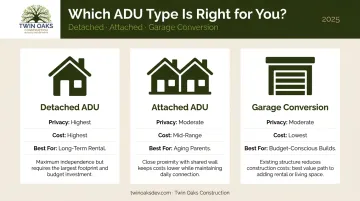
Garage conversions are the most cost-effective starting point for homeowners who already have a structure to work with — no new foundation, no new shell. Twin Oaks Construction builds all three types across LA and Ventura Counties, from custom detached units to full garage-to-living-space conversions.
Why Build an ADU: Benefits for LA and Ventura County Homeowners
Rental Income Potential
LA County is one of the highest-rent markets in the country. While ADU-specific average rents aren't reliably tracked as a separate category, the broader market context is instructive: the Los Angeles median apartment rent sits around $2,068, with studio units in Ventura County listing at $2,500+ in current market listings. An ADU targeting the studio or one-bedroom segment can generate real monthly income — enough to offset a significant portion of a mortgage payment over time.
Property Value
FHFA data published in 2025 shows that in 2013, California properties with ADUs carried a median appraised value of $550,000 versus $405,000 for comparable properties without one — and that gap grew through 2023. These figures are descriptive, not a guaranteed return, but they reflect what appraisers and buyers consistently see: a permitted ADU adds recognized value and broadens the pool of interested buyers.
Multigenerational Living
Southern California's family-oriented communities make this one of the most practical use cases. An ADU lets households share the same property without sharing the same walls. Common arrangements include:
- Aging parents living independently while staying close to family
- Adult children establishing their own space on the home lot
- Live-in caregivers with private quarters separate from the main house
Each household keeps its own routines — a real advantage for long-term livability.
Housing Supply Without New Infrastructure
Because ADUs are built on existing lots, they don't require new roads, utility extensions, or public infrastructure. They add rental inventory to high-demand neighborhoods while using a smaller physical footprint than new single-family construction — a practical advantage in the already built-out neighborhoods of LA and Ventura Counties.
ADU Regulations and Zoning in California
California has made itself one of the most ADU-permissive states in the country — and that matters directly to your project. A series of targeted legislative reforms have removed many of the local barriers that once blocked or delayed ADU approvals, giving homeowners significantly more flexibility than they had even five years ago.
The State Law Framework
Key legislation reshaped the landscape:
- AB 68 and AB 881 (effective 2020) — Eliminated minimum lot-size barriers, streamlined approvals, and cut the application review window from 120 days to 60 days
- AB 2221 and SB 897 (effective 2023) — Required objective standards, prevented denials based on certain nonconforming zoning conditions, and set higher minimum height allowances in qualifying cases
- AB 976 (effective 2024) — Permanently prohibited local agencies from imposing owner-occupancy requirements on ADU properties
- AB 1033 (effective 2024) — Allows cities that opt in to permit separate ADU sales as condominiums (check local adoption before assuming this applies)
The core principle: state law sets a floor that local ordinances cannot go below. Cities can still establish local standards, but they cannot use those standards to effectively block ADU construction.
Standard Zoning Requirements
Requirements vary by municipality, but typical parameters include:
- 4-foot setbacks on the side and rear — a state-established minimum that applies to many ADUs
- Size caps tied to the primary home's square footage, with exact limits set by your city or county
- Height limits that vary locally — Ventura, for example, caps detached ADUs at 16 feet under its 2023 ordinance
- Short-term rental restrictions in some jurisdictions — Ventura prohibits ADU rentals under 30 days
The Permitting Process
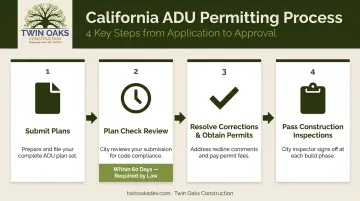
All ADU construction requires permits — no exceptions. The typical sequence:
- Submit architectural plans and permit application to the local building department
- Await plan check approval (local agencies must act within 60 days of a complete application under California's ADU Handbook)
- Receive permits before any construction begins
- Pass required inspections at key construction stages
Building without permits creates serious exposure: fines, code enforcement action, and complications when refinancing or selling.
ADUs and Junior ADUs (JADUs)
Under state law, single-family lots can typically accommodate both a standard ADU and a JADU. A JADU is a smaller internal conversion — 500 square feet maximum — created within the existing walls of the primary residence. Key JADU requirements:
- Separate exterior entrance (and interior access if no separate bathroom)
- Efficiency kitchen with food-prep counter, storage, sink, and cooking appliance
- May share bathroom facilities with the main home
Local Rules Still Matter
Los Angeles operates under its own ZA Memo No. 143 framework, which aligns with state law but has city-specific design and coastal requirements. Thousand Oaks maintains its own ADU page covering parcel-level standards. Before finalizing any plans, confirm requirements directly with your city or county planning department — what applies in one neighborhood may not apply in the next.
Planning Your ADU: From Lot Assessment to Breaking Ground
Before Design Begins
Three things to verify before engaging a designer:
- Confirm your lot meets local size and setback requirements for your preferred ADU type
- Assess existing structures for constraints or conversion opportunities (a detached garage, for example)
- Locate water, sewer, and electrical connection points early — these directly affect design options and cost estimates
The Design-to-Permit Timeline
The permit-only clock is 60 days for a complete application, but that assumes your plans are ready when you submit. Real-world timelines depend on how long design and plan preparation take before submission, and whether your first submission triggers corrections.
The general sequence:
- Engage an architect or designer to produce permit-ready drawings
- Submit to the local building department
- Receive plan-check comments and resolve corrections
- Obtain permits
- Begin construction
Working with the Right Contractor
An experienced local contractor shortens this timeline and reduces the risk of plan-check rejections. Twin Oaks Construction manages the full permitting and planning process for homeowners across LA and Ventura Counties, handling code compliance, corrections, and coordination with local building departments. With over 20 years working in the region, they know what local inspectors and plan checkers expect — which helps keep first submissions clean.
Common Pitfalls to Avoid
- Submitting incomplete plans (the most common cause of timeline extension)
- Underestimating utility upgrade costs, especially for older homes
- Hiring a contractor without specific LA/Ventura ADU experience
- Starting design without first confirming lot feasibility
Designing Your ADU for Your Southern California Property
Functional Priorities
ADUs typically range from 400 to 1,200 square feet — every design decision matters at that scale. Key priorities:
- Efficient layout: Open-plan living/kitchen areas maximize perceived space without wasting square footage
- Natural light: Well-placed windows, clerestory glazing, or a skylight can transform a compact unit
- Smart storage: Built-ins, under-stair storage, and vertical shelving reduce clutter without reducing livable area
- Private entrance: Required for JADUs; strongly recommended for all ADUs regardless of type
Architectural Integration
An ADU that looks like it was dropped onto your property from a different neighborhood hurts both aesthetics and resale value. The unit should share the primary home's exterior materials, roofline logic, and architectural language — whether that's a Craftsman bungalow in Pasadena, a Spanish Colonial Revival in Oxnard, or a mid-century ranch in the Valley.
Twin Oaks Construction builds this integration into every ADU project from the first consultation — each unit is designed to read as part of the existing home, not an afterthought added to the lot.
Southern California-Specific Considerations
Architecture sets the tone, but the local climate and lifestyle shape the details. A few features are worth prioritizing specifically for Southern California:
- Outdoor living access: Even a small patio or deck adds significant livability — and in Southern California, outdoor space is usable most of the year
- Energy efficiency: Proper insulation, efficient HVAC sizing, and solar-readiness are practical investments in a warm climate with high utility costs
- ADA-accessible design: If the ADU will house an aging family member, single-level layouts, wider doorways, and accessible bathroom design are worth building in from the start — changes made after construction cost significantly more
How Much Does an ADU Cost (and How to Finance It)?
Cost Ranges
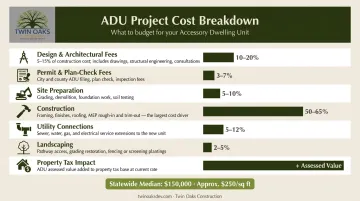
The most authoritative statewide benchmark comes from a UC Berkeley Terner Center survey: the median California ADU construction cost was $150,000, or roughly $250 per square foot, with 37% of ADUs costing under $100,000. That data is from 2021, and LA/Ventura construction costs have generally risen since — use these figures as a floor, not a ceiling.
Cost drivers to plan for:
| Category | Notes |
|---|---|
| Design and architectural fees | Typically 5–15% of construction cost |
| Permit and plan-check fees | Vary by municipality; verify locally |
| Site preparation | Grading, demolition, access |
| Construction | Highest variability; detached new-build vs. garage conversion differs significantly |
| Utility connections | Water, sewer, electrical — can be substantial for older properties |
| Landscaping | Often underestimated post-construction |
| Property tax impact | Partial reassessment on new construction value only |
Every project is different. For a cost estimate tailored to your property and scope, Twin Oaks Construction offers project consultations at (833) 621-7251.
Financing Options
Private financing options currently available to homeowners:
- HELOC — Revolving credit line secured against your home equity; useful for phased projects
- Cash-out refinance — Replace your existing mortgage at a higher balance and pocket the difference
- Home equity loan — Fixed-rate lump sum; predictable payments, no draw flexibility
- Renovation/construction loans — Structured for build timelines, with funds released in stages
- ADU-specific lending programs — Some lenders now underwrite future rental income to improve qualification
On the public side, CalHFA's ADU Grant Program provided up to $40,000 for predevelopment costs — but its latest funding round was fully allocated in December 2023. No new funding round is currently open. Check CalHFA's ADU Grant page for current status.
Consult a lender early in the planning process. Financing terms and qualification requirements vary, and knowing your budget before finalizing design avoids costly scope changes down the line.
Property Tax Considerations
Under California's Prop 13 framework, ADU construction typically triggers a partial reassessment — only the new construction value is added to your existing assessed value; your home's base assessment stays intact. Rental income from the ADU may carry income tax implications as well. Consult a tax professional before and after completing your project for guidance on both.
Frequently Asked Questions
What qualifies as an accessory dwelling unit?
An ADU is a self-contained secondary residential unit on the same lot as a primary single-family home, with its own kitchen, bathroom, and sleeping area. It can be detached, attached, or created through conversion of existing space — what it cannot be is just an extra room without independent living function.
How much does an ADU cost in Southern California?
Costs vary by ADU type, lot conditions, and local labor rates. California's statewide median was around $150,000 in 2021, and Southern California's coastal markets typically run higher. Get a local contractor quote for numbers that reflect current labor and material costs in your area.
How long does ADU permitting take in California?
California law requires local agencies to act on ADU permit applications within 60 days. In practice, timelines in LA and Ventura Counties can vary based on project complexity, plan check queues, and whether your application requires corrections. Working with a contractor experienced in local permitting can shorten the process considerably.
Can I build an ADU on my property in California?
California state law strongly supports ADU construction on most single-family lots. However, specific setback, size, and design requirements still apply at the city or county level. Verify with your local planning department before finalizing any plans.
Do I need a permit to build an ADU?
Yes — always. Building an unpermitted ADU can result in fines, code enforcement action, and complications when you sell or refinance. Permitted ADUs also carry the appraised value benefit; unpermitted units do not. A contractor who handles permitting support, like Twin Oaks Construction, can manage this process on your behalf.
Does an ADU add value to my home?
In most cases, yes. FHFA data shows California properties with ADUs consistently appraise higher than comparable properties without them. The exact increase depends on local market conditions, ADU quality, and rental income potential — but a permitted, well-designed unit broadens buyer appeal and adds recognized value.