

That assumption is wrong.
Cosmetic upgrades, smart material swaps, and a few well-chosen professional touches can completely transform a kitchen without touching plumbing, moving walls, or maxing out a home equity line. According to HomeAdvisor's 2025 data, the average kitchen remodel costs $26,945 — but plenty of homeowners achieve dramatic results for a fraction of that by focusing on the right upgrades in the right order.
This guide covers how to set a realistic budget, which upgrades deliver the most visible impact per dollar, which materials offer near-luxury looks without the price tag, and when to call in a licensed contractor versus handling things yourself.
Key Takeaways
- Cosmetic upgrades — paint, hardware, lighting, and backsplash — can transform a kitchen for under $5,000
- Keeping your existing layout avoids costly plumbing and electrical relocations
- Laminate countertops and LVT flooring offer high-end looks at a fraction of stone or hardwood prices
- Always set aside a 10–20% contingency for hidden costs before work begins
- DIY cosmetic tasks; hire licensed pros for plumbing, electrical, gas, and structural work
Set Your Budget First: Understanding Kitchen Renovation Cost Tiers
Before touching a single cabinet door, establish a number. Without a budget ceiling, costs can spiral fast — a project that starts as a backsplash refresh can easily balloon into a $30,000 full remodel.
The Three Budget Tiers
| Tier | Budget Range | What It Typically Covers |
|---|---|---|
| Cosmetic Refresh | Under $5,000 | Paint, hardware, lighting, peel-and-stick backsplash |
| Mid-Range Renovation | $5,000–$15,000 | Countertops, cabinet refacing, new flooring, fixture upgrades |
| Full Remodel | $15,000+ | New cabinetry, appliances, possible layout changes |
Costs vary meaningfully by scope, materials, and local labor rates. Gather at least three contractor quotes before locking in a number — especially in LA and Ventura Counties, where labor costs run higher than national averages.
The Contingency Buffer
Hidden costs are not the exception — they're the rule. Outdated wiring behind walls, water-damaged subfloors, and permit fees surface constantly once demolition begins. Bankrate recommends setting aside 10–20% of your total renovation budget as a contingency fund before the first nail is pulled.
Kitchen ROI: Framing Spending as Investment
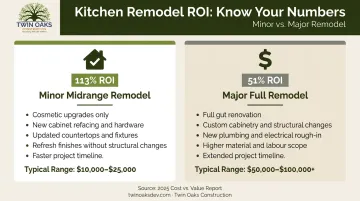
That contingency mindset also shapes where you spend. The 2025 Cost vs. Value Report shows a minor midrange kitchen remodel returning 113% of its cost at resale — meaning smart, targeted upgrades don't just improve daily life, they pay back more than they cost when you sell. Major remodels, by contrast, recoup only 51%. Focused, cosmetic-forward projects deliver better financial returns than gut renovations.
High-Impact, Low-Cost Kitchen Upgrades
Paint the Cabinets
Cabinet painting is the single best return on investment in kitchen renovation. No other upgrade shifts a kitchen's feel this completely for the price.
DIY materials run $200–$600. Hiring a professional averages $425–$1,466 for most kitchens, though larger projects can reach $4,000–$6,500. The process matters as much as the paint itself: clean thoroughly, sand to scuff the surface, apply a bonding primer, then finish with a cabinet-specific topcoat (alkyd or waterborne enamel). Skip any of those steps and the paint chips within months.
For the smoothest finish without brush marks, a spray specialist delivers near-factory results — worth considering if the cabinets are in good condition and you want a high-end look without replacing boxes.
Swap Hardware and Update Fixtures
Cabinet hardware is the jewelry of a kitchen. Replacing knobs and pulls on 30–40 cabinet doors and drawers costs $2–$50 per piece — and the visual shift can be striking.
Popular finish trends right now:
- Matte black — bold, contemporary, pairs well with white or gray cabinets
- Brushed gold — warm, transitional, works in both traditional and modern spaces
- Brushed nickel — versatile, timeless, safe choice for resale
Consistency is key. Mixing three different finishes across a kitchen makes even expensive hardware look cheap.
Install a New Backsplash
The backsplash draws the eye and defines the kitchen's personality. Three options by budget:
- Peel-and-stick tile — $2.42–$15.15/sq ft, true DIY installation, zero mess
- Ceramic or subway tile — $0.88–$22.70/sq ft for materials, requires thin-set and grout
- Statement tile (zellige, handmade ceramic, mixed patterns) — higher material cost, but makes the entire kitchen look renovated at a fraction of the price
Upgrade the Lighting
Outdated overhead lighting makes even new cabinets look dingy. The three-layer approach:
- Ambient/overhead — replace fluorescent fixtures with flush LED panels or semi-flush pendants
- Task/under-cabinet — LED strip kits run $12.98–$149 at most hardware stores; hardwired puck lights cost slightly more
- Accent/pendant — island pendants range $109–$269 for mid-market options
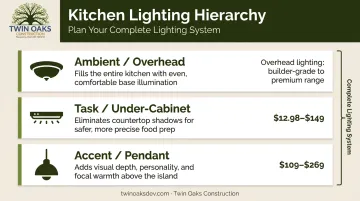
Lighting is one of the few upgrades that improves both how a kitchen looks and how well you can actually use it.
Reface Rather Than Replace Cabinets
If the cabinet boxes are structurally sound, replacing just the doors and drawer fronts dramatically updates the look without the $500–$1,200/linear ft cost of custom cabinetry. It's a meaningful visual upgrade over paint alone — new door profiles, new style — at a fraction of full replacement cost.
Smart Material Choices: Countertops, Cabinets, and Flooring
Countertop Options by Budget
| Material | Cost Range | Notes |
|---|---|---|
| Laminate | Most affordable | Realistic stone looks, durable, wide style range |
| Butcher block | $70–$150/sq ft | Warm, DIY-installable, requires annual sealing |
| Ceramic tile | Budget-friendly | Heat-resistant, grout lines need maintenance |
| Engineered quartz | ~$88/sq ft avg | Long-lasting, low maintenance, premium look |
A smart strategy: use laminate on perimeter counters and butcher block on an island. You get the warmth and texture variation of mixed materials while keeping total countertop costs well below quartz throughout.
Cabinet Choices Beyond Custom
Cabinet costs break down roughly by tier:
- Stock: $100–$400/linear ft
- Semi-custom: $150–$700/linear ft
- Custom: $500–$1,200/linear ft
For most budget renovations, stock or ready-to-assemble (RTA) options have improved significantly in quality and look far better than they did a decade ago.
The most powerful cost-saving decision on cabinets: keep the existing layout. Moving the sink or range means rerouting plumbing and gas lines — a cost that can quickly consume the entire renovation budget.
Flooring That Lasts
| Option | Installed Cost | Best For |
|---|---|---|
| LVT/LVP | $3–$16/sq ft | Water resistance, realistic wood/stone looks |
| Laminate | $3–$13/sq ft | DIY-friendly, budget-friendly |
| Ceramic tile | $15–$20/sq ft | Durable, moisture-resistant |
| Solid hardwood | $6–$25/sq ft | Beautiful but vulnerable to moisture, not ideal for kitchens |
LVT/LVP is the strongest all-around choice for most kitchens: waterproof cores, scratch-resistant surfaces, and realistic visual profiles that read as wood or stone from across the room.
Where to Splurge vs. Save
- Splurge on faucets, countertop edge details, and drawer pulls — the things you interact with every day
- Save on laminate counters, LVT flooring, and painted cabinets, where budget alternatives are nearly indistinguishable at a glance
DIY vs. Professional Work: Know the Difference
Getting this wrong is expensive in both directions — paying a pro for work you could safely do yourself, or attempting trade work that requires a license.
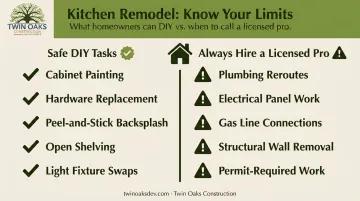
Safe DIY Tasks
With patience and proper prep, these are achievable for most homeowners:
- Cabinet painting (cleaning, sanding, priming, topcoating)
- Hardware replacement
- Peel-and-stick backsplash installation
- Open shelving installation
- Light fixture swaps (with the breaker off)
Always Hire a Licensed Professional
These are non-negotiable:
- Plumbing reroutes — any relocation of supply or drain lines
- Electrical panel work — new circuits, subpanel additions, GFCI upgrades
- Gas line connections — range hookups, any gas appliance work
- Structural wall removal — load-bearing assessment and modification
- Permit-required work — anything that triggers an inspection
In LA and Ventura Counties, work performed without required permits is classified as illegal construction by both LA County Public Works and Ventura County RMA. It can result in fines, mandatory tear-outs, and serious complications at resale. Cosmetic work — painting, tiling, cabinet installation, countertops — is generally exempt, but any electrical, plumbing, or mechanical work requires separate permits.
Navigating permits and coordinating licensed trades is where many budget renovations stall. Twin Oaks Construction has handled kitchen renovations across LA and Ventura Counties for over 20 years, managing permitting, trade scheduling, and quality oversight from planning through completion.
Budget Renovation Mistakes to Avoid
Even well-planned kitchen projects run into surprises. Here are three mistakes that consistently blow budgets — and how to avoid them.
Skipping the contingency buffer. More than 50% of homeowners encountered surprise expenses during home projects in 2024. Outdated wiring, water-damaged subfloors, and corroded plumbing don't show up until demolition begins. Budget 10–20% above your project estimate before starting.
Choosing price over durability on high-use surfaces. The cheapest and second-cheapest laminate countertops may look identical in a showroom but behave very differently after three years of daily use. Find the sweet spot between affordability and quality — not the absolute floor price.
Ignoring permits. Any electrical, plumbing, or structural work without the appropriate permits can result in fines, required demolition of completed work, and a red flag during home sales. In LA and Ventura Counties, check with local building departments before beginning any work that goes beyond cosmetic finishes.
Frequently Asked Questions
What is the least expensive way to remodel a kitchen?
Focus entirely on cosmetic changes: repaint cabinets, swap hardware, install peel-and-stick backsplash, and upgrade lighting. Done well, these four upgrades can transform a kitchen's appearance for well under $5,000 without touching any plumbing, electrical, or cabinetry structure.
Can you remodel a kitchen for $5,000?
Yes — for a cosmetic facelift. Fresh paint, new hardware, updated lighting, and a backsplash refresh are all achievable within that budget. It won't cover new cabinets, countertop replacements, or appliances unless you handle most of the labor yourself.
How do I prioritize what to renovate first in my kitchen?
Start with the highest-visibility elements — cabinets (paint or reface), countertops, and lighting — since these define the overall look. Then layer in hardware, backsplash, and flooring as budget allows.
Should I hire a contractor or DIY my kitchen renovation?
DIY works well for cosmetic tasks — painting, hardware, peel-and-stick tile, light fixture swaps. A licensed contractor is required for plumbing, electrical, gas, and structural changes. A hybrid approach lets you handle the easy work while hiring out the technical tasks.
How long does a budget kitchen renovation typically take?
Cosmetic refreshes can be completed in a weekend to two weeks. Mid-range renovations involving countertops, flooring, or cabinet refacing typically take two to six weeks. Full remodels extend considerably longer depending on scope, permit timelines, and material lead times.
Does a kitchen renovation increase home value?
Kitchen renovations consistently rank among the highest-return home improvement projects. The 2025 Cost vs. Value Report shows minor midrange kitchen remodels recouping 113% of their cost at resale nationally.