
Introduction
If your kitchen feels more like a hallway with a stove than a place where meals actually happen, you're not alone. Cramped counters, zero storage, and a layout that forces you to sidestep the refrigerator every time you open the oven — these are daily frustrations for homeowners across LA and Ventura Counties, where older housing stock and multifamily buildings mean compact kitchens are the norm, not the exception.
The good news: a small footprint doesn't mean you're stuck with a bad kitchen. According to the NAR's 2025 Remodeling Impact Report, kitchen upgrades earn a Joy Score of 10 out of 10 — the highest possible — with roughly 60% estimated cost recovery at resale.
This post covers 20+ proven small kitchen remodel ideas organized by category: layout moves, storage solutions, visual design tricks, and appliance upgrades. Pick the ideas that match your budget and pain points, then build from there.
Key Takeaways
- Layout changes that open kitchens to adjacent rooms deliver the biggest perceived-space gains
- Vertical storage and interior organizers recover significant usable space without touching the footprint
- Light colors, reflective surfaces, and layered lighting all make a small kitchen feel larger
- Structural changes require a licensed contractor and permits; cosmetic updates are often DIY-friendly
- Even modest upgrades can increase resale value — scope and budget determine how far you go
Layout and Structural Ideas That Transform Small Kitchens
The biggest transformations in small kitchens come from rethinking the layout itself — not just refreshing surfaces. These changes carry the highest impact and the highest complexity.
Structural moves like wall removal require a licensed contractor and proper permits. In LA County, LADBS requires permits for any changes to walls, openings, or new plumbing and electrical fixtures. Twin Oaks Construction handles kitchen remodeling across LA and Ventura Counties and can help homeowners evaluate which structural changes make sense before committing to a scope.
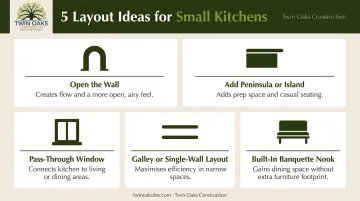
Idea 1: Open the Wall to the Living or Dining Room
Removing a non-load-bearing wall between the kitchen and an adjacent room is one of the highest-impact changes possible. Houzz's 2024 Kitchen Trends Study found that 43% of kitchen renovators made their kitchens more open to interior rooms and 45% revamped the floor plan — making this the most popular structural move by a wide margin. The visual payoff is dramatic: the room opens up, natural light reaches deeper into the space, and that closed-off feeling disappears.
Always have a structural engineer or licensed contractor confirm whether a wall is load-bearing before any demo work begins.
Idea 2: Add a Peninsula or Custom Island
A peninsula or moveable island adds prep space, defines the kitchen zone in an open floor plan, and doubles as casual dining with barstools. The critical detail: size it correctly. NKBA guidelines recommend at least 42 inches of work aisle clearance for one cook, and 48 inches for multiple cooks. An island that blocks traffic flow creates more problems than it solves.
Idea 3: Create a Pass-Through Window or Cased Opening
Not ready for a full wall removal? A pass-through window or cased opening borrows light and sightlines from the adjacent room with far less structural work. It's a practical middle ground — typically faster to permit and significantly less expensive than taking down a full wall.
Idea 4: Convert to a Galley or Single-Wall Layout
Galley and single-wall kitchens get a bad reputation, but they're efficient. Consolidating everything to two parallel walls or one wall creates a clean work triangle and eliminates wasted movement. Houzz data shows galley kitchens represent 11% of new layouts and single-wall 5% — both are solid design choices, not fallbacks. For narrow kitchens where an island would block movement, this is often the smartest path.
Idea 5: Build a Built-In Banquette Eating Nook
A small dining nook with built-in bench seating — and storage tucked underneath — frees the main kitchen from needing a table and chairs entirely. That reclaimed floor space goes back to cooking, not eating. A standard banquette can seat four comfortably in less space than a 36-inch round table, making it one of the most space-efficient swaps in a small kitchen.
Smart Storage Solutions for Every Inch
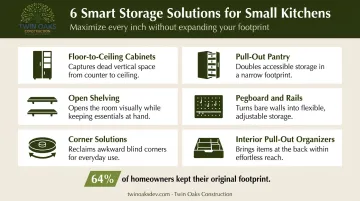
Smart storage is the single biggest differentiator between a cluttered small kitchen and one that feels organized and spacious. Houzz's 2025 Kitchen Trends Study found that 64% of homeowners kept their original kitchen footprint during a remodel — which means the storage inside the existing walls has to do all the heavy lifting.
Idea 6: Install Floor-to-Ceiling Cabinetry
Extending cabinets all the way to the ceiling eliminates the dead zone above standard upper cabinets. Store rarely used items at the top; keep everyday essentials at eye level. The vertical line also draws the eye upward, making ceilings feel taller than they are.
Idea 7: Add a Pull-Out Pantry in Narrow Gaps
The slim vertical gap between the refrigerator and an adjacent wall — sometimes as narrow as 6 inches — can become a custom pull-out pantry for spices, cans, and dry goods. Rev-A-Shelf manufactures base filler pull-outs starting at 3 inches wide, so almost any gap is workable. Most homeowners are genuinely caught off guard by how much these slim units can hold.
Idea 8: Replace Some Upper Cabinets with Open Shelving
Swapping one or two upper cabinets for open floating shelves reduces visual weight and puts everyday items within easy reach. Houzz data shows open shelves without doors appear in 16% of accent cabinet choices. Keep this approach honest: it works best for households with limited dishware, since cluttered open shelves create more visual noise than the cabinets they replaced.
Idea 9: Install Pegboard, Rails, or Under-Cabinet Hooks
Vertical wall storage using pegboard panels or mounted rails frees up cabinet and drawer space while keeping pots, pans, and utensils accessible. It's also one of the most affordable upgrades on this list, and matte black or brushed brass rail systems can double as a design feature in their own right.
Idea 10: Use Corner Solutions Strategically
Corner cabinets are notorious for swallowing items whole. Lazy Susans, blind corner pull-outs, and corner drawer units can reclaim several cubic feet of storage that's otherwise unreachable. If your kitchen has dead corners, addressing them often delivers the biggest storage gain per dollar spent.
Idea 11: Add Interior Cabinet Organizers and Pull-Out Drawers
67% of renovators added pull-out waste and recycling bins and 59% added cookie-sheet organizers, per Houzz 2025. Pull-out shelves, drawer inserts, and tiered organizers inside existing cabinets eliminate the "black hole" effect where items disappear at the back. This is a highly DIY-friendly upgrade with immediate, visible results.
Color, Light, and Visual Design Tricks
Strategic use of color, light, and materials can make a small kitchen feel noticeably larger without moving a single wall. These ideas tend to offer the highest visual payoff per dollar spent.
Idea 12: Choose Light or White Tones for Cabinets and Walls
A cohesive light palette across cabinets, walls, and countertops creates a unified visual flow the eye reads as spacious. Sherwin-Williams recommends soft whites, pale grays, and gentle beiges with a Light Reflectance Value (LRV) above 65 for an expansive feel. Houzz 2024 data confirms white cabinetry remains the top choice at 46% of renovated kitchens. The opposite — multiple competing colors and finishes — visually fragments the space and makes it feel smaller.
Idea 13: Paint Cabinets in High-Gloss or Two-Tone Finishes
A high-gloss cabinet finish bounces light around the room, adding brightness and depth. The two-tone trend — lighter uppers, slightly deeper lowers — grounds the space without making it feel heavy. Cabinet painting is also one of the most DIY-accessible updates on this list, with a high visual return for relatively modest effort.
Idea 14: Install a Reflective Backsplash
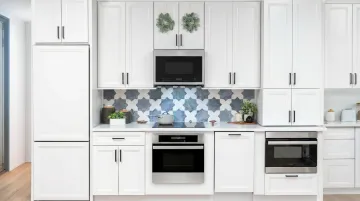
Glazed subway tile, Zellige tile, mirrored glass tile, or polished stone backsplashes reflect light and create a sense of depth behind the range and counters. Matte tiles absorb light instead of reflecting it — a meaningful difference in a tight space. Even a standard 3×6 glazed subway tile can visibly brighten a kitchen that gets limited natural light.
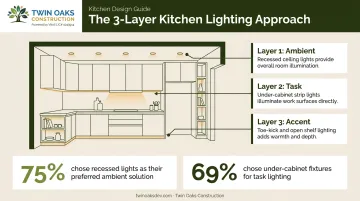
Idea 15: Layer Lighting — Ambient, Task, and Accent
NKBA guidelines outline a three-layer approach that eliminates the dark corners that make small kitchens feel cramped:
- Ambient — Recessed ceiling lights or a statement pendant for overall brightness
- Task — Under-cabinet lighting directly illuminating counters and prep zones
- Accent — Toe-kick lighting or open shelf lighting for warmth and depth
Houzz 2024 found 75% of renovators chose recessed lights and 69% chose under-cabinet fixtures — both layers, not one or the other.
Idea 16: Use Large-Format Flooring Installed Diagonally
Oversized tiles or a diagonal installation pattern tricks the eye into perceiving more floor space. Small mosaic tiles do the opposite — they create a visually busy surface that emphasizes how small the room is. Large-format tile with tight grout lines keeps the floor plane open and uncluttered.
Idea 17: Use Vertical Design Elements to Add Perceived Height
Vertical lines — shiplap panels, cabinet doors with vertical grooves, stacked art, or tall pendant light cords — direct attention upward and create the illusion of greater ceiling height. In a kitchen with 8-foot ceilings, this trick alone can make the room feel closer to 10.
Appliance and Fixture Upgrades for Small Kitchens
Choosing the right appliances for a small kitchen is about fitting the tool to the space. The wrong size can eat up floor space, block walkways, and make a compact kitchen feel permanently cramped.
Idea 18: Right-Size Your Major Appliances
Whirlpool defines counter-depth refrigerators as 24–30 inches deep, compared to 31–36 inches for standard-depth models. That difference of up to 12 inches can be transformative in a galley or narrow kitchen. Bosch's 18-inch dishwashers — designed specifically for compact kitchens — handle 8–10 place settings while reclaiming several inches of counter and walkway width.
Idea 19: Opt for a Wall Oven and Cooktop Combo
Separating the oven (mounted in the wall) from the cooktop (installed in a counter or island) frees up the lower cabinet storage that a standard range would occupy. Microwave-wall oven combination units move the microwave off the counter entirely, consolidating two appliances into one built-in footprint. This configuration also unlocks layout flexibility — you can position the cooktop near a window for ventilation and place the oven at a more ergonomic height.
Idea 20: Install an Under-Cabinet or Over-Range Microwave
Moving the microwave to an under-cabinet mount or over-the-range position reclaims usable counter space. Over-the-range models double as a ventilation hood, eliminating the need for a separate range hood entirely. Note that externally vented OTR units typically require professional installation, so factor that into your budget from the start.
Idea 21: Choose Multi-Function Appliances to Eliminate Clutter
Combination units can consolidate several countertop devices into a single footprint. For small kitchens where every square inch of counter is contested, the gains add up quickly. Common multi-function options include:
- Convection/air fryer/microwave combos that replace 2–3 separate appliances
- Induction cooktops with built-in downdraft ventilation, eliminating a separate hood
- Compact toaster oven/air fryer hybrids that replace both countertop units
- Refrigerator/freezer drawers built into an island, freeing full-size fridge space
Planning Your Small Kitchen Remodel: Budget and When to Hire a Pro
Understanding the Cost Range
Small kitchen remodel costs vary widely based on scope. HomeAdvisor's 2025 cost guide gives useful benchmarks:
| Kitchen Size | Typical Cost Range |
|---|---|
| 75 sq ft | $5,600 – $17,500 |
| 100 sq ft | $7,500 – $25,000 |
| General kitchen remodel | $14,600 – $41,600 |
Houzz data shows small-kitchen major remodels can reach a $45,000 median spend when layout changes, custom cabinetry, and structural work are involved. The biggest cost drivers: layout reconfiguration, plumbing or electrical moves, and custom-built storage.
DIY vs. Licensed Contractor
DIY-friendly (no permit typically required):
- Painting cabinets and walls
- Installing open shelves and pegboard
- Swapping hardware and light fixtures
- Adding interior cabinet organizers
Requires a licensed contractor:
- Removing or modifying walls
- Moving plumbing or electrical panels
- Custom built-ins and structural reconfiguration
- Any work where changes exceed $500 in California (per CSLB licensing rules)
Don't skip permits to save money. In LA County, unpermitted structural work can complicate resale and may need to be disclosed or remediated before a property can transfer.
A Practical Planning Sequence
- Identify your biggest pain point — lack of storage, poor layout, or insufficient light
- Prioritize changes that address that first before moving to cosmetics
- Layer in visual upgrades once structural and storage needs are resolved
- Get a realistic project plan and budget before committing to any scope
Twin Oaks Construction offers kitchen remodeling consultations for homeowners across LA and Ventura Counties. With over 20 years of experience in design-build remodeling, they can help you move from a list of ideas to an actual project plan.
Conclusion
Small kitchens are not a design limitation — they're a design challenge with proven answers. The right combination of layout thinking, intentional storage, and visual strategy can produce results that genuinely surprise people who've resigned themselves to cooking in a closet.
When you're ready to put these ideas to work, Twin Oaks Construction is a good place to start. Call (833) 621-7251 to schedule a consultation. They've spent over 20 years helping homeowners throughout LA and Ventura Counties turn tight, underperforming kitchens into spaces that actually work.
Frequently Asked Questions
Frequently Asked Questions
What should a small kitchen remodel cost?
Expect to spend $5,600–$17,500 for a 75 sq ft kitchen and $7,500–$25,000 for 100 sq ft, based on HomeAdvisor's 2025 cost data. Scope, materials, layout changes, and local labor rates all shift the number. LA and Ventura County projects typically land toward the higher end due to regional labor costs and permit requirements.
What is the single most impactful change in a small kitchen remodel?
Opening the kitchen to an adjacent room — either through wall removal or a pass-through — typically delivers the biggest transformation in perceived space. According to Houzz research, 43% of kitchen renovators made this exact move. High-impact storage and lighting upgrades often come close, at a fraction of the cost.
How long does a small kitchen remodel take to complete?
Cosmetic refreshes (painting, hardware, open shelves) take one to two weeks. A full structural remodel typically runs six to ten weeks for construction alone. Factor in permit approvals and custom cabinet lead times before committing to a move-back-in date.
Can I remodel a small kitchen without changing the layout?
Yes. Cabinet painting, new hardware, open shelving, updated lighting, a new backsplash, better appliances, and interior organizers can collectively transform how a kitchen looks and functions without touching the layout.
What are the best colors for a small kitchen?
Light neutrals (whites, soft grays, and warm off-whites with an LRV above 65) make small kitchens feel most open. Bold accent colors can work when balanced with plenty of light and reflective surfaces, but a high-contrast palette across every surface tends to visually fragment a compact space.