
The "10x10 kitchen" isn't necessarily a description of your actual kitchen. It's a standardized pricing template the industry uses to compare costs consistently across materials, labor, and project scope. Understanding it is the first step to making sense of any quote you receive.
This guide breaks down what a 10x10 remodel actually costs in the California market, what pushes prices up or down, where the money goes, and what to watch before signing anything.
Key Takeaways
- The "10x10 kitchen" is an industry pricing benchmark (~20 linear feet of cabinetry in an L-shaped layout), not a literal room size
- Budget remodels in LA/Ventura start around $25,000–$45,000; mid-range runs $45,000–$85,000; high-end exceeds $85,000
- Cabinetry alone accounts for 29–40% of total project cost—it's the single biggest budget lever
- LA-area construction labor runs roughly 20% above national averages, so expect costs higher than most online calculators estimate
- Keeping your existing layout is the fastest way to save $5,000–$15,000
How Much Does a 10x10 Kitchen Remodel Cost?
The "10x10 kitchen" is an L-shaped layout with approximately 20 linear feet of cabinetry and 100 square feet of floor area. Cabinet manufacturers, retailers like Home Depot, and kitchen design firms all use it as a consistent baseline for comparing materials and pricing across brands and configurations.
That context matters here, because national averages don't reflect what remodels actually cost in Southern California. LA mid-range kitchen remodels run $45,000–$85,000, well above the $15,000–$75,000 national range. Construction trades in the LA metro earn a mean of $37.00/hr versus $30.73/hr nationally—a 20% labor premium that carries through every licensed trade on your project.
Here's how that breaks down across three remodel tiers typical for LA and Ventura County homeowners.
Tier 1: Budget / Cosmetic Refresh — $25,000–$45,000
What's included:
- Stock or RTA cabinetry (or cabinet refacing)
- Laminate or entry-level quartz countertops
- LVP flooring
- Updated fixtures and hardware
- No layout changes, no structural work
Best for: Homeowners wanting a visual refresh without a full gut renovation, landlords preparing a rental for sale, or anyone working within a fixed budget.
Tier 2: Mid-Range Remodel — $45,000–$85,000
What's included:
- Semi-custom cabinetry with soft-close hardware
- Quartz or granite countertops
- Tile backsplash
- Stainless steel appliances
- Updated lighting, plumbing fixtures, and minor electrical work
Best for: Primary residences being upgraded for daily function and long-term value, or homeowners preparing to sell in a competitive LA or Ventura County market.
Tier 3: High-End / Full Transformation — $85,000–$120,000+
What's included:
- Fully custom cabinetry
- Natural stone countertops (marble, quartzite)
- Professional-grade appliances
- Structural changes, premium lighting, smart home integration
- Custom tile work and full-height slab backsplash
Best for: Luxury renovations, whole-home remodels, or homeowners whose neighborhood comps support the investment.
Key Factors That Affect the Cost of a 10x10 Kitchen Remodel
Pricing depends on design decisions, material quality, local labor rates, and the condition of the existing kitchen. Here's what actually moves the needle.
Layout Changes and Structural Work
Keeping your sink, stove, and refrigerator in their current positions is the single most effective cost-control decision you can make. Moving a plumbing line adds $1,000–$15,000 depending on complexity and distance. Removing a load-bearing wall in Southern California adds:
- Structural evaluation: $400–$800
- Engineering plans and sign-off: $1,200–$3,500
- Construction (beam installation): $2,000–$15,000
For older homes—common throughout both LA and Ventura Counties—structural surprises are more likely, not less. California law requires permits and engineering sign-off for this scope of work.
Cabinet Type and Configuration
Cabinetry is the largest single cost category in almost every kitchen remodel. Here's how the tiers break down for a 10x10 (20 linear feet):
| Cabinet Type | Cost Per Linear Foot | Estimated 10x10 Total (Materials) |
|---|---|---|
| Stock / RTA | $60–$300 | $1,200–$6,000 |
| Semi-Custom | $150–$900 | $3,000–$18,000 |
| Custom (LA market, installed) | $500–$1,500 | $10,000–$30,000+ |
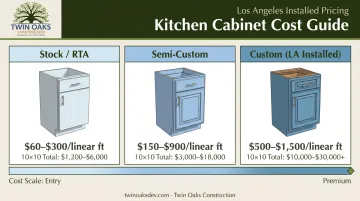
Configuration choices within each tier also matter. Adding pull-out shelves, deep drawer banks, pantry units, or interior organizers can add $1,500–$4,000 to an otherwise mid-tier cabinet package.
Material Selection for Countertops and Flooring
Countertop choice alone can swing your budget by thousands. For a typical 10x10 kitchen (25–35 sq ft of counter surface):
| Material | Installed Cost/SF | Estimated 10x10 Total |
|---|---|---|
| Laminate | $8–$27 | $200–$945 |
| Granite | $40–$100 | $1,000–$3,500 |
| Quartz | $50–$120 | $1,250–$4,200 |
| Marble / Quartzite | $40–$200+ | $1,000–$7,000+ |
Flooring follows the same pattern. For approximately 100 sq ft of kitchen floor in California:
- LVP: $400–$1,600 installed
- Porcelain tile: $500–$2,000 installed
- Engineered hardwood: $700–$2,000 installed
Labor Costs and California Market Conditions
Licensed trades in LA and Ventura Counties run well above the national average:
- Electricians: $39.95/hr (LA) vs. $32.60/hr (national) — ~24% premium
- Plumbers: $35.35/hr (LA) vs. $32.62/hr (national) — ~11–15% premium
- Carpenters: $34.44/hr (LA mean) vs. $27.09/hr (national median) — ~27% premium
Labor accounts for 20–30% of total project cost, so this premium alone adds roughly $2,000–$7,500 to a typical 10x10 remodel compared to national estimates.
California also requires permits for any kitchen work involving electrical, plumbing, or gas. LA City permit fees for a kitchen-scale project with multiple trades typically run $500–$3,000, with approval timelines of 2–4 weeks. Ventura County's initial plan review takes 3–4 weeks. Skipping permits creates legal liability that surfaces directly at resale — and unpermitted work can trigger costly retroactive corrections.
Where Does the Money Go? A Complete Cost Breakdown
Total project cost includes several categories that homeowners frequently overlook when comparing quotes.
| Category | Typical % of Total Budget |
|---|---|
| Cabinetry and hardware | 29–40% |
| Labor (all trades) | 20–30% |
| Appliances | ~15% |
| Countertops | 10–15% |
| Flooring | 5–10% |
| Permits, disposal, contingency | Variable |
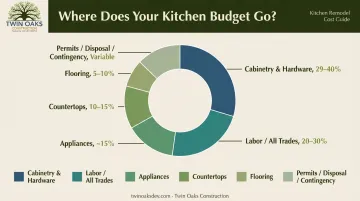
Cabinetry and Hardware consistently claims the largest share of any kitchen budget. Hardware, soft-close mechanisms, and interior organizers are frequently quoted separately—confirm these are included before accepting any bid.
Countertops and Backsplash costs hinge on material, edge profile, and cutouts for sinks or cooktops. A full-height slab backsplash in the same stone as the countertop can cost 3–4x more than ceramic tile covering the same area.
Appliances range widely from builder-grade to professional. Finalize selections before cabinet ordering, since appliance dimensions directly affect cabinet sizing. Changing them mid-project is expensive.
Labor, Demolition, and Disposal are the most variable line items between contractor quotes. Two bids with the same cabinet package can differ by $8,000–$12,000 based on how labor is priced. Always compare line-item quotes, not lump sums.
Permits, Contingency, and Hidden Costs require a dedicated line in your budget. Set aside 15–20% of your total project cost as a contingency.
Older homes in LA and Ventura Counties frequently surface outdated wiring, galvanized pipes, water damage, or subfloor issues once demolition begins. These aren't rare surprises. Experienced contractors raise them in planning conversations before a single wall comes down.
Budget vs. High-End: What's the Real Difference?
The gap between a $30,000 cosmetic refresh and a $100,000+ transformation isn't just aesthetic. It reflects real differences in how a kitchen performs over time.
Durability and Longevity
Stock cabinets use particleboard boxes that can degrade with moisture exposure over 10–15 years. Semi-custom and custom cabinets built with plywood boxes and dovetail joinery routinely last 25–30 years. Laminate countertops chip and stain; quartz handles daily abuse without sealing or special care.
Functionality
A budget kitchen gives you storage. A mid-to-high-end kitchen gives you an optimized workflow—soft-close drawers that don't slam, pull-out organizers that eliminate dead corner space, and drawer banks that outperform door cabinets for accessibility.
ROI and Resale
According to the JLC 2024 Cost vs. Value Report, minor midrange kitchen remodels recoup approximately 96% of cost at resale nationally—and 96.1% in the Pacific region. Major midrange remodels recoup only 50%. Upscale major remodels recoup just 36–38%.
The over-improvement trap is real. Spending $120,000 on a kitchen in a home worth $800,000 rarely pays back at sale.
The NKBA recommends budgeting 15–20% of your home's current value for a kitchen remodel. For a $900,000 LA County home, that's $135,000–$180,000 as an absolute ceiling—with the understanding that recovery on the upper end of that range is unlikely.
For most LA and Ventura County homeowners optimizing for both livability and resale, a well-executed mid-range remodel in the $45,000–$65,000 range delivers the strongest combined return.
How to Estimate the Right Budget for Your Kitchen Remodel
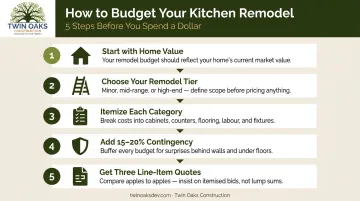
Here's a practical five-step framework:
- Start with your home value. Apply the 15–20% guideline to establish a ceiling. This is a maximum, not a target.
- Choose your remodel tier. Cosmetic refresh, functional upgrade, or full transformation—be honest about your goals and how long you plan to stay in the home.
- Itemize each category. Use the cost ranges in this guide to build a low-to-high estimate for cabinets, countertops, flooring, appliances, labor, and permits separately.
- Add a 15–20% contingency. Non-negotiable for older California homes. Budget for surprises before demolition, not after.
- Get at least three line-item quotes. Not lump sums—actual line items. This is the only way to make valid comparisons.
Common Budgeting Mistakes to Avoid
- Pricing materials without accounting for labor (labor is 20–30% of your total)
- Comparing quotes that cover different scopes
- Choosing the lowest bid without verifying California contractor licensing and insurance
- Using national cost calculator estimates without adjusting for LA/Ventura labor rates
- Ignoring permit fees and lead times when setting a project start date
For homeowners in LA and Ventura Counties, working with a licensed local contractor who understands regional permit requirements and the specific challenges of older California homes matters more than most homeowners realize.
Twin Oaks Construction has handled kitchen remodels across both counties for over 20 years. Permit timelines, trade costs, and hidden structural issues are part of the planning conversation from day one—not discoveries mid-project. Reach their team at (833) 621-7251 or request a free consultation at twinoaksdev.com/contact.
Frequently Asked Questions
How do I budget for a 10x10 kitchen remodel?
Determine your remodel tier (cosmetic, mid-range, or high-end), then build a line-item estimate for each cost category using low-to-high ranges. Get itemized quotes from at least three licensed contractors, and set aside 15–20% as a contingency fund for issues discovered during demolition.
What is the most expensive part of a kitchen remodel?
Cabinetry typically accounts for 29–40% of total project cost, making it the single largest budget category. In California, labor runs 20%+ above national averages, so the combined cabinetry-plus-installation figure often exceeds 50–60% of the total project budget.
How many cabinets fit in a 10x10 kitchen?
A standard 10x10 layout accommodates roughly 20 linear feet of cabinetry—typically 4–5 base cabinets and 6–8 wall cabinets. The exact count depends on cabinet widths, appliance placement, and whether the layout is L-shaped or galley-style.
How long does a 10x10 kitchen remodel take?
A cosmetic refresh typically runs 2–4 weeks of construction; a full mid-range remodel takes 6–12 weeks. California permits add 2–4 weeks in LA City and 3–4 weeks in Ventura County. Custom cabinet lead times of 8–16 weeks are often the longest single variable, so order early in the process.
Is a 10x10 kitchen remodel worth it for home value?
Minor kitchen remodels consistently outperform major ones at resale. The 2024 Cost vs. Value Report shows minor midrange remodels recouping 96% nationally and 96.1% in the Pacific region. In LA and Ventura County markets, a well-scoped mid-range remodel improves both sale price and buyer appeal without the diminishing returns of a full gut renovation.