Introduction
California's housing shortage is severe. The state needs to plan for more than 2.5 million homes in the current eight-year cycle. The median home price hovers around $775,000, putting ownership out of reach for most families. For homeowners who already have a property, an ADU is one of the most practical responses to both the affordability gap and the demand for more housing.
The good news: state law has systematically removed most of the barriers that made ADUs difficult to approve before 2020. In 2026, most single-family lots in California have a legal right to an ADU — no discretionary hearings, no neighborhood-character reviews, no HOA veto.
Even so, ADU regulations still operate on three levels — state law, county rules, and city zoning. Getting the details wrong at any level costs time and money.
This guide covers everything LA and Ventura County homeowners need to know: ADU types, the 2026 California regulatory framework, size and setback rules, and the permit process step by step. It also covers the most common mistakes to avoid before breaking ground.
Key Takeaways
- ADUs are permitted by-right on nearly all single-family lots in California — local governments cannot block a compliant application
- California distinguishes between full ADUs (up to 1,200 sq ft) and Junior ADUs/JADUs (capped at 500 sq ft), each governed by separate rules
- State law sets minimum standards — LA and Ventura Counties layer on design and fire-zone requirements
- Permit review is ministerial — jurisdictions must approve or deny within 60 days of a complete application
- A licensed local contractor familiar with both state and county rules helps avoid the delays that stall viable projects
What Is an ADU? Types and Key Definitions
An Accessory Dwelling Unit is a self-contained residential unit on the same lot as a primary single-family home. To legally qualify as an ADU, the unit must include a kitchen, bathroom, and sleeping area. That's what separates it from a guest house or bonus room — no kitchen means no ADU under California law.
Common ADU Types in Southern California
| ADU Type | Description | Relative Complexity |
|---|---|---|
| Detached new construction | Standalone backyard cottage built from the ground up | Highest cost, most design flexibility |
| Garage conversion | Existing attached or detached garage converted to living space | Popular in LA; no new foundation required |
| Attached addition | New living space added to the side or rear of the primary home | Mid-range complexity |
| Basement conversion | Existing below-grade space finished as a unit | Site-specific; less common in SoCal |
| Above-garage unit | New or converted living space built over an existing garage | Requires structural review |
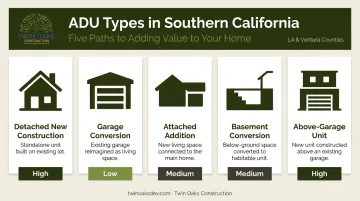
Twin Oaks Construction builds both custom detached ADUs and garage conversions across LA and Ventura Counties — two of the most common configurations given lot sizes and existing structures in the region.
Junior ADUs (JADUs)
A Junior ADU is a California-specific category: a unit of up to 500 sq ft created entirely within the existing walls of the primary residence — typically a converted bedroom or attached garage.
JADUs operate under different rules than a standard ADU. They may share a bathroom with the main house, carry distinct owner-occupancy provisions when sanitation facilities are shared, and follow a separate permitting pathway that differs meaningfully from a full ADU application.
California ADU Laws: Key 2026 Regulations You Should Know
California's ADU statutes were recodified in 2024 under SB 477. Current law is now found in Government Code Sections 66310–66342 — not the older Section 65852.2. Any contractor or attorney still citing 65852.2 as the current code is working from outdated materials.
The Legislative Foundation
Two bills from 2022 — effective in 2023 — are the backbone of today's ADU rights:
- AB 2221 strengthened the 60-day approval process, required written deficiency comments on incomplete applications, and protected an 800 sq ft ADU from being blocked by front setbacks or lot coverage rules
- SB 897 required objective standards for ADU review, expanded height allowances near transit, and limited denials tied to nonconforming conditions unless there's a genuine health and safety issue
More recent updates worth knowing:
- AB 1033 allows local governments to opt into permitting separate ADU sale as condominiums
- AB 1332 requires cities to offer pre-approved ADU plan programs
- AB 2533 creates a pathway to legalize some pre-2020 unpermitted ADUs
- SB 1211 primarily expands ADU rights on multifamily lots — it does not create extra ADU allowances for larger single-family parcels
Owner Occupancy and HOA Rules
California eliminated the owner-occupancy requirement for ADUs as of January 1, 2020, and AB 976 removed the prior sunset on that change. You do not need to live on the property to build or rent a standard ADU. JADU owner-occupancy rules are more nuanced when sanitation facilities are shared.
For HOA-governed properties, Civil Code Section 4751 makes CC&R provisions that prohibit or unreasonably restrict ADUs void and unenforceable. HCD's March 2026 ADU Handbook also notes that AB 130 prohibits HOA fees specifically targeting ADUs. An HOA can impose reasonable design review, but it cannot function as a ban.
How Many ADUs Per Lot?
Under current California law, single-family and multifamily lots are treated differently:
- Single-family lots: one ADU plus one JADU — no larger-lot exception exists for single-family properties
- Multifamily lots: SB 1211 expanded unit-count allowances, but those rules apply only to multifamily parcels
- The key takeaway: if you own a single-family home, the one ADU + one JADU limit applies regardless of lot size
ADU Size, Height, and Setback Requirements in LA and Ventura Counties
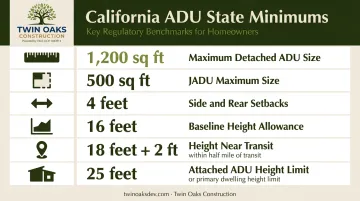
State law creates a floor that local governments cannot undercut. Under Government Code Section 66321, no local standard — including FAR, lot coverage, or open-space rules — can prevent an ADU of at least 800 sq ft, 16 ft in height, with 4-foot side and rear setbacks from being built.
State Minimums at a Glance
| Requirement | State Rule |
|---|---|
| Detached ADU maximum size | Up to 1,200 sq ft |
| JADU maximum size | 500 sq ft |
| Side and rear setbacks | Minimum 4 feet |
| Height (baseline) | 16 feet |
| Height near transit (within ½ mile of major transit stop) | 18 feet, plus 2 ft for roof pitch alignment |
| Attached ADU height | Up to 25 feet or primary dwelling height limit, whichever is lower |
Local Rules: LA County vs. Ventura County
Unincorporated LA County (per the April 2024 ordinance analysis):
- Detached ADU cap: 1,200 sq ft; JADU cap: 500 sq ft
- Setbacks: 4 ft side/rear
- General height: 25 ft
- Rentals must be at least 30 consecutive days
- Parking not required outside Very High Fire Hazard Severity Zones
- Objective design compatibility standards apply
Unincorporated Ventura County (non-coastal, effective July 3, 2024):
- Allows up to two ADUs and one JADU
- New detached ADUs: up to 850 sq ft by building permit, up to 1,800 sq ft by zoning clearance depending on lot size
- Setbacks: 4 ft side/rear; height: 16 ft (18 ft near transit)
- No parking required for JADUs converting existing space
- Coastal-zone parcels face different requirements — confirm before assuming non-coastal rules apply
City of Los Angeles: LADBS offers a Standard Plan Program with pre-approved ADU designs that reduce plan-check time. It's a useful shortcut for straightforward sites, but pre-approval doesn't substitute for site-specific zoning, fire, or utility review.
Parking: State law under Government Code Section 66322 bars local parking requirements when an ADU meets any of the following conditions:
State law under Government Code Section 66322 bars local parking requirements when an ADU meets any of these conditions:
- Located within ½ mile of public transit
- Situated in a historic district
- Built within an existing structure
- Within one block of a car-share vehicle
Most dense LA-area neighborhoods qualify for at least one exemption. That said, confirm your parcel's fire-zone classification — LA County retains parking requirements in Very High Fire Hazard Severity Zones regardless of transit proximity.
The ADU Permit Process in California: Step-by-Step
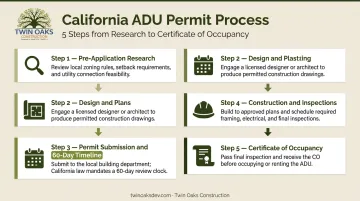
Step 1 — Pre-Application Research
Before engaging a designer, confirm:
- Your property's zoning designation
- Whether you're in unincorporated LA County, a city like Pasadena or Thousand Oaks, or unincorporated Ventura County — each has its own ADU guidelines layered on state law
- Any fire-zone, coastal, or historic district status that modifies standard rules
- HOA rules (even if unenforceable bans exist, reasonable HOA design review still applies)
Step 2 — Design and Plans
You'll need permit-ready architectural drawings. Many California cities — including Los Angeles and Ventura County — now offer pre-approved or standardized ADU plan programs that reduce plan-check time significantly.
Working with an experienced design-build contractor makes a real difference here. Twin Oaks Construction provides full ADU design and construction services across LA and Ventura Counties, managing the process from initial design through final inspection, including permitting support and coordination with local agencies.
Step 3 — Permit Submission and Timeline
Government Code Section 66317 requires jurisdictions to approve or deny an ADU application within 60 days of receiving a complete application when an existing dwelling is on the lot. JADUs have a parallel 60-day rule under Section 66335.
Common causes of delay:
- Incomplete application submissions (missing site plans, energy calculations, or soils reports)
- Fire-zone or coastal overlay complications
- Utility pre-clearance requirements
Step 4 — Construction and Inspections
ADU construction requires inspections at multiple milestones:
- Foundation and framing
- Electrical and plumbing rough-in
- Insulation
- Final inspection
Inspectors in LA and Ventura Counties enforce local requirements closely. Failed inspections add weeks to a project timeline, so hiring a licensed contractor familiar with those standards is essential.
Step 5 — Certificate of Occupancy
The Certificate of Occupancy is the finish line. Without it, the ADU cannot be legally occupied or rented. It's issued after the final inspection confirms the completed unit meets all building code requirements. Any unpermitted work discovered during final inspection can delay or block issuance entirely.
Benefits of Building an ADU in Southern California
ADUs offer Southern California homeowners three concrete advantages: rental income, increased property value, and flexibility for family living. Here's what each actually looks like in practice.
Rental Income Potential
Southern California's rental market makes ADUs a compelling income asset. In Los Angeles, average one-bedroom rents run approximately $2,513 — and a well-located ADU can generate comparable monthly income depending on size, condition, and location. These figures represent apartment comparables, not guaranteed ADU rents, but they give a reasonable ballpark for evaluating your project's financial return.
One important restriction: California state law permits local agencies to require ADU rentals to be for terms of 30 days or longer. Both LA County and Ventura County enforce this minimum. Don't plan an ADU project around short-term rental income unless your specific city has confirmed STR eligibility.
Property Value
Freddie Mac notes that ADUs may have the potential to increase long-term property and resale value, and Zillow's ADU explainer confirms that legally permitted ADUs tend to add value. Permitted is the key word here — an unpermitted ADU can complicate a sale rather than enhance it.
Multigenerational Living
For many LA homeowners, the motivations are personal rather than financial. Common scenarios include:
- Aging parents who want independence without moving into assisted living
- Adult children returning from out of state who need their own space
- Extended family members who need proximity but not shared walls
- Caregivers who require on-site housing
Twin Oaks designs ADUs to integrate architecturally with the existing home — so the addition reads as a deliberate part of the property, not an afterthought.
Common ADU Mistakes to Avoid
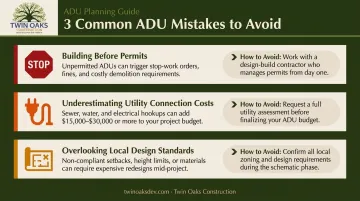
Three mistakes consistently derail ADU projects in LA and Ventura Counties — and all three are avoidable with early planning.
Building before permits are approved is the most expensive error homeowners make. Stop-work orders, fines, required demolition, and resale complications are all on the table. In California, AB 2533 only provides a legalization pathway for certain pre-2020 unpermitted units — anything built after 2020 without permits has very limited options for retroactive approval.
Underestimating utility connection costs catches many homeowners off guard. Detached ADUs often require upgraded electrical panels, separate water meters, sewer lateral extensions, and new gas lines. LADWP requires a formal service request for new or modified electric connections; SoCalGas handles gas meter and pipeline applications through its Builder Services program. Get utility pre-clearance quotes before you finalize your budget — these costs are site-specific and can shift your numbers significantly.
Overlooking local design standards leads to costly late-stage redesigns. State law limits what cities can regulate, but LA County and most Ventura County jurisdictions still enforce objective design compatibility requirements — matching exterior materials, window proportions, and rooflines to the primary residence. Catching these requirements in early planning takes hours; catching them at permit review takes weeks.
Frequently Asked Questions
What qualifies as a backyard accessory dwelling unit?
A backyard ADU (also called a detached ADU or backyard cottage) is a self-contained residential unit built as a separate structure on the same lot as the primary home. It must include a kitchen, bathroom, and sleeping area, and must comply with local setback, size, and zoning requirements to be legally permitted and occupied.
How many ADUs can I build on my property in California?
Under current California law, most single-family lots are allowed one ADU plus one Junior ADU (JADU). No verified 2024–2026 legislation created a larger-lot exception for single-family properties — the expanded unit counts in recent bills apply to multifamily lots.
Do I need to live on the property to build an ADU in California?
No. California eliminated the owner-occupancy requirement for ADUs in 2020, and AB 976 removed the sunset on that change permanently. You can build and rent an ADU without living on the property. JADU owner-occupancy provisions are more nuanced when the JADU shares sanitation with the main house.
What is a Junior ADU (JADU) and how does it differ from a standard ADU?
A JADU is a California-specific unit of up to 500 sq ft created within the existing walls of the primary residence — typically from a converted bedroom or attached garage. Unlike a standard ADU, it may share a bathroom with the main house and has fewer independent utility requirements.
How long does ADU permit approval take in LA County?
California law requires jurisdictions to respond to complete ADU applications within 60 days. Real-world timelines can vary based on application completeness, fire-zone complications, utility pre-clearance, and plan-check volume. Using a pre-approved standard plan (available through LADBS and Ventura County) is one of the most reliable ways to reduce review time.
Can I rent out my ADU in California?
Yes. Long-term rentals are generally permitted. State law and local ordinances in LA County and Ventura County allow jurisdictions to require rental terms of 30 days or longer, so check your city's short-term rental ordinance before assuming Airbnb-style income is available.