ADU pricing varies widely based on type, size, site conditions, and which jurisdiction is processing your permits. The single most common mistake homeowners make is planning around a "construction-only" estimate, then discovering the all-in cost runs 30–50% higher once design, permits, and sitework are included.
This guide breaks down 2026 ADU pricing by type and size, explains the five key cost drivers, and shows you exactly where your budget goes — so you can plan accurately from the start.
Key Takeaways
- Garage conversions are the most affordable path to a permitted ADU, typically running $60,000–$150,000 all-in
- Detached new construction in Southern California ranges from roughly $220,000 for a 500 sqft unit to $450,000–$720,000+ for 1,200 sqft
- ADUs under 750 sqft are exempt from impact fees under California state law — a significant cost exemption worth knowing
- Site conditions (slope, utility access, soil) can add $30,000–$60,000+ beyond base construction costs
- The CalHFA ADU Grant covers up to $40,000 in pre-development costs — check current availability before budgeting
How Much Does an ADU Cost in California? Prices by Type and Size
Even two identical floor plans can carry very different price tags depending on site conditions, jurisdiction, and finish level. There's also an important distinction between "vertical build cost" — the structure itself — and "all-in cost," covering design, permits, engineering, sitework, and utilities. Many contractor quotes and online estimates cover only the former, so it's easy to underestimate your true total before construction begins.
Cost per square foot is typically higher for smaller ADUs — and it's worth understanding why before reviewing the ranges below. Fixed costs like design fees, permits, kitchens, bathrooms, and contractor mobilization stay roughly the same regardless of whether you're building 400 or 800 square feet. On a smaller unit, those fixed costs spread across fewer square feet — driving the per-sqft number up.
Garage Conversion ADUs
All-in cost range: $60,000–$150,000
This range covers structural upgrades, insulation, plumbing rough-in, electrical work, and interior finishes. Where your project lands within that range depends heavily on:
- The existing garage's structural condition and ceiling height
- Whether the main electrical panel needs upgrading
- Distance from the sewer connection point
- How much plumbing needs to be run from scratch
Best for: Homeowners with an existing garage in reasonable structural shape who want the most affordable path to a permitted ADU. Permitting is typically faster than other ADU types, and while rental income potential runs lower than a detached unit, upfront costs are the lowest available.
Attached ADUs and Junior ADUs (JADUs)
All-in cost range: $150,000–$350,000 (or roughly $200–$400/sqft)
JADUs are capped at 500 sqft under California law and must be created within the existing home's footprint — meaning no new foundation or framing from scratch. This limitation keeps costs lower but also limits scope. Attached ADUs that require an addition to the home sit at the higher end of this range.
Typically included:
- Interior conversion work and new kitchen installation
- Bathroom addition or upgrade
- Separate entry
Typically excluded:
- Major structural changes
- Full utility separation
Best for: Homeowners with underutilized interior space — an oversized bonus room, a large attached garage within the main structure — who want a cost-efficient unit for family use or modest rental income.
Detached New Construction ADUs
Detached ADUs carry the highest upfront cost but typically deliver the strongest long-term return through rental income and property value appreciation. Southern California runs higher than statewide averages — labor rates in LA and Ventura Counties, combined with jurisdiction-specific permitting requirements, add meaningful cost compared to Central Valley or Northern California benchmarks. Site preparation, utility connections, and the need for an independent foundation all contribute to the wider cost range at this tier.
| Size Band | Estimated All-In Cost (LA/Ventura) | Approx. Cost Per Sqft |
|---|---|---|
| 400–500 sqft | $180,000–$250,000 | $360–$500/sqft |
| 600–800 sqft | $240,000–$340,000 | $340–$470/sqft |
| 800–1,000 sqft | $300,000–$420,000 | $330–$450/sqft |
| 1,000–1,200 sqft | $420,000–$720,000+ | $375–$600+/sqft |
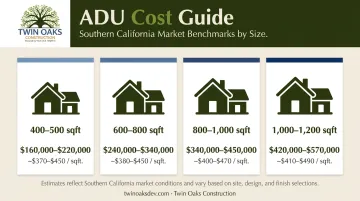
Note: These are directional market benchmarks based on current Southern California contractor data, not government-verified averages. Final costs depend on site conditions, finish level, and jurisdiction.
Ideal if: You're prioritizing maximum rental income, full tenant privacy, and the strongest property value increase. The higher upfront cost is real — but in LA and Ventura County's high-demand rental markets, the long-term return on a well-built detached ADU is equally real.
Key Factors That Drive ADU Construction Costs in California
ADU type sets the general cost category. These five variables determine where your specific project lands within, or outside, that range.
Construction Method
Site-built custom, pre-engineered, and prefab/modular construction each carry different cost profiles. Prefab can offer price certainty on simple, flat lots, but sitework, utility connections, foundation, and local fees apply regardless of how the unit is manufactured.
On constrained or sloped lots, prefab rarely saves much money. Custom designs increase design fees and engineering complexity, though they give you full control over layout and finishes.
Size and Square Footage
Larger ADUs cost more in total but often less per square foot due to economies of scale in framing, roofing, and finishes. The catch: the kitchen and bathroom are fixed cost centers regardless of how large the unit is.
A $30,000–$50,000 kitchen and bath package costs roughly the same whether the total ADU is 500 or 900 square feet.
Site Conditions
A flat lot with easy equipment access is the baseline. Anything else adds cost:
- Sloped lots require engineered foundations and potentially retaining walls
- Poor soil triggers geotechnical reports and deeper or wider footings
- Limited side-yard access means materials may need to be hand-carried
- Long utility runs from the main home to the ADU site add trench and pipe costs
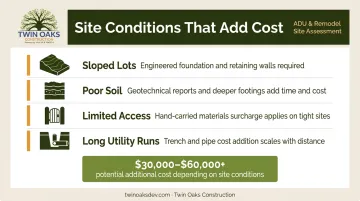
Challenging site conditions in Southern California can add $30,000–$60,000 or more over a straightforward flat-lot build, based on contractor-reported component ranges for utility lateral work, panel upgrades, and access constraints.
Location and Permit/Impact Fees
Fees vary significantly across LA and Ventura County jurisdictions. The HCD's March 2026 ADU Handbook confirms that ADUs with 750 sqft or less are exempt from impact fees — a critical budget lever. ADUs above that threshold may be charged proportionately.
Fee examples from actual jurisdictions:
- City of LA: $1,045 for a 400 sqft garage conversion permit; $8,448 for a 1,200 sqft new ADU permit
- Oxnard: $1,790 ADU review fee, plus proportional impact fees for units over 750 sqft (including traffic, park, mobility, and growth fees that can sum to significant amounts)
Always verify fees with your specific city's building department before finalizing a budget.
Finish Level
Standard finishes (stock cabinets, basic tile, vinyl plank flooring) vs. premium finishes (custom cabinetry, quartz countertops, upgraded appliances) represent one of the most controllable variables in any ADU budget. Premium finishes can add $20,000–$50,000 or more.
Higher-end finishes can support higher rental rates and stronger resale positioning, but the payback timeline extends accordingly.
Full ADU Cost Breakdown: Where Your Budget Actually Goes
Understanding the split between soft costs and hard costs prevents the most common budgeting mistake.
Soft Costs (Design, Engineering, Permits)
Soft costs typically represent 10–20% of the total ADU budget — and homeowners who skip these in their planning often face real shortfalls. For LA and Ventura County ADU projects, expect:
- Architectural design and drafting: $15,000–$35,000 depending on complexity
- Structural engineering and Title 24 energy compliance: $3,000–$8,000
- Permit and plan-check fees: Varies by jurisdiction and size (see examples above); ADUs over 750 sqft may trigger impact fees that add significantly to this line
A combined soft cost budget of $25,000–$60,000 covers most detached ADU projects in Southern California.
Hard Costs (Physical Construction)
Hard costs cover everything that gets built. Key categories for LA/Ventura ADU projects:
- Site preparation and foundation: grading, excavation, and concrete work
- Framing and structure: walls, roof framing, and sheathing
- Exterior finishes: stucco, roofing, windows, and exterior doors
- Plumbing: one of the largest single line items, especially when new utility connections are required
- Electrical: panel work, wiring, and fixtures
- HVAC: mini-split systems are the standard choice for ADUs
- Interior finishes: flooring, cabinetry, tile, paint, and fixtures
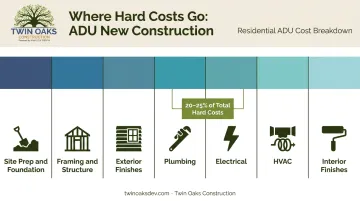
Plumbing and electrical together often represent 20–25% of the total hard cost budget on new construction ADUs. Utility connections — particularly new sewer and electrical service — are the line item most likely to exceed early estimates.
Post-Construction Ongoing Costs
Once construction wraps, ownership costs begin. Building an ADU triggers a supplemental assessment from the county assessor — under Proposition 13, the ADU's value is added to your existing assessed value without triggering a full reassessment of your home.
At California's roughly 1% property tax rate, a $300,000 ADU build adds approximately $3,000/year in property taxes.
Beyond taxes, budget for:
- Annual maintenance: 1–2% of ADU value per year
- Utilities: Separate meter installation adds upfront cost but simplifies billing if you're renting the unit
How to Estimate the Right ADU Budget for Your LA or Ventura County Property
Start with Intended Use
Rental income, multigenerational family housing, and occasional guest use point to very different configurations:
- Rental income focus: Prioritize a detached unit, at least 600–750 sqft, with a separate entrance and private outdoor space
- Multigenerational housing: Attached or detached depending on desired privacy; size to the occupant's actual needs
- Guest use: A garage conversion or JADU often delivers more than enough space at the lowest cost
Over-building for your actual situation wastes budget. A family member who needs a one-bedroom doesn't benefit from 1,200 sqft.
Assess Site Conditions Before Committing to a Number
Get a formal feasibility review or site assessment before finalizing any budget figure. A lot's slope, utility access points, and setback constraints can shift the realistic total by tens of thousands of dollars, and none of that is visible without an actual site evaluation.
Skipping this step is one of the leading causes of mid-project budget surprises.
Twin Oaks Construction has served LA and Ventura County homeowners for over 20 years and builds ADU estimates that account for site conditions and local permitting requirements upfront. Call (833) 621-7251 or use their project inquiry form to start with a site-specific conversation.
What Most Homeowners Miss When Budgeting for an ADU in California
Focusing Only on the Vertical Build Cost
Many contractor quotes and online ADU cost calculators cover only the structure. Homeowners who plan around that number are often caught off guard when the all-in total — including design, permits, engineering, and sitework — comes in 30–50% higher.
Underestimating Site-Specific Costs
These are the most consistent source of budget overruns:
- Grading and retaining walls on sloped lots
- Electrical panel upgrades (often required when adding a full unit)
- Sewer lateral replacement or extension
- Separate utility meter installation
- Long trenching runs for water, gas, or electrical
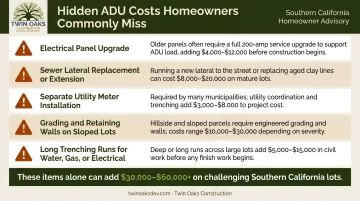
On a challenging lot in Southern California, these line items alone can add $30,000–$60,000+ over what you'd pay on a flat, well-serviced property. Watch for: sloped terrain, older homes with undersized panels, long distances between the main home and ADU site, and properties on septic systems.
Overlooking Financing Costs and Available Grants
If you're using a HELOC or construction loan, interest accrues during the full design-permit-build cycle — which can run 12–18 months before rental income starts. At a national average home equity loan rate of 8.09% as of July 2026, carrying costs on a $300,000 construction draw can reach $20,000–$24,000 in interest before your first tenant pays rent.
The CalHFA ADU Grant Program offered up to $40,000 for pre-development and non-recurring closing costs — covering architectural designs, permits, soil tests, and similar expenses. The most recent funding round was fully allocated on December 28, 2023. Check CalHFA's website directly for any new funding announcements before assuming the grant is unavailable.
Leaving Out Long-Term Value Context
When you account for the full cost of an ADU — including soft costs, sitework, and financing — it's still one of the strongest property investments available to LA and Ventura County homeowners. In Ventura County, average apartment rents reached $2,711/month in July 2025. Against a well-structured build, that monthly income can recover total project costs faster than most homeowners expect.
Frequently Asked Questions
How much does it cost to build a 1,200 sq ft ADU in California?
Based on current Southern California contractor benchmarks of $375–$600+/sqft, a 1,200 sqft detached ADU runs approximately $450,000–$720,000+ all-in. At this size, impact fees apply and the project sits at or near the upper end of what local ordinances typically permit for ADUs. Site conditions and finish level can push costs toward either end of that range.
What is the $40,000 grant in California for ADUs?
The CalHFA ADU Grant Program provided eligible homeowners with up to $40,000 to cover pre-development costs — architectural designs, permits, soil tests, property surveys, and related expenses. The most recent round was fully allocated on December 28, 2023. Visit CalHFA's ADU Grant page for current funding status before ruling it out.
Is it worth it to build an ADU in California?
In high-demand markets like LA and Ventura Counties, ADUs typically generate strong monthly rental income and add meaningful property value, making them one of the better ROI home investments available. The math depends on your build cost, achievable rental rate, and financing terms — and it works best when all costs are accounted for accurately upfront.
What is the cheapest type of ADU to build in California?
Garage conversions and JADUs are typically the least expensive because they reuse an existing structure, eliminating foundation and framing costs. Final cost still depends on the structure's condition, required utility upgrades, and plumbing scope.
What hidden costs should I budget for when building an ADU in California?
The most commonly missed costs include:
- Electrical panel upgrades
- Sewer lateral replacement or extension
- Separate meter installation
- Grading and retaining walls on sloped lots
- Fire sprinkler requirements in some jurisdictions
- Financing interest during the 12–18 month design-permit-build period
- Post-completion property tax increases from the supplemental assessment
How long does it take to build an ADU in California?
The full timeline from planning to certificate of occupancy typically runs 12–18 months. A rough breakdown: 1–3 months for design and feasibility, 4–6 months for permitting and plan check (LA County is on the longer end), and 4–8 months for active construction depending on project complexity and scope.