For many LA homeowners, the answer is an ADU. Whether it's a backyard cottage generating monthly rental income, a converted garage housing an aging parent, or a junior unit carved out of an existing bedroom, accessory dwelling units have become one of the most practical tools available to property owners in this region.
This guide covers everything you need to know: what ADUs are, which types you can build in LA, the current regulations, realistic costs, and how to navigate the permit and construction process from start to finish.
Key Takeaways
- LA allows four main ADU types: detached, attached, garage conversion, and junior ADU (JADU)
- State law mandates permit approval or denial within 60 days of a complete application
- ADUs under 750 sq ft are exempt from most impact fees under California's SB 13
- The CalHFA ADU Grant Program offers up to $40,000 toward pre-development costs
- LA homeowners typically recoup ADU construction costs through rental income within 5–8 years, depending on unit size and location
What Is an ADU and Why Are LA Homeowners Building Them?
An ADU — accessory dwelling unit — is a secondary residential unit on a lot with an existing or proposed primary home. It must have its own permanent living, sleeping, cooking, and sanitation facilities. You'll hear them called granny flats, casitas, in-law units, or backyard cottages. They're all the same thing legally.
Three reasons drive most LA homeowners to build one:
- Rental income: LA 1-bedroom rents average around $1,850/month, and a Terner Center ADU survey found 51% of California ADUs are rented out at a median of $2,000/month for new units.
- Increased property value: a permitted ADU raises assessed value and appeals to buyers looking for income potential or multigenerational flexibility.
- Family housing: keeping aging parents or adult children on the same property while preserving privacy on both sides.
How California Made ADUs Easier to Build
Before 2017, local jurisdictions could effectively block ADU construction through zoning restrictions and lengthy discretionary review. A wave of state legislation changed that.
Key reform bills passed between 2019 and 2023:
| Bill | Key Provision |
|---|---|
| AB 68 | Expanded ministerial approval; allowed one ADU + one JADU on single-family lots |
| AB 881 | Limited local barriers to ADU approvals |
| SB 13 | 60-day permit review deadline; banned impact fees for ADUs under 750 sq ft |
| AB 670 | HOA restrictions that effectively prohibit ADUs are void and unenforceable |
| AB 671 | Required local housing elements to include ADU incentives |
| AB 976 (2023) | Permanently removed owner-occupancy requirements for ADUs (JADU rules still apply) |
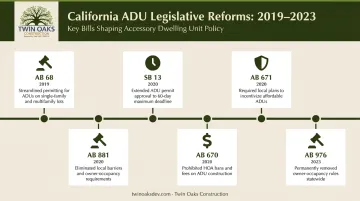
The practical result: LA homeowners today face fewer bureaucratic roadblocks, lower fees, and faster permit timelines than at any point in recent history — which is why ADU construction has accelerated sharply across the region.
Types of ADUs You Can Build in Los Angeles
LA homeowners have several options, each with different cost profiles, size limits, and site requirements.
Detached ADU
A fully independent structure separated from the primary home — most often built in the backyard. It allows the largest footprint, up to 1,200 sq ft, and offers the most rental appeal because tenants get a completely separate residence.
Attached ADU
A unit sharing at least one wall with the primary residence, allowed up to 50% of the primary home's square footage. A good choice when yard space is limited but the home has room to expand horizontally or vertically.
Garage Conversion ADU
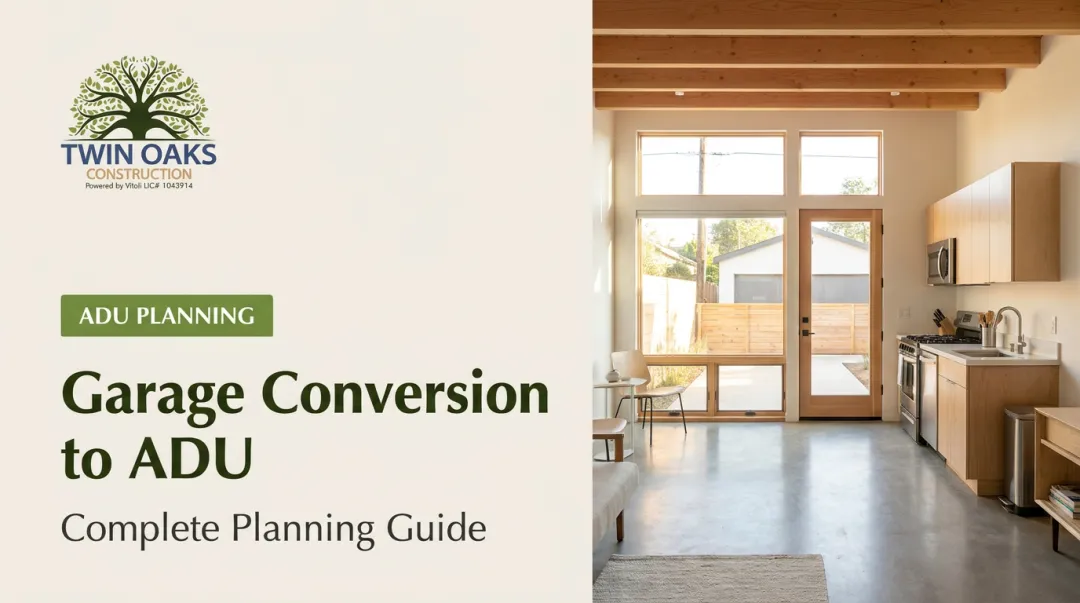
Converting an existing attached or detached garage into a livable unit. Because it uses existing structure, setback rules are often relaxed — existing walls and foundations don't need to comply with the standard 4-foot setback requirement. Since the structure is already in place, labor and material costs drop significantly — making this the most cost-effective ADU type for most homeowners.
Junior ADU (JADU)
No more than 500 sq ft, created entirely within the existing primary residence — from a bedroom, attached garage, basement, or attic. JADUs require an efficiency kitchen and owner-occupancy in either the JADU or the primary home. They're the fastest and cheapest path to a legal rental unit for many homeowners.
The table below summarizes how each type compares across the key decision factors.
Quick Reference: ADU Types by Key Criteria
| Type | Max Size | Typical Cost | Best For |
|---|---|---|---|
| Detached ADU | 1,200 sq ft | Highest | Maximizing rental income, full separation |
| Attached ADU | 50% of primary | Mid-range | Limited yard space |
| Garage Conversion | Existing footprint | Lowest-mid | Cost-conscious owners with unused garage |
| JADU | 500 sq ft | Lowest | Quick, affordable interior conversion |
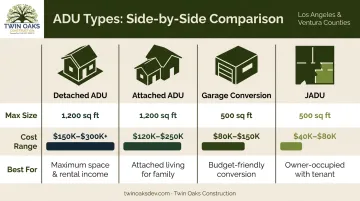
Multifamily properties follow different rules: California law allows up to eight detached ADUs on multifamily lots, provided that number doesn't exceed existing units on the property. Single-family lots are permitted one ADU plus one JADU.
Los Angeles ADU Regulations and Requirements
LA ADU projects operate under two overlapping layers of rules: California state law and the City of Los Angeles ADU Ordinance.
The City of LA ADU Ordinance
The City of Los Angeles adopted Ordinance #186,481 (effective December 19, 2019), codified under LAMC Section 12.22A.33. It established a ministerial review process — meaning ADU applications are evaluated against objective development standards, not subjective planning criteria. This removes most discretionary risk from the approval process.
Key Development Standards
Size limits:
- Detached ADU: up to 1,200 sq ft
- Attached ADU: up to 50% of the primary home's floor area
- JADU: up to 500 sq ft
- State law requires local jurisdictions to allow at least 850 sq ft for a one-bedroom ADU and 1,000 sq ft for two or more bedrooms
Height limits: Most detached ADUs are capped at 16 feet. Units over 800 sq ft may be permitted at two stories depending on site conditions.
Setbacks:
- 4 feet from side and rear property lines for new detached ADUs
- Existing structures converted to ADUs often qualify for exceptions to standard setback rules
Fire Hazard and Hillside Areas
Properties in Very High Fire Hazard Severity Zones (VHFHSZ) and hillside areas face additional restrictions. There's no single universal rule — requirements depend on the specific parcel. If your property falls into one of these categories, verify eligibility and applicable standards directly with the LA Department of Building and Safety before planning your project.
City vs. County Jurisdiction
This is a common source of confusion. City of Los Angeles homeowners use LADBS for plan review, permits, and inspections. Unincorporated LA County homeowners follow LA County Regional Planning and the County Department of Building & Safety. Check which jurisdiction applies to your address before submitting anything.
How Much Does an ADU Cost in Los Angeles?
The most reliable cost benchmark comes from the Terner Center's statewide ADU owner survey, which found a median construction cost of $150,000 and approximately $250 per square foot in 2021. LA-specific costs from that same period averaged around $148,000. Current construction costs are higher — expect those figures to shift with materials prices, site conditions, and project scope.
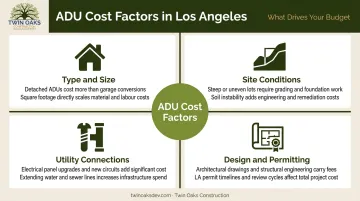
What Drives ADU Costs
- Type and size — Garage conversions cost less than new detached construction. Smaller units carry a higher cost per square foot because utilities, a kitchen, and a bathroom are required regardless of total size.
- Site conditions — Sloped lots, hillside locations, or fire overlay areas add engineering and construction complexity.
- Utility connections — Running new electrical panels, water lines, and sewer connections adds significant cost, especially on larger lots.
- Design and permitting — Architectural plans, structural engineering, and permit fees (which can range from a few hundred to over $10,000 depending on project scope) all contribute to the total.
Fee Relief and Financial Support
Impact fee exemption: Under SB 13, ADUs under 750 sq ft are exempt from most local impact fees. For larger units, fees must be proportional to the ADU's size relative to the primary dwelling — not calculated at the full residential rate.
CalHFA ADU Grant Program: The California Housing Finance Agency's ADU Grant Program provides up to $40,000 toward pre-development and non-recurring closing costs, including permits, designs, soil tests, and energy reports. Availability depends on current funding cycles and participating lenders — verify status before counting on it.
LADBS Standard Plan Program: The city offers pre-approved ADU designs through LADBS. Using a standard plan reduces plan-check time, which lowers both soft costs and the carrying costs of a longer permit process.
ROI Context
With LA median 1-bedroom rents around $1,850/month, a well-located ADU can generate $22,000+ annually. At that rate, a $150,000 garage conversion could theoretically pay for itself in under seven years — before accounting for property value appreciation.
These are illustrative figures. Actual returns depend on construction costs, financing, local vacancy rates, and rental market conditions at the time you build.
The ADU Permit and Construction Process in Los Angeles
The path from idea to occupancy follows a predictable sequence, though the timeline varies significantly based on project type, completeness of your application, and whether corrections are required.
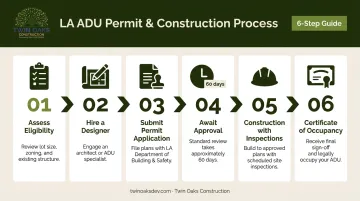
Step-by-Step Process
Assess eligibility — Confirm your lot's zoning, jurisdiction (City vs. County), and any overlay restrictions (fire hazard, hillside, coastal). This shapes what you can build before you spend a dollar on design.
Hire a designer or architect — Architectural plans are required for permit submission. Working with someone who knows LA's ADU ordinance reduces the chance of plan check corrections that extend your timeline.
Submit permit application — City of LA homeowners submit through ePlanLA, the electronic plan review system managed by LADBS, along with architectural plans and applicable permit fees.
Await approval — State law requires ministerial approval or denial within 60 days of a complete application. If the application is incomplete, the clock doesn't start until corrections are submitted. Pre-approved standard plans from LADBS can shorten this phase.
Construction with inspections — Once permits are issued, construction begins. Inspectors visit at required milestones — foundation, framing, rough electrical and plumbing, insulation, and final inspection.
Certificate of Occupancy — After passing final inspection, you receive your CO, which legally authorizes occupancy of the ADU.
Working With an Experienced ADU Contractor
One of the most consistent sources of delay in the LA permit process is incomplete or incorrect plan submissions — triggering back-and-forth corrections that can add weeks to the timeline. Contractors with deep experience in LA's permitting environment know what LADBS plan checkers look for.
Twin Oaks Construction has built ADUs and handled garage conversions across LA and Ventura Counties for over 20 years. Their integrated design-build model means one team manages every phase — not separate firms handing off to each other. For homeowners who want a single point of contact from first consultation to final walkthrough, that structure eliminates handoff delays and keeps accountability in one place.
Key advantages of working with an integrated ADU contractor:
- In-house architecture and design eliminates the gap between plans and what actually gets built
- Permitting support from a team familiar with LADBS plan checker expectations
- Single point of contact across design, permits, and construction
Key Benefits of Building an ADU in Los Angeles
Rental Income
With LA's rental market consistently tight, a permitted ADU in a well-located neighborhood can command strong monthly rents. The Terner Center's statewide survey found a $2,000 median monthly rent for new ADUs in California — and in many LA neighborhoods, rents run considerably higher. That income can offset mortgage costs, pad a retirement fund, or simply improve monthly cash flow.
Property Value
The FHFA's 2025 analysis found that California single-family properties with ADUs showed higher relative growth in median appraised value compared to properties without ADUs. A permitted ADU also expands the pool of potential buyers — investors, multigenerational families, and house-hackers all see income-producing ADUs as a premium feature.
Multigenerational Living
An ADU lets family members live close without sharing a front door. Common use cases include:
- Aging parents with their own kitchen, bathroom, and entrance
- Adult children gaining independence without the cost of a separate lease
- Extended family staying nearby during life transitions
Across LA's diverse homeowner base, this setup is both culturally familiar and financially practical.
Frequently Asked Questions
How much does a 500 square foot ADU cost in Los Angeles?
A 500 sq ft ADU in LA can range widely depending on type. A JADU carved from existing interior space will cost considerably less than a new detached 500 sq ft structure. Based on Terner Center benchmarks of roughly $250/sq ft, expect a ballpark of $100,000–$150,000+ for a new detached unit of that size, with JADUs and garage conversions typically coming in lower.
What is the new law for accessory dwelling units in California?
A wave of California legislation starting in 2019 significantly loosened ADU rules. Key provisions: permits must be approved or denied within 60 days, ADUs under 750 sq ft are exempt from most impact fees, and HOA restrictions that effectively prohibit ADUs are unenforceable. AB 976 (2023) permanently removed owner-occupancy requirements for ADUs.
What are the ADU size limits in Los Angeles?
Detached ADUs are allowed up to 1,200 sq ft; attached ADUs are capped at 50% of the primary home's floor area; JADUs max out at 500 sq ft. State law also overrides stricter local limits by guaranteeing at least 850 sq ft for a one-bedroom and 1,000 sq ft for two or more bedrooms.
How long does it take to build an ADU in Los Angeles?
State law requires permit approval or denial within 60 days, but total timelines from design to final inspection typically run 6–18 months depending on project complexity. Garage conversions and JADUs tend to move faster than new detached builds. Using LADBS pre-approved standard plans can shorten the permit phase by several weeks.
Do I need to live on the property to build an ADU in Los Angeles?
No, for most ADU types. AB 976 (2023) permanently prohibits local owner-occupancy requirements for ADUs. The main exception is JADUs — the owner must occupy either the JADU or the primary residence. Verify current requirements with LADBS, as regulations do evolve.
Can I rent out my ADU in Los Angeles?
Yes. ADUs can be rented as long-term rentals. Most newly constructed ADUs and JADUs are not subject to LA's Rent Stabilization Ordinance (RSO) — but RSO can become an issue if the ADU replaces or is created from space that was previously covered under RSO. Parcel-specific status should be verified with the LA Housing Department.