The problem isn't that bathroom remodels are inherently expensive. It's that most homeowners enter them without a fixed scope, make critical decisions mid-project, and treat contingency as optional. Those patterns — not the remodel itself — drive costs past budget.
This guide breaks down where costs actually come from and gives you concrete strategies across three dimensions: decisions made before work begins, how the project is managed, and the conditions surrounding the remodel.
Key Takeaways
- Moving plumbing or electrical is the single biggest budget spike — keeping fixtures in place saves thousands
- Labor typically makes up 40–65% of total bathroom remodel cost; reducing labor complexity matters more than picking cheaper tile
- DIY painting and hardware swaps; hire licensed pros for plumbing, tile, and electrical
- Lock in all design decisions before demo starts — mid-project changes are the top source of overruns
- Off-peak scheduling (fall/winter) and phased remodeling are underused tools for controlling total spend
How Bathroom Remodel Costs Add Up
Most homeowners are surprised by how much the final invoice exceeds the original estimate. Costs build in layers — some obvious from the start, others that only surface once demo begins.
According to HomeAdvisor, labor alone accounts for 40–65% of a bathroom remodel's total cost. On top of that, demolition and site prep runs $1,000–$2,300, and permit fees add $100–$1,000 whenever plumbing or structural work is involved.
Then there's the damage you can't see until the walls come down. Water damage restoration averages $3,864; mold remediation averages $2,225. Either one can blow a tight budget before new tile ever goes up.
Where Costs Quietly Accumulate
Several line items catch homeowners off guard:
- Material delivery and disposal fees — rarely included in initial quotes
- Grout, adhesive, backer board, and underlayment — small-ticket items that add up across a full tile job
- Contractor material markup — when contractors source materials on your behalf, markups of 30–50% are common
- Change orders — any mid-project decision change can trigger wasted materials, rescheduled labor, and additional contractor fees
NARI recommends setting aside a 10–20% contingency buffer for unexpected conditions like subfloor damage or outdated wiring. Treat that buffer as a fixed line in your budget, not a fallback.
Key Cost Drivers for a Bathroom Remodel
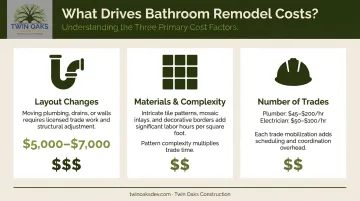
Three decisions account for the majority of bathroom remodel costs — and all three are within your control before a single wall opens.
The Three Primary Drivers
Layout changes — Moving a toilet, shower, or vanity means opening walls and floors. Angi's 2026 cost data puts standard plumbing updates around $800, rough-in work for a major renovation near $7,000, and layout changes adding roughly $5,000 on top. One planning decision drives that entire swing.
Materials and installation complexity — Stock subway tile and decorative specialty tile don't just differ in material price. More cuts, irregular patterns, and difficult substrates add labor hours. The finish you choose affects what you pay the installer, not just the supplier.
Number of trades on the job — Plumbers run $45–$200/hour, electricians $50–$100/hour. Each additional trade adds scheduling coordination and potential delays that compound the final labor cost.
Why LA and Ventura County Costs Run Higher
Those three drivers hit harder in Southern California. Cost vs. Value data shows LA homeowners pay $27,143 for a midrange remodel vs. the $26,138 national average, with upscale projects reaching $85,055 vs. $81,612 nationally. When labor rates are already elevated, every decision that cuts hours — keeping the existing layout, choosing simpler tile patterns, handling cosmetic work yourself — has an outsized effect on the final number.
That's where working with an experienced local contractor matters. Twin Oaks Construction helps LA and Ventura County homeowners identify where their labor dollars are actually going and where scope can be adjusted without affecting the finished result.
Cost-Reduction Strategies for a Budget Bathroom Remodel
Effective cost reduction means cutting the right thing. Saving $200 by skimping on waterproofing, for example, often creates a $3,000+ repair within a few years. Match the strategy to the source of cost.
Strategies That Reduce Costs Through Upfront Decisions
Keep the existing plumbing and electrical layout This is the highest-leverage decision you'll make. Layout changes can add $5,000–$7,000 in plumbing alone, before electrical is factored in. If your toilet, sink, and shower are functional where they are, leave them there and upgrade the fixtures instead.
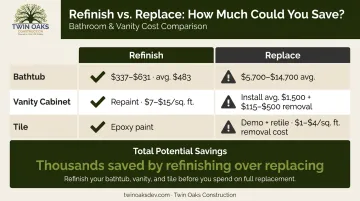
Refinish rather than replace when the structure is sound
- Professional tub refinishing costs $337–$631, averaging $483 — compared to new tub installation averaging $5,700 and reaching $14,700 with removal factored in
- Vanity cabinet repainting runs $7–$15/sq. ft. vs. vanity installation averaging $1,500 plus $115–$500 for old vanity removal
- Existing tile can be painted with epoxy rather than demolished and retiled, eliminating tile removal costs of $1–$4/sq. ft.
Use expensive tile strategically, not universally Reserve decorative or specialty tile for one focal area: a shower niche, accent wall, or backsplash. Use standard subway tile or straight-edge tile for the rest. Simpler tile patterns also cost less to install because they require fewer cuts and less layout complexity.
Choose a vanity with an integrated sink and countertop Stock vanities with premade countertops and sinks range from $100–$2,600. Buying the vanity cabinet, countertop, and sink as separate components consistently costs more and adds installation complexity.
Shop open-box, scratch-and-dent, and clearance outlets Big-box clearance sections, local warehouse liquidators, and online resellers regularly carry returned or lightly imperfect vanities, toilets, and fixtures. The flaw is usually minor (a small chip on a side panel, a scratched exterior) and invisible once installed.
Strategies That Reduce Costs Through Better Project Management
DIY cosmetic work; hire licensed pros for technical trades Safe DIY territory includes:
- Painting walls and cabinets
- Replacing hardware and towel bars
- Hanging mirrors and floating shelves
- Installing peel-and-stick flooring over existing tile
- Swapping shower curtains and accessories
Leave plumbing, tile installation in wet areas, electrical, and waterproofing to licensed professionals. Mistakes in these areas are expensive to fix and can affect future permitting and resale.
Source your own materials When contractors purchase materials on your behalf, markups of 30–50% are standard. Buying tile, fixtures, and hardware yourself, after confirming specs with your contractor, lets you price shop, catch sales, and sidestep that markup entirely.
Get at least three itemized bids The California Contractors State License Board advises getting at least three bids. Beyond creating competitive pressure, a line-item estimate tells you which costs are fixed (materials, permits) vs. negotiable (labor scope, scheduling). It also reveals which scope items you can defer to a second phase.
Lock in every design decision before demo begins Mid-project changes trigger a chain reaction: wasted materials, rescheduled labor, contractor fees for rework. Finalize tile model and quantity, fixture SKUs, paint colors, and hardware before the first tile is pulled. Changes made after demo starts are where most bathroom remodels blow their budgets.
Strategies That Reduce Costs by Adjusting Timing and Sequencing
Schedule during fall or winter Spring and summer are peak demand periods for contractors in California. Scheduling your bathroom remodel in fall or winter typically means greater contractor availability, faster project timelines, and in some cases lower labor rates, all of which reduce your total project cost.
Consider a phased approach to spread costs Not every upgrade needs to happen simultaneously. A practical phasing approach:
- Phase 1: Structural and functional work — tile, waterproofing, vanity, plumbing fixtures, shower
- Phase 2: Cosmetic finishes — lighting upgrades, mirror framing, accessories, paint
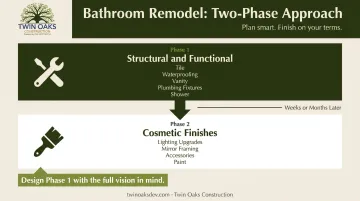
This lets you manage cash flow and refine preferences after living in the updated space. The key: design Phase 1 with the full vision in mind so Phase 2 doesn't require undoing any previous work.
Get permit requirements sorted before work starts In LA and Ventura Counties, unpermitted construction can create legal and financial issues, affect resale value, and and, according to LA County, potentially result in civil or criminal prosecution. LADBS allows a combined bathroom remodel permit for replacing cabinets, flooring, wall finishes, tile, counters, and fixtures, but it does not allow wall changes or new plumbing/electrical penetrations into existing walls without additional permits. Know what your project requires before work begins.
Conclusion
The real savings in a bathroom remodel come from deliberate decisions — keeping the layout, timing your materials purchases, locking in selections before work starts, and understanding where labor costs actually come from before you commit to anything.
Keep the layout. Refinish what's still sound. Lock in your selections early. Hire licensed pros where mistakes are expensive, and handle the rest yourself — or bring in a contractor who can manage the full scope from the start.
Homeowners in LA and Ventura Counties can reach out to Twin Oaks Construction for help navigating these decisions. With over 20 years of experience in bathroom remodeling across the region, they specialize in keeping projects on budget through clear communication, early planning, and hands-on project management from start to finish.
Frequently Asked Questions
What is the cheapest bathroom remodel?
The most affordable option focuses entirely on cosmetic updates: painting walls and cabinets, replacing hardware, updating lighting, and adding new accessories without touching plumbing, tile, or structural elements. Costs typically run a few hundred to a few thousand dollars, depending on how much work is DIYed.
How much should I budget for a small bathroom remodel?
HomeAdvisor's 2026 small bathroom cost data shows a typical range of $1,500–$15,000, with an average of $6,500 and $6,000–$8,000 for a small full bath around 40 sq. ft. Budget largely depends on whether plumbing is relocated, what materials are chosen, and how much labor is DIYed.
What bathroom upgrades add the most value to a home?
The 2025 Cost vs. Value report shows LA midrange bathroom remodels recouping 89.6% of project cost at resale, above the national average of 80%. Updated vanities, fresh tilework, new flooring, and modernized fixtures consistently perform well with buyers and appraisers in the LA and Ventura County market.
Should I remodel my bathroom in phases to save money?
Phasing is a legitimate cost-management strategy, and it works well when Phase 1 is planned with the complete design in mind. Complete structural and functional work first (tile, waterproofing, plumbing) then layer in cosmetic upgrades. Avoid phasing that requires redoing finished work.
Is it worth hiring a contractor for a budget bathroom remodel?
Yes — especially for plumbing, tile, and waterproofing. Errors in these areas are expensive to correct and can create permitting problems at resale. Hiring licensed professionals for technical trades while DIYing painting, hardware, and accessories is the most cost-effective split for most LA and Ventura County homeowners.
How can I save money on bathroom tile without it looking cheap?
Choose simple straight-edge or subway tile for the majority of surfaces since it costs less to buy and install with fewer cuts. Reserve a higher-end accent tile for one focal point, like a shower niche or backsplash — the contrast reads as intentional design, not a budget workaround.