A garage conversion doesn't require building an addition or buying a bigger home. The structure already exists, the foundation is in place, and the footprint is ready. For homeowners in LA and Ventura Counties, where usable square footage commands a premium, converting an underused garage into livable space is one of the most practical moves available — especially with California's ADU-friendly regulations making the process more accessible than ever.
This article covers inspiring before-and-after transformation ideas, what to address before construction begins, realistic cost expectations, and design strategies to make your converted space feel like a true part of the home.
Key Takeaways
- Garage conversions add livable square footage without the disruption of a full home addition
- Popular conversion types include home offices, guest suites, ADUs, gyms, and family entertainment rooms
- Permits, insulation, electrical, and flooring prep must be handled before any design decisions
- California does not require homeowners to replace parking spaces when converting a garage to an ADU
- A well-executed conversion improves daily living and can boost property value
Why Homeowners Are Rethinking Their Garages
According to a 2022 CRAFTSMAN/Stanley Black & Decker survey, 36% of Americans said their garage was too cluttered to fit a car inside. For most households, the garage has become a second storage unit — one that happens to be attached to the house.
Three motivations consistently drive homeowners in LA and Ventura Counties to finally act:
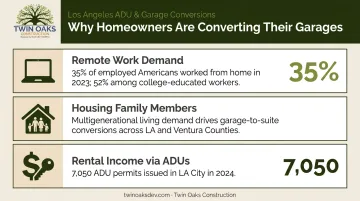
- Remote work demand. The BLS reported that 35% of employed Americans worked from home at least part of the time in 2023, with that figure rising to 52% among workers with a bachelor's degree or higher. A dedicated workspace that's physically separate from the living room isn't a luxury anymore — it's a productivity requirement.
- Housing family members. Whether it's aging parents who need proximity without sacrificing privacy, or adult children navigating a difficult housing market, a converted garage offers a practical multigenerational solution.
- Rental income through ADUs. Los Angeles City alone issued 7,050 ADU permits and recorded 5,107 completions in 2024, reflecting enormous demand for additional units. A properly permitted garage ADU can generate meaningful monthly income.
Homeowners already own the structure. Converting it costs far less than building new — and delivers functional square footage without the wait.
Inspiring Garage Conversion Ideas: Before and After
Every garage starts from the same baseline — unfinished walls, a concrete slab, dim overhead lighting, and a door designed for vehicles. The "after" depends entirely on vision and planning.
Home Office Conversion
Before: A dim, dusty garage with exposed wiring, a single overhead fixture, and two outlets — enough for a car, nothing else. No acoustic separation from the house, no environment that supported focused work.
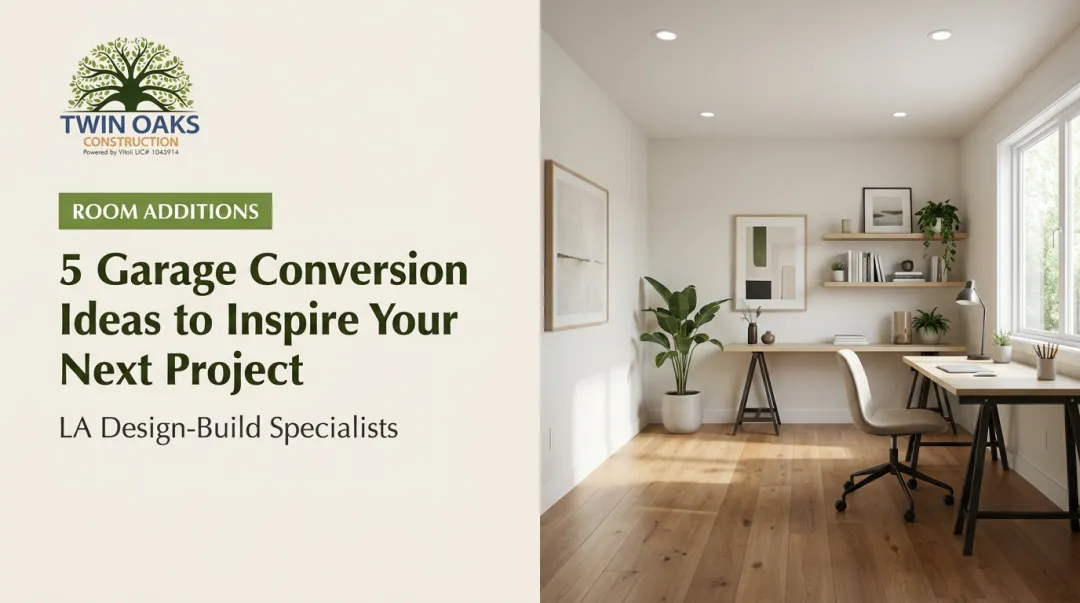
After: A quiet, light-filled workspace purpose-built for productivity:
- Built-in shelving and organized storage zones
- Layered lighting — recessed ambient plus dedicated task lighting at the desk
- A solid door that closes, creating real acoustic separation from the rest of the house
- Distinct zones for video calls, focused work, and reference materials
That physical separation from the main living area creates a boundary remote workers rarely appreciate until they actually have it.
Home office conversions rank among the most requested projects for LA-area homeowners — and for good reason. Dedicated workspace now appears on most buyers' checklists, making this one of the few conversions that pays off both daily and at resale.
Guest Suite or ADU
Before: A single-car or two-car garage used primarily for seasonal storage — functional for nothing the household actually needed on a daily basis.
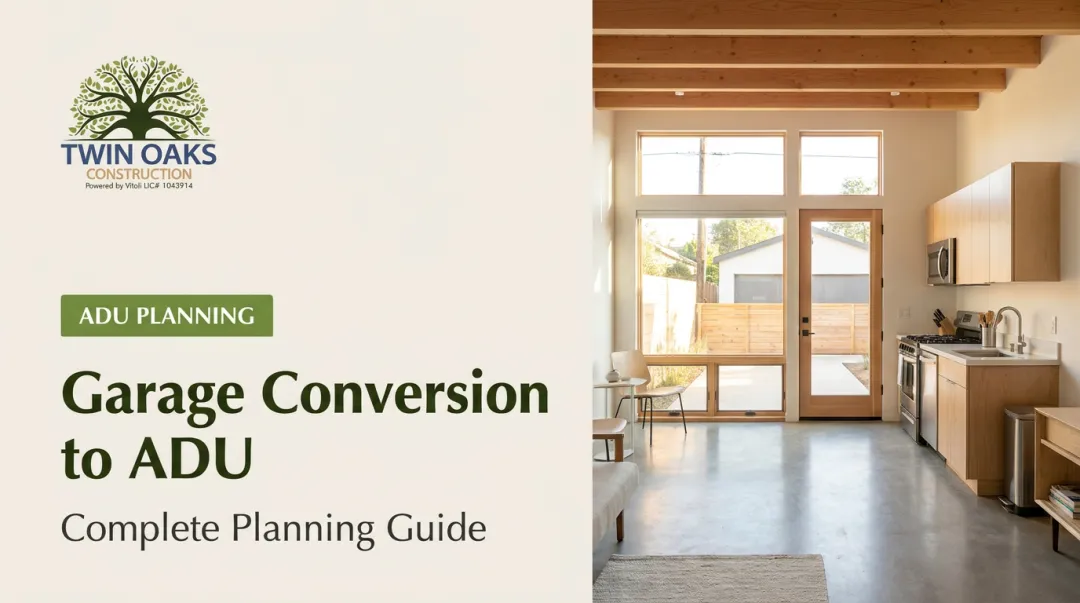
After: A fully equipped guest suite or ADU built for real daily use:
- Private entrance separate from the main home
- Full bathroom and kitchenette
- Comfortable living area that works for family visits, aging parents, or long-term tenants
- Legal ADU status, opening the door to rental income
The finished unit can host visiting family, provide housing for aging parents, or generate rental income as a legal ADU.
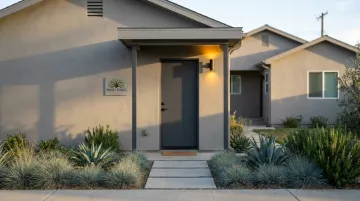
California's regulations make this conversion type particularly attractive. Under SB 13, local agencies cannot require replacement parking when a garage is converted to an ADU — removing one of the most common objections homeowners had previously. Twin Oaks Construction specializes in garage-to-ADU conversions across LA and Ventura Counties, with a focus on integrating the finished unit seamlessly with the existing home's architectural style.
Home Gym or Wellness Space
Before: A cold, echoey space with cracked concrete and fluorescent lighting. Functional for parking, hostile for anything else.
After: A purpose-built training space that a spare bedroom could never match:
- Rubber flooring installed over a properly prepared slab
- Mirrored walls and wall-mounted equipment racks
- Natural light from added windows
- A ductless mini-split for year-round temperature control
The garage footprint handles full racks, cardio equipment, and floor space simultaneously — none of which fit comfortably in a standard bedroom.
This conversion stands out for one practical reason: it doesn't require plumbing. That keeps the budget lower than a guest suite while delivering a space that gets daily use.
Kids' Playroom or Family Entertainment Room
Before: A garage acting as a second junk room — mismatched storage bins, forgotten sporting equipment, and wasted potential right next to the home's main living areas.
After: A bright playroom with built-in storage, a chalkboard wall, and a reading nook with direct access from the home. Or flip the concept for older families: a dedicated entertainment room with a big screen, comfortable sectional, and a fireplace as the focal wall.
Converting for family use is one of the fastest ways to reclaim meaningful daily space. The garage's proximity to the main living areas makes access effortless, and the separation keeps noise and mess contained.
Studio Apartment or Flexible Living Space
Before: An oversized garage with a solid structure but zero habitability — no insulation, no plumbing, no ventilation worth mentioning.
After: A compact studio with smart dual-function furniture, a Murphy bed, a mini kitchenette, and bifold or French doors that open to a small outdoor patio. The indoor-outdoor connection dramatically expands how large the space feels.
One overlooked asset worth protecting: vaulted ceilings from a pitched roofline. Even a modest footprint feels genuinely loft-like when ceiling height is preserved rather than dropped with a suspended ceiling system.
What to Consider Before Converting Your Garage
Before any design decisions are made, these four areas need to be resolved — skipping them is where projects stall, budgets blow up, and permits get denied.
Structural and Safety Assessment
A garage was engineered to shelter vehicles, not support the demands of a living space. Before any plans are drawn, a professional should evaluate:
- Foundation and slab condition (levelness, cracks, moisture infiltration)
- Roof framing and load capacity
- Existing wall framing adequacy for insulation and drywall
- Any structural reinforcement required for new openings
Skipping this step is the single most common cause of budget surprises mid-project.
Permits and Local Regulations
A garage conversion in California requires building permits — no exceptions. Unpermitted work in LA or Ventura County can result in fines, orders to comply, and complications at the time of sale. LADBS actively enforces unpermitted improvements, and the current property owner bears responsibility regardless of when the work was done.
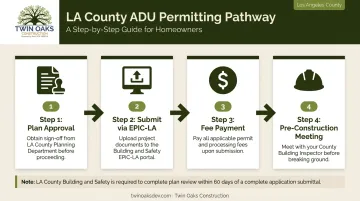
The permitting pathway for a garage ADU in LA County includes:
- Plan approval from LA County Planning
- Submission to Building and Safety through EPIC-LA
- Fee payment
- Pre-construction meeting with a County Building Inspector
Ventura County follows a similarly structured process.
Working with a contractor experienced in local codes — like Twin Oaks Construction, which provides full permitting support across both counties — reduces delays and the risk of rejection.
Insulation, Climate Control, and Moisture
Garages are typically uninsulated and prone to moisture migration through the slab. Without proper treatment, a converted space will feel cold and damp regardless of how it's finished. Standard upgrades include:
- Wall and ceiling insulation to meet California energy code
- Vapor barrier or retarder under the finished floor (mandatory when moisture vapor emission exceeds NWFA thresholds)
- A ductless mini-split system for heating and cooling without connecting to the home's existing HVAC
Electrical and Plumbing Upgrades
Most garages have one overhead fixture and two outlets — nowhere near enough to support a functional room. New circuits are almost always required.
If a bathroom or kitchenette is planned, plumbing must be roughed in before walls are drywalled. Getting this sequence wrong means opening finished walls later — at significant added cost.
How Much Does a Garage Conversion Cost?
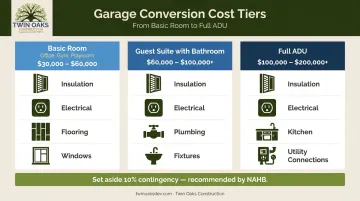
Cost varies significantly by scope, and LA and Ventura County projects typically run higher than national averages due to local labor rates and permitting fees. Here's a general framework:
| Conversion Type | Approximate Range | Key Variables |
|---|---|---|
| Basic room (office, gym, playroom) | $30,000–$60,000 | Insulation, electrical, flooring, windows |
| Guest suite with bathroom | $60,000–$100,000+ | Plumbing rough-in, tile, fixtures |
| Full ADU (kitchen, bath, entrance) | $100,000–$200,000+ | All of the above, plus kitchen, separate utility connections |
These ranges are starting points. What moves the number up or down comes down to a handful of factors worth understanding before you budget.
Primary Cost Drivers
- Plumbing rough-in (for any bathroom) is typically the largest single line item — new supply and drain lines require significant labor
- Electrical panel upgrades are common in older garages, which often run a sub-panel that won't handle a full living space's load
- Ceiling height changes or enlarged openings trigger engineering review and structural work, adding both time and cost
- Finish selections — LVP versus hardwood, stock versus custom cabinetry — compound quickly across an entire room
Set aside a contingency of at least 10% of total project cost (recommended by NAHB) for discoveries during construction, such as moisture damage in the slab, outdated wiring, or framing that requires reinforcement.
Design Tips to Make Your Converted Space Feel Like Home
Start With the Floor
The concrete slab must be tested for moisture, leveled to within 1/8 inch per 6 feet (per NWFA installation standards), and treated with a vapor barrier before any finished flooring is installed. Material choice follows function:
- Luxury vinyl plank: Durable, moisture-tolerant, and a solid default for nearly any conversion
- Engineered hardwood: Warmer appearance when installed over a proper sleeper or subfloor system
- Rubber flooring: Purpose-built for gym use; handles impact and cleans easily
Maximize Light Strategically
Garages are naturally dark spaces. A layered approach solves this:
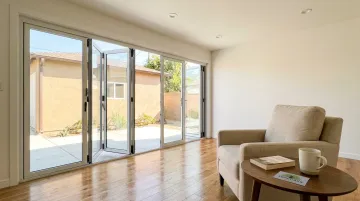
- Replace the garage door opening with large windows, French doors, or bifold glass panels to bring in natural light
- Install recessed ceiling fixtures for even ambient coverage
- Add task lighting specific to the room's function (desk lighting for an office, spotlights for artwork in a studio)
The opening treatment is the single biggest visual decision in a garage conversion. Get it right, and the room stops reading as a garage entirely.
Use Paint and Finishes to Erase the Garage
A few finishing choices carry most of the visual weight:
- Light wall colors (soft whites, warm grays) counteract limited natural light and open up smaller footprints
- Accent features like shiplap, a bold wall color, or a decorative detail give the room character without overpowering it
- Cohesive finishes that match the main home's interior prevent the space from reading as a tacked-on addition
The goal is for someone walking in to forget it was ever a garage.
Frequently Asked Questions
What is the average cost of a garage conversion?
Basic conversions (office, gym, playroom) in LA and Ventura Counties typically start around $30,000–$60,000. A guest suite with a bathroom runs $60,000–$100,000+, and a full ADU with kitchen, bath, and separate entrance can reach $150,000–$200,000+. Local labor and permitting costs push these figures above national averages.
Does converting a garage add value to your home?
A well-executed conversion adds functional square footage and generally improves resale appeal. According to FHFA 2023 data, California properties with ADUs carried a median appraised value of $1,064,000, compared to $715,000 for properties without one — though this reflects correlation, not a guaranteed return on any single project.
Do I need a permit to convert my garage in California?
Yes. Building permits are required for any garage-to-living-space conversion in California. In LA and Ventura Counties, that means plan review, fees, and inspections — and unpermitted work creates liability that follows the property through any future sale.
How long does a garage conversion typically take?
California requires local agencies to approve or deny complete ADU applications within 60 days. Construction timelines vary by scope — simpler room conversions move faster than full ADUs, which involve more trade coordination. The Houzz 2024 Study reported an average planning phase of 7.4 months for garage projects, covering the full pre-construction cycle from concept to permit approval.
What is the difference between a garage conversion and an ADU?
A basic garage conversion turns the space into a single-purpose room within the main home — an office, gym, or playroom. An ADU is a fully independent living unit with its own entrance, kitchen, and bathroom, making it legally rentable and treated as a separate dwelling for appraisal purposes.
What is the most popular type of garage conversion?
Home offices and guest suites are currently among the most requested conversions. ADUs are increasingly popular in California specifically, driven by favorable state legislation and persistently high housing demand — reflected in LA City's 7,050 ADU permits issued in 2024 alone.