Introduction
You love your neighborhood, your lot, your commute. What you've outgrown is the square footage. Moving means leaving behind the street you know, the school district you chose, and the community you've built — and in LA and Ventura Counties, it often means trading up into a market that's moved well past your budget.
A partial second story addition solves this differently. Instead of rebuilding your entire home or relocating, you build up — but only above one targeted section, like the garage or a single-story wing. The result is meaningful new space without a full-home overhaul.
This guide covers:
- What a partial second story addition looks like before and after
- Which room types deliver the biggest impact
- What the project realistically costs
- What to plan for structurally and logistically before you commit
Key Takeaways
- Builds above one section of your home only, keeping costs and disruption lower than a full second-story addition
- Most projects fall between $80,000 and $200,000, or $200–$350 per square foot, depending on size, finishes, and structural requirements
- Requires a structural assessment first — most existing foundations weren't built to carry a second story
- Delivers more than extra square footage: expect gains in privacy, defined living zones, and resale value
- Plan for a realistic 6–12 month timeline from first consultation to move-in, including permitting
What Is a Partial Second Story Addition?
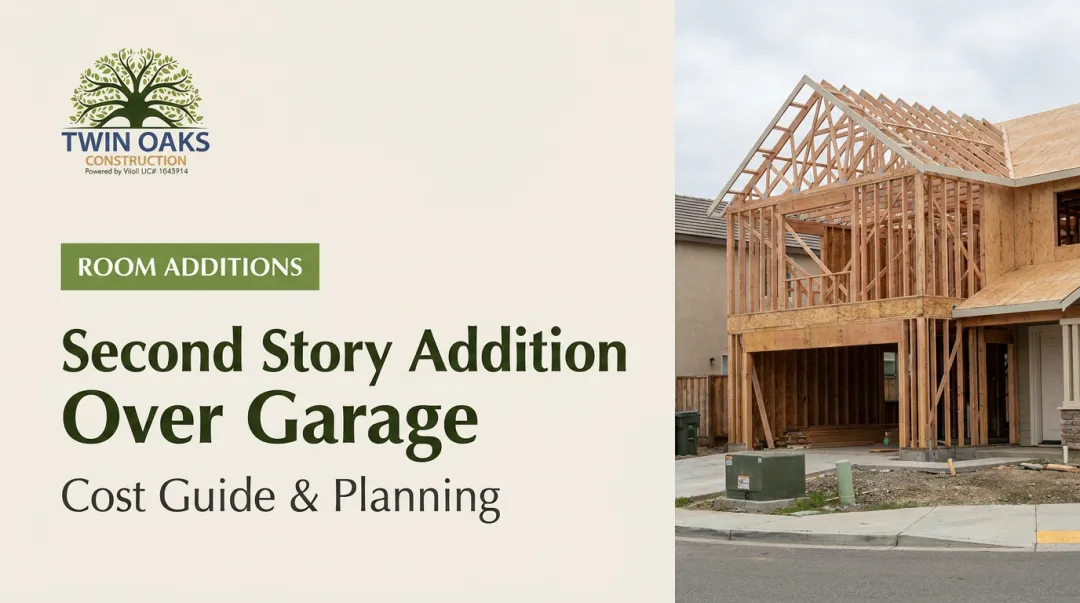
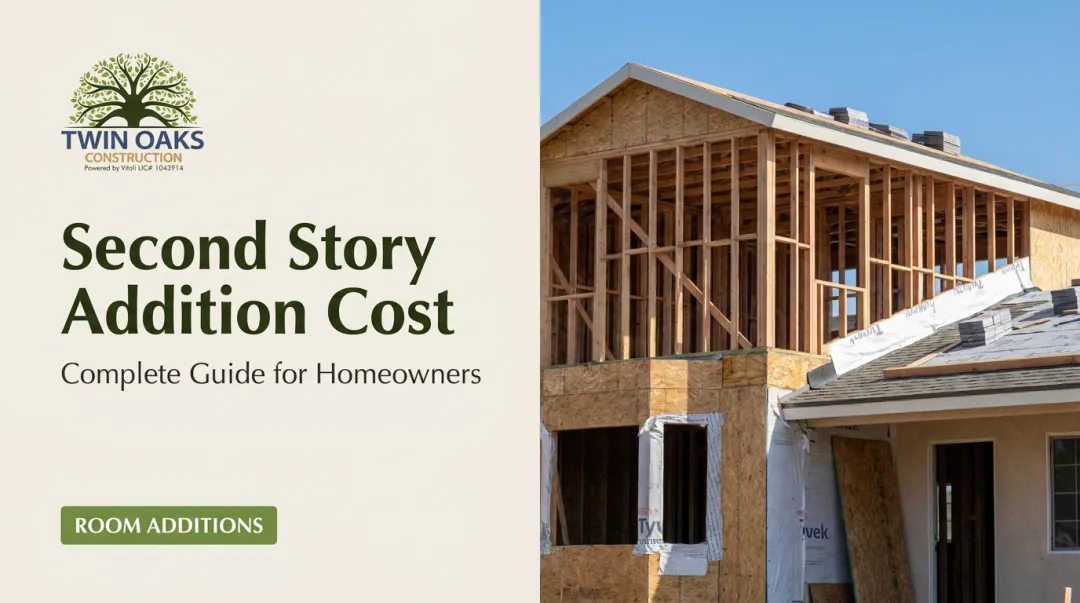
A partial second story addition builds new living space above only one section of an existing home — typically above a garage, a single-story wing, or a flat-roofed section — rather than extending across the entire footprint. The scope stays targeted, and the disruption stays contained.
This appeals to homeowners who need one or two specific rooms — a primary suite, a home office, a kids' zone — without redesigning how the whole house flows. For families in high-cost markets like LA and Ventura Counties, it's often the smarter financial path: you get exactly the space you need without paying for square footage you don't.
Partial vs. Full Second Story Addition
The distinction matters more than most homeowners expect — and it shapes both your budget and your timeline.
| Factor | Partial Addition | Full Addition |
|---|---|---|
| Scope | Above one section only | Entire home footprint |
| Roof removal | Often avoided | Typically required |
| Cost | Lower | Substantially higher |
| Timeline | Shorter | Longer |
| Disruption | Contained | Whole-home |
| Square footage gained | Targeted | Maximum |
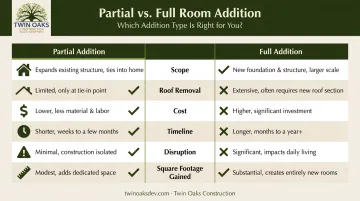
A full addition removes the entire roof and rebuilds a new level across the whole footprint — more square footage and slightly better resale ROI on paper, but at a significantly higher cost and longer timeline.
The partial route makes sense when your needs are specific, your budget has a ceiling, or your home's structural layout makes a full addition impractical.
Before and After: Real Partial Second Story Transformations
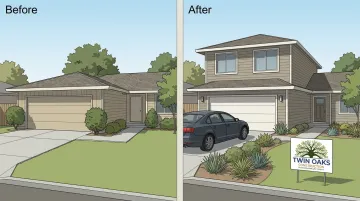
The most successful partial second story additions share one visible characteristic: the new level looks like it was always there. Matching siding, cohesive rooflines, and windows that suit the original architecture make the difference between an addition that adds value and one that looks like an afterthought.
Here's what the before-and-after actually looks like across three common scenarios.
Ranch Home to Primary Suite Above the Garage
Before: A two- or three-bedroom single-story ranch with no separation between adult and kid spaces, a shared bathroom that everyone fights over, and a flat or low-slope garage roof doing nothing for the home's profile.
After: A private primary suite above the garage — bedroom, en-suite bathroom, walk-in closet, optional sitting area — completely removed from the main floor's noise and activity. Structurally, the garage roof becomes a proper upper level with windows and matching exterior finishes.
Curb appeal shifts noticeably. Homes that looked squat and flat take on a more substantial presence from the street.
This configuration works especially well for families with teenagers or multigenerational households where adult privacy has disappeared.
Single-Story Home to a Family Hub
Before: A cramped main floor where living, dining, homework, and play all compete for the same space. Every room is doing three jobs.
After: A partial second story over a side or back wing adds two kids' bedrooms and a bathroom, freeing the main floor to function the way it was meant to — as a social, open-plan space for cooking, gathering, and entertaining.
The exterior gains a more traditional two-story profile that often fits the neighborhood aesthetic better than the original flat footprint. Inside, the transformation is functional: the main floor becomes quieter, less cluttered, and more adult. The upper level becomes the private, contained zone it should be.
Staircase placement matters here. Where you put the stairs shapes how the addition feels in everyday use, so it's one of the first design decisions to lock in.
Cramped Layout to Work-From-Home Sanctuary
Before: A remote worker using a corner of the kitchen table or a bedroom as a makeshift office. Noise everywhere, no separation, no door that closes.
After: A dedicated studio above the garage with proper electrical, insulation, and — most importantly — a door that physically separates work life from home life.
The U.S. Census Bureau reported that people primarily working from home tripled from 5.7% in 2019 to 17.9% in 2021, a jump from roughly 9 million to 27.6 million workers. In metro areas like Los Angeles, that share climbed from 6% to nearly 19% over the same period.
That shift didn't reverse. Homeowners who didn't build dedicated workspace in 2021 are building it now.
The result is a home where work has its own address — separate hours, separate noise level, separate headspace.
Popular Room Ideas for Your Partial Second Story Addition
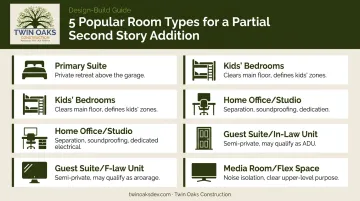
Not all additions serve the same purpose. These five room types consistently deliver the most functional value for homeowners adding a partial second story.
Primary suite above the garage — Structurally straightforward and naturally separated from the main floor, this is the most popular choice. Design a full suite with an en-suite bath and walk-in closet without disrupting the rest of the home.
Kids' bedrooms or homework loft — Relocating children's spaces upstairs clears the main floor and gives siblings defined zones for sleeping and studying within a shared footprint.
Dedicated home office or creative studio — Separation is the real value. Plan for a closing door, soundproofing, and dedicated electrical from the start — these aren't easy to retrofit later.
Guest suite or in-law unit — Above-garage space lends itself well to semi-private accommodation. In LA and Ventura Counties, this type of addition may qualify for ADU designation under local zoning rules. Twin Oaks Construction can clarify what's permissible in your municipality.
Media room or bonus flex space — When extra bedrooms aren't the goal, a media room, gym, or playroom gives the upper level clear purpose and keeps noise away from sleeping areas below.
How Much Does a Partial Second Story Addition Cost?
Cost Per Square Foot and Typical Budget Range
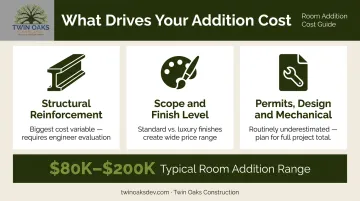
Most partial second story additions fall between $80,000 and $200,000, with a cost per square foot of roughly $200–$350 for a straightforward project. According to HomeAdvisor, the average second-story addition runs around $175,000, with a wider range of $80,000 to $600,000 depending on scope.
The lower end reflects a simple bedroom or office addition with standard finishes. A primary suite with a luxury bathroom and complex structural requirements sits at the upper end — and that's where California projects tend to land.
BLS data shows California construction laborers earn a mean of $30.14/hour versus $24.94/hour nationally. Permitting fees in LA and Ventura Counties add further to the total.
Two budgeting rules worth following:
- The 30% rule — Avoid spending more than 30% of your home's current market value on a single renovation to protect against over-capitalization
- Build in a 10–20% contingency — NARI recommends this cushion specifically to absorb unexpected structural or mechanical findings once walls open
Key Factors That Influence the Final Price
Understanding what drives costs up makes it easier to budget accurately. Three factors account for most of the variation:
- Structural reinforcement — The single biggest cost variable. If the existing foundation and first-floor framing need strengthening (new footings, upgraded beams, reinforced framing), the budget climbs fast. A structural engineer's evaluation is the only way to know what's needed before work begins.
- Scope and finish level — A bedroom addition and a primary suite with vaulted ceilings, custom cabinetry, and luxury tile fall in the same category but carry very different price tags. Choosing standard-sized materials and upgradeable finishes is a practical way to manage costs without sacrificing quality.
- Permits, design fees, and mechanical upgrades — Architectural plans, structural engineering, permit fees, and extending HVAC, electrical, and plumbing to the new level are all part of the real total, and routinely underestimated by homeowners. Twin Oaks Construction provides full permitting and planning support as part of its room addition process, helping homeowners navigate these costs across LA and Ventura Counties.
What to Know Before You Build: Structural, Permits, and Planning
Structural Assessment Comes First
Most single-story homes were built with foundations designed to support exactly one story. Adding a new level introduces thousands of additional pounds of load — and not every home can handle it as-is.
There's a critical distinction that catches many homeowners off guard: ceiling joists are designed to hold drywall, not people, furniture, and flooring. They are not the same as floor joists. The California Residential Code specifies minimum live loads of 30 psf for sleeping rooms and 40 psf for other occupied rooms — loads that standard ceiling framing was never meant to carry.
A structural engineer must evaluate the foundation, footings, and first-floor framing before any design work is finalized. For homeowners in LA and Ventura Counties, Twin Oaks Construction coordinates this evaluation as part of the room addition planning process — so structural concerns are resolved before design work begins, not during construction.
Permits, Local Codes, and the Approval Timeline
Building permits for a second story addition in California involve local building department review, plan checking, and in some cases HOA approval. Ventura County plan review turnaround ranges from 4–5 weeks for new submittals to 2–3 weeks for resubmittals. LA County projects vary by complexity and jurisdiction.
Skipping permits risks fines, work-stop orders, or forced demolition. Working with a contractor who knows LA and Ventura County requirements keeps the process moving and avoids costly delays mid-project.
Timeline and Living Arrangements
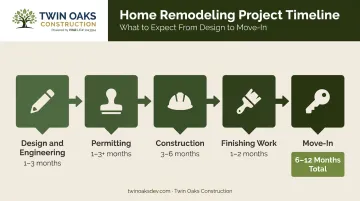
Here's a realistic end-to-end breakdown:
| Phase | Duration |
|---|---|
| Design and engineering | 1–3 months |
| Permitting | 1–3+ months |
| Construction | 3–6 months |
| Finishing work | 1–2 months |
| Total | 6–12 months |
Can you stay in the house? For most partial additions, yes — construction is contained to one section, and a well-managed contractor will establish dust barriers and noise schedules. During phases involving roof work or significant structural changes, temporary relocation may be the more practical choice. This is worth discussing during the planning phase, not after demo begins.
Frequently Asked Questions
What is a partial second story addition?
A partial second story addition builds new living space above only one section of an existing home — such as a garage or single-story wing — rather than adding a full upper level across the entire footprint. Common uses include adding a primary suite, home office, or extra bedrooms without touching the rest of the home.
How much does a partial second story addition cost?
Most projects fall between $80,000 and $200,000, or $200–$350 per square foot. Final cost depends on size, structural requirements, finish level, and local labor and permit costs — all of which trend higher in California markets.
What's the difference between a full and partial second story addition?
A full addition covers the entire home footprint and typically requires removing the whole roof. A partial addition targets one section, costs less, takes less time, and causes less disruption — though it adds fewer square feet overall.
How long does a partial second story addition take?
From first consultation to move-in, expect 6–12 months total. Design and permitting alone can take 2–6 months. Construction and finishing run 4–8 months depending on structural complexity and finish choices.
Can I stay in my home during a partial second story addition?
In most cases, yes. Because construction is confined to one section, the rest of the home remains livable. During roof work or major structural phases, temporary relocation may be recommended.
Does a partial second story addition add value to a home?
Yes. Adding square footage — particularly a primary suite or bedroom — increases market appeal and resale value. According to the JLC Cost vs. Value 2025 report, a midrange primary suite addition recoups roughly 32% of its cost at resale, with stronger buyer interest in high-demand markets like LA and Ventura Counties.