Key Takeaways
- A garage conversion ADU is a permitted dwelling unit with its own kitchen, bathroom, and entrance — built from an existing attached or detached garage.
- California Government Code 66314 grants homeowners on residentially zoned lots the right to convert garages to ADUs; LA and Ventura Counties add local rules on top.
- Conversion costs run lower than new construction ADUs, with California's median ADU construction cost reported at $150,000 per a Terner Center/CCI survey.
- A permitted conversion adds rental income and property value, but requires professional design, permits, and careful planning from the start.
What Is a Garage Conversion ADU?
Under California Government Code 66313, an ADU is defined as an attached or detached residential dwelling unit providing complete independent living facilities — permanent provisions for living, sleeping, eating, cooking, and sanitation — on the same parcel as a primary residence.
A garage conversion ADU repurposes an existing attached or detached garage into that self-contained unit. The garage structure's foundation, walls, and roof stay in place; contractors rebuild the interior to function as an independent home.
What Doesn't Qualify
Not every garage project produces a legal ADU. Three categories often cause confusion:
- Studios or home offices without a kitchen and full bathroom don't qualify for ADU status
- Units built above a garage fall under the carriage house ADU category, which carries different requirements
- Structures built from scratch on the lot are new detached ADUs, not garage conversions
The Legal Basis
California's modern ADU framework traces to AB 2299 and SB 1069, signed in September 2016 and effective January 1, 2017. Gov. Code 66314 now explicitly requires local agencies to allow ADUs within or attached to primary dwellings, including attached garages, and detached ADUs, including detached garages.
LA and Ventura Counties layer additional local rules on top of that state baseline — covering unit sizes, setbacks, utility connections, and fee structures.
Why LA and Ventura County Homeowners Are Converting Their Garages
Garage conversions have become one of the most practical moves available to LA and Ventura County homeowners — and the math behind that decision is hard to argue with.
The Financial Case
Renters in Los Angeles County need $49.58 per hour to afford the average monthly asking rent, according to the CHPC's 2025 housing needs report. Ventura County's residential vacancy rate sits at approximately 2.9%. In that environment, a permitted ADU with a separate entrance commands real market demand.
The core cost advantage: because the foundation, walls, and roof already exist, a garage conversion typically costs significantly less than a comparable new-construction detached ADU at similar square footage. That cost difference is the primary reason many homeowners pursue conversion before considering ground-up construction.
Three Primary Use Cases
Most homeowners converting garages in LA and Ventura Counties fall into one of these categories:
- Rental income — offsetting mortgage costs with a long-term or short-term tenant
- Multigenerational living — private housing for aging parents or adult children without sharing the main home
- Home office or studio — professional-grade workspace separated from the primary residence
Regional Lifestyle Factors
LA and Ventura Counties add a few location-specific factors worth considering:
- Mild year-round climate makes indoor-outdoor elements — covered patios, sliding glass doors, operable windows — genuinely usable, not just aesthetic
- Backyard preservation — a conversion uses existing footprint rather than consuming outdoor space the way a detached ADU would
- Lot coverage constraints — in dense neighborhoods where coverage limits are already tight, conversion is often the only realistic path to adding a legal unit
How the Garage to ADU Conversion Process Works: Step by Step
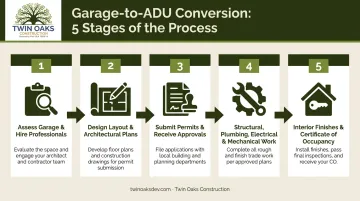
Most garage conversions in LA and Ventura Counties move through five distinct phases. The full arc — design through certificate of occupancy — takes time, with the permitting phase alone often matching or exceeding active construction in duration.
Here's what to expect at each stage:
- Assess your garage and hire professionals
- Design your layout and develop architectural plans
- Submit for permits and receive approvals
- Complete structural, plumbing, electrical, and mechanical work
- Finish the interior and obtain your Certificate of Occupancy
Working with an experienced contractor matters throughout this process. Twin Oaks Construction has handled ADU and garage conversion projects across both LA and Ventura Counties for over 20 years, with in-house architecture services and full permitting support — so approvals don't become a bottleneck.
Step 1: Assess Your Garage and Hire Professionals
Before any design work begins, evaluate what you're working with:
- Floor area — most 2-car garages offer 400–500 sq ft of convertible space
- Ceiling height — CBC Title 24, Part 2, Section 1208.2 requires a minimum 7 ft 6 in ceiling height for habitable spaces
- Foundation condition — cracks, settling, or undersized slabs may require reinforcement
- Utility proximity — distance from the main house to existing water, sewer, and electrical service affects connection costs significantly
A licensed contractor or structural engineer can identify whether reinforcement, foundation work, or ceiling modifications are needed before design begins.
Step 2: Design Your Layout and Develop Architectural Plans
Key layout decisions at this stage include kitchen placement, bathroom location, window and egress placement, and HVAC routing. Layouts typically fall into one of three configurations:
- Studio — open living/sleeping area with kitchenette and bathroom (fits most 2-car garages)
- One-bedroom — defined bedroom with separate living area (requires more square footage)
- Multi-purpose — flexible layout serving as guest suite plus home office
Twin Oaks Construction offers in-house architecture and design services, meaning homeowners don't need to hire a separate architect to get started.
Step 3: Submit for Permits and Receive Approvals
Complete architectural and engineering plans go to the local building department for review. Under California Government Code 66317, when an existing dwelling is on the lot, the permitting agency must approve or deny a complete ADU application within 60 days — or it is deemed approved.
Plan review covers structural, electrical, plumbing, mechanical, and energy compliance. Incomplete submissions restart the 60-day clock, so submitting complete plans — structural, electrical, plumbing, mechanical, and energy — in a single round is worth the upfront effort.
Step 4: Complete Structural, Plumbing, Electrical, and Mechanical Work
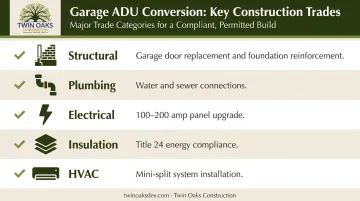
This is the core construction phase. Major work categories include:
- Structural — garage door replacement with framed wall, foundation reinforcement if needed, ceiling height adjustments
- Plumbing — new water and sewer connections (detached garages typically require trenching)
- Electrical — panel upgrades, typically 100–200 amp service for a full ADU
- Insulation — Title 24 energy compliance; garage-to-ADU conversions are classified as additions for energy code purposes
- HVAC — mini-split systems are the most common solution for garage conversions
Each trade requires inspections at specific milestones. Missing one can force rework or prevent the next trade from starting.
Step 5: Complete Interior Finishes and Obtain Certificate of Occupancy
Final work includes drywall, flooring, kitchen cabinetry and appliances, bathroom tile and fixtures, lighting, and hardwired smoke and CO detectors. Egress windows are required in sleeping areas.
Once all work passes final inspection by the local building department, the homeowner receives a Certificate of Occupancy — the legal authorization to occupy and rent the unit.
Permits, Zoning, and Compliance in LA and Ventura Counties
Setbacks: A Key Advantage for Existing Garages
Under Gov. Code 66314, no setback is required for an existing accessory structure converted to an ADU. New-construction ADUs must maintain a 4-foot side and rear setback. This distinction matters in LA's dense residential neighborhoods, where many garages sit close to property lines that would otherwise make a new build impossible.
Local agencies also cannot require correction of nonconforming zoning conditions as a condition for ministerial ADU approval under Gov. Code 66323.
Parking Replacement
Gov. Code 66314 explicitly bars local agencies from requiring replacement of off-street parking spaces when a garage is converted to an ADU. No replacement parking is legally required. Still, if your neighborhood has limited street parking, losing covered garage space can affect daily convenience — factor that into your decision before finalizing the conversion.
Local Size and Fee Rules
| Jurisdiction | Max ADU Size | Fee Structure |
|---|---|---|
| City of Los Angeles | Up to 1,200 sq ft detached; JADUs up to 500 sq ft | Valuation-based; no impact fees for ADUs under 750 sq ft |
| City of Ventura | Studio/1-bed up to 850 sq ft; 2+ bed up to 1,000 sq ft | Valuation-based per 2024 fee schedule |
| Ventura County (unincorporated) | Up to 850–1,000 sq ft building-permit path; up to 1,800 sq ft with zoning clearance | $663.70 base for first $25,000 + $16.80 per additional $1,000 in valuation |
HOA Properties
Under California Civil Code 4751, HOA rules cannot effectively block ADUs on single-family lots. Key points to know:
- HOAs may impose reasonable design restrictions (materials, colors, exterior appearance)
- They cannot prohibit or unreasonably restrict a legally compliant ADU conversion
- A legally approved permit takes precedence over conflicting HOA language
Garage Conversion Costs and ROI in Southern California
Cost Ranges
The Terner Center/CCI statewide ADU owner survey reported a median ADU construction cost of $150,000, or approximately $250 per square foot, with 71% of respondents reporting costs under $200,000. That 2021 statewide figure covers all ADU types — not garage-conversion-specific — and current LA/Ventura construction costs have shifted since then.
Working from that benchmark, garage conversion scope typically breaks down as:
- Straightforward 2-car conversion, modest finishes — lower end of the range, benefiting from existing structure
- Structural upgrades, vaulted ceilings, or high-end finishes — middle to upper range
- 3-car garage or significant structural remediation — can approach or exceed new construction costs
Major Cost Drivers
- Utility connections — plumbing and electrical are often the largest variables, particularly for detached garages requiring trenching
- Structural modifications — foundation reinforcement, ceiling height adjustments, or load-bearing changes
- Design and permit fees — plan preparation, engineering, and permit fees add notable upfront costs
- Interior finish quality — cabinetry, flooring, and fixture choices affect final costs significantly
Budget a 10–15% contingency for unexpected structural or compliance issues. Older garages frequently reveal foundation conditions or pest damage that only appear after demolition begins.
ROI Considerations
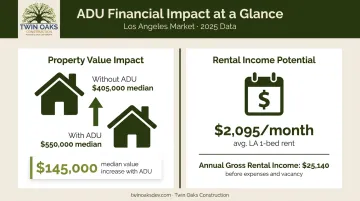
FHFA's 2025 analysis found that California properties with ADUs carried a median appraised value of $550,000 compared to $405,000 for comparable properties without ADUs. That's a statewide figure across all ADU types, not garage conversions specifically — but it shows how consistently the California market prices ADU-equipped homes higher.
Rental income sharpens the picture further. With LA one-bedroom asking rents averaging around $2,095/month per Zillow's current data, a permitted ADU in a desirable neighborhood can directly offset monthly loan payments.
Financing Options
Common funding paths include:
- Home equity loans — fixed rates, lump-sum disbursement, predictable payments
- HELOCs — draw funds as needed during construction, variable rate
- Cash-out refinancing — replaces your existing mortgage at a new rate; works best when current rates are favorable
Note that CalHFA's ADU Grant Program — which reimbursed up to $40,000 in predevelopment costs — exhausted its funding as of December 28, 2023, and is not currently accepting applications.
Common Misconceptions About Garage Conversions
"Any garage can be converted cheaply."
Garages with cracked foundations, pest damage, or undersized slabs require remediation that narrows the cost advantage over new construction. The structure's condition drives the budget more than any other single factor.
"No permits are needed — it's just a garage."
Every garage-to-ADU conversion in California requires a building permit. Under Civil Code 1102.6, unpermitted improvements must be disclosed in residential transfer disclosures. Unpermitted ADUs carry real legal and financial risk — including potential fines and required removal.
"There's a 10-year rule that legalizes old unpermitted garages."
No blanket statewide "10-year rule" exists. The relevant statutes are Health and Safety Code 17980.12, which allows a 5-year enforcement delay for qualifying building-standard violations, and AB 2533 (Gov. Code 66332), which addresses unpermitted ADUs and JADUs built before January 1, 2020. Rules vary by jurisdiction. Verify with your local building department before assuming an unpermitted structure qualifies.
These myths point to real constraints — and in some cases, a garage conversion simply isn't the right fit.
When a Garage Conversion May Not Be the Right Choice
- The garage is too small to meet minimum habitable space requirements
- Structural condition is so compromised that remediation costs approach new construction
- Maximum design flexibility or a larger unit is the priority — a new detached ADU may deliver a stronger return on investment
- The property already lacks off-street parking and local buyers or tenants place high value on it
For homeowners who can't convert an existing garage, new detached ADUs, attached ADUs, and Junior ADUs (JADUs) are all viable paths — each with different cost ranges, permitting timelines, and design constraints worth evaluating before committing to a direction.
Frequently Asked Questions
What is the 10-year rule for garage conversions?
No statewide "10-year rule" exists by that name. AB 2533 (Gov. Code 66332) allows legalization of unpermitted ADUs and JADUs built before January 1, 2020, and HSC 17980.12 provides a 5-year enforcement-delay process for qualifying violations. Eligibility varies by jurisdiction — confirm with your local building department before assuming coverage.
Does converting a garage to an ADU add value?
A permitted garage conversion typically increases property value in California markets. FHFA data shows California properties with ADUs carry meaningfully higher median appraised values than those without. The net gain depends on local demand for ADUs versus covered parking in your specific neighborhood.
How much does it cost to convert a garage into an ADU?
The Terner Center's statewide ADU survey found a median construction cost of $150,000, with 71% of projects coming in under $200,000. Utility connections and structural modifications are the biggest variables in the LA/Ventura market. Get a project-specific estimate based on your garage's condition and desired scope.
Is it cheaper to convert a garage or build an addition?
A garage conversion is generally less expensive because the foundation, walls, and roof already exist. Costs can converge if the garage requires extensive structural remediation or if the desired ADU size exceeds the existing footprint — in those cases, new construction may offer better value and design flexibility.
Do you need to replace parking when converting a garage to an ADU in California?
No. California Government Code 66314 explicitly bars local agencies from requiring replacement parking when a garage is converted to an ADU. Confirm local rules, and weigh the practical impact on resale value in your specific neighborhood.
How long does a garage to ADU conversion take from start to finish?
Plan for several months from initial design through certificate of occupancy. Under Gov. Code 66317, permitting agencies have 60 days to approve or deny a complete application when an existing dwelling is on the lot. Construction duration varies based on scope and structural complexity.