Moving isn't the only answer. A bump-out addition lets you expand a specific room outward by a few feet, solving the exact problem that's making your home feel cramped — without displacing your family during a months-long overhaul.
According to the National Association of Realtors, kitchen upgrades earned a Joy Score of 10 in 2025, and realtor-reported demand for kitchen upgrades rose 48% while bathroom renovation demand climbed 35% over two years. Homeowners aren't just thinking about resale — they want to actually enjoy where they live.
This guide explains what a bump-out addition is, why it works, what it costs, and how to approach it correctly in LA and Ventura Counties.
Key Takeaways
- A bump-out extends an existing room 2–15 feet, adding targeted square footage without building a new room from scratch
- A 3×15 ft kitchen bump-out adds 45 sq ft — roughly 30% more space to a 150 sq ft kitchen
- Costs typically range from $10,000 to $43,000, far less than a full room addition
- Minor kitchen remodels recoup approximately 113% of costs at resale
- Midrange bath remodels recoup around 80% of costs at resale
- California requires permits for bump-outs; skipping this creates permit violations that surface at resale
What Is a Bump-Out Addition?
A bump-out is a small horizontal extension of an existing room — not a new room, just more of the room you already have. It pushes one wall out by 2 to 15 feet, adding targeted square footage while sharing the existing room's flooring, lighting, and HVAC.
Cantilevered vs. Foundation-Supported Extensions
The construction approach depends on depth:
- Cantilevered bump-outs (roughly under 2 feet): Supported by extended floor joists, no foundation required — lower cost and simpler to build
- Foundation-supported bump-outs (typically 2–8+ feet): Require footings, piers, or a slab — more complex but opens up significantly more usable space
- Full additions (100+ sq ft of new ground coverage): A different category entirely, with corresponding cost and scope
Where Bump-Outs Make the Most Sense
| Room | Common Problem Solved | What a Bump-Out Adds |
|---|---|---|
| Kitchen | No room for an island or dining nook | 4 ft out = space for an island and seating |
| Bathroom | Single vanity, no separate tub | 3 ft out = double vanity or soaking tub |
| Bedroom | Can't fit furniture around a king bed | 2–3 ft out = sitting area or closet expansion |
| Living room / mudroom | No drop zone or entry storage | Targeted footage for built-ins or seating |
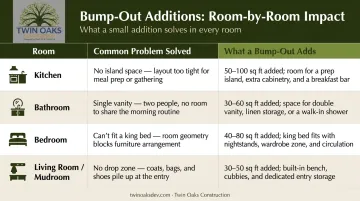
The key distinction: a bump-out solves a specific spatial problem in a room that already works — it just doesn't have enough space to work well.
Key Advantages of a Bump-Out Addition
Targeted Space That Transforms How a Room Functions
A full addition creates new rooms. A bump-out fixes the room that's already frustrating you every day.
Consider the math: a 3×15 ft kitchen extension adds 45 sq ft. If your existing kitchen is 150 sq ft, that's a 30% increase in usable space — enough to fit an island, create a proper dining nook, or finally have counter space on both sides of the stove. A 4 ft bathroom extension can mean the difference between a cramped shower-only bath and one with both a walk-in shower and a soaking tub.
The space works immediately. It connects directly to the existing room with matching flooring and finishes — no awkward transition, no adjustment period.
Houzz's 2025 kitchen study of 1,620 homeowners found that 35% increased their kitchen footprint during a renovation, while 64% worked within the original square footage. Bump-outs serve both camps — expanding those who need more room while keeping the project scope contained.
The impact is most immediate when one room is bottlenecking daily life:
- The galley kitchen where two people can't cook at the same time
- The master bath two adults share with nowhere to store anything
- The bedroom that can't fit a king-size bed and a dresser without blocking the door
Meaningful Increase in Home Value and Resale Appeal
Bump-outs improve home value two ways: by adding square footage that affects appraised value, and by improving the functionality of the rooms buyers care about most.
In Los Angeles County, the median sale price per square foot sits at $600. In Ventura County, it's $525. Permitted additional square footage carries real weight in those markets.
For resale benchmarks, the 2025 Cost vs. Value data is instructive:
- Minor midrange kitchen remodel: $28,458 cost / $32,141 resale value — approximately 113% cost recouped
- Midrange bath remodel: $26,138 cost / $20,915 resale value — approximately 80% cost recouped
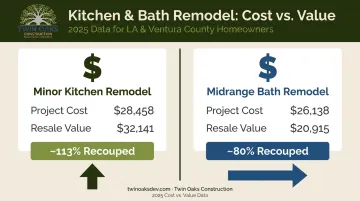
These aren't bump-out-specific figures, but they reflect the category of improvement most bump-outs fall into. A kitchen or bathroom that feels spacious and well-designed signals to buyers that the home has been thoughtfully maintained, and that perception translates directly into offers.
The value lift is most pronounced when:
- You're planning to sell within 3–7 years
- The listing is in a competitive market where kitchen and bath quality drive decisions
- A cramped layout is the main objection keeping buyers from making an offer
Lower Cost and Disruption Than a Full Room Addition
A bump-out costs a fraction of a full addition because it shares the home's existing structural, mechanical, and roofing systems instead of building all new ones.
Cost comparison at a glance:
- Bump-out addition: $10,000–$43,000 (average ~$27,000), or roughly $85–$300 per sq ft
- Full home addition: $21,910–$83,349 on the broader end, with $80–$200/sq ft for building out and $300–$500/sq ft for building up
Construction timelines follow a similar pattern. Bump-out projects typically involve 2–4 weeks of active construction, with the total timeline (including design and permitting) running 2–4 months. Most families can remain in the home throughout — the primary work happens outside the existing living space, not through it.
This advantage matters most for homeowners with a single underperforming room, those working within a defined budget under $60,000, or properties where a full addition would consume too much yard space or push against lot coverage limits.
What Happens When the Space Problem Goes Unaddressed
Adapting to a tight kitchen or cramped bathroom is easy to rationalize. Most homeowners tell themselves it's manageable — until it's been five years and the workarounds have become the routine.
The daily costs are real and cumulative:
- Cooking around each other in a galley kitchen
- Taking turns getting ready in a single-vanity bathroom
- Arranging furniture to function rather than to feel like home
These aren't emergencies. But over time, they erode how much a family actually enjoys living in the house.
From a property value standpoint, the delay has consequences too. Redfin notes that updated homes tend to sell faster and for more money than homes needing work. Zillow found that listings describing a home as "remodeled" sold for a 3.7% premium. In a market where LA County homes are trading near $937,000 and Ventura County near $922,000, that premium is meaningful.

Delaying also creates execution risk. Homeowners who wait and then rush into a bump-out project are more likely to skip permitting, choose an inexperienced contractor, or discover that setback violations prevent the extension they planned. California's Contractors State License Board is direct on this: construction without a permit can expose homeowners to additional liability and costs — problems that surface most painfully at the point of sale.
Addressing the problem proactively — with the right contractor and a proper permit — is what separates a smooth bump-out project from a costly one.
How to Get the Most Value from Your Bump-Out Addition
A well-executed bump-out delivers on its promise when three things are done right: the size is driven by actual functional need, the exterior matches the existing home, and the permits are pulled from the start.
Design for the Room's Function First
The goal isn't to add feet — it's to solve the specific problem. Before finalizing dimensions, ask: what does this room need to work the way it should? An island that seats four people needs different footage than a double vanity. Size the bump-out to the outcome, not to a round number.
Roofline and exterior materials matter more than most homeowners expect. A bump-out that visually looks like it was bolted on later hurts curb appeal and raises buyer questions. Matching the pitch, siding, and trim to the original structure keeps the addition looking intentional.
Address Mechanical Systems Early
Plumbing and HVAC are the two most common sources of mid-project cost surprises. Extending a bathroom outward may require rerouting drain lines or moving supply plumbing — costs that depend on what's behind the walls. Kitchen bump-outs involving appliance relocations can trigger the same issue.
Evaluate these systems during the design phase, not after permits are pulled. Twin Oaks Construction addresses this through its architecture and design services, building mechanical considerations into the project scope before construction begins rather than treating them as surprises later.
Understand Local Zoning Before Committing to a Design
In LA County, standard residential setbacks for R-1 zones include a 20 ft front yard, 5 ft interior side yard, and 15 ft rear yard, though parcel-specific standards can vary. Ventura County's non-coastal R1 zones carry similar requirements. HOA rules layer on top of those.
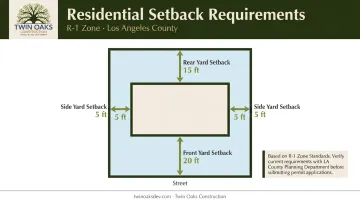
Knowing these limits upfront means your design gets built as drawn, not revised after the fact or rejected at permit review.
Twin Oaks Construction brings over 20 years of room addition experience across LA and Ventura Counties, including permitting and planning support that navigates local zoning on your behalf. That regional familiarity prevents the delays and cost overruns that come from discovering a setback conflict after plans are already drawn.
Conclusion
A bump-out addition doesn't change your address. It changes how your house actually works: one room, one targeted extension, one real problem solved. Done well, it adds usable square footage, improves daily livability, and builds equity in markets where every square foot carries real value.
The difference between a bump-out that feels seamless and one that looks like an afterthought comes down to planning: matching the home's design, pulling proper permits, and working with a contractor who knows the local rules before breaking ground.
Homeowners in LA and Ventura Counties ready to explore what's possible can reach Twin Oaks Construction for a free consultation at (833) 621-7251 or online at twinoaksdev.com/contact.
Frequently Asked Questions
What is a bump-out addition?
A bump-out is a small horizontal extension of an existing room — typically 2 to 15 feet deep — that adds targeted square footage without building an entirely new room. Extensions under roughly 2 feet can be cantilevered without a foundation; deeper ones require footings. They're most common in kitchens, bathrooms, and bedrooms.
Is a bump-out addition worth it?
Bump-outs deliver strong value for homeowners needing more functional space in a specific room. They cost far less than a full addition and typically recoup 50–80% of project costs at resale — with the highest ROI in kitchens and bathrooms.
How much does a bump-out addition cost?
Costs typically range from $10,000 to $43,000 (averaging around $27,000), with per-square-foot rates between $85 and $300. Smaller projects trend higher per square foot because fixed costs spread across less space. Plumbing or HVAC tie-ins can push totals toward the higher end.
Do bump-out additions require permits in California?
Yes. California Residential Code R105.1 requires a permit before any owner enlarges or alters a structure. Bump-outs involve structural work and often plumbing or electrical, all of which require permits. Setback requirements and lot coverage limits in LA and Ventura Counties must also be verified before any design is finalized.
How long does a bump-out addition take to complete?
Active construction typically runs 2–4 weeks for most bump-outs, with the full timeline including design and permitting running 2–4 months. Ventura County plan review alone can take 4–5 weeks for initial submittals. Most homeowners can continue living in the home throughout construction.