Introduction
Many LA and Ventura County homeowners hit the same wall: the family has grown, the home hasn't, but the neighborhood is exactly where they want to be. Selling means competing in one of the country's most expensive real estate markets, absorbing transaction costs, and resetting a mortgage — often for a lateral move. Adding a second story sidesteps all of that.
The catch? Pricing is rarely straightforward. According to Angi's 2026 second-story cost guide, most homeowners spend between $100,000 and $250,000, with an average around $175,000 — but full premium builds in high-cost California markets can push well past $500,000. Understanding what drives that range is how you build a realistic budget before the first contractor walks through your door.
This guide covers the cost drivers, what each price tier actually gets you, and how to approach the decision strategically — whether you're still researching or ready for your first contractor quote.
Key Takeaways
- Standard second story additions run $100–$300 per sq ft; total projects typically fall between $100,000 and $300,000
- LA and Ventura County labor rates run roughly 20% above the national average — national benchmarks underestimate local costs
- Structural work (foundation, load-bearing walls, engineering) is often the biggest budget wildcard
- Plan for a 15–20% contingency on top of your contractor estimate
- Most homeowners must vacate during construction; budget $3,000–$17,000+ for temporary housing
How Much Does a Second Story Addition Cost?
In LA and Ventura Counties, second story addition costs run well above national averages — driven by local labor rates, permitting requirements, and the structural complexity of building vertical. The per-square-foot figure you'll see online is only part of the picture.
Two budgeting mistakes show up repeatedly. The first: focusing on cost per square foot while ignoring structural reinforcement, mechanical upgrades, architect fees, permits, and temporary housing. The second: hiring a contractor without vertical addition experience — someone who underestimates what's involved in removing a roof, reinforcing a foundation, and managing multiple subcontractors across trades.
Here's how the three main cost tiers break down:
Budget Range: $100,000–$175,000
- Partial addition over a portion of the footprint — one or two rooms, minimal plumbing
- Standard builder-grade finishes, conventional framing and roofing
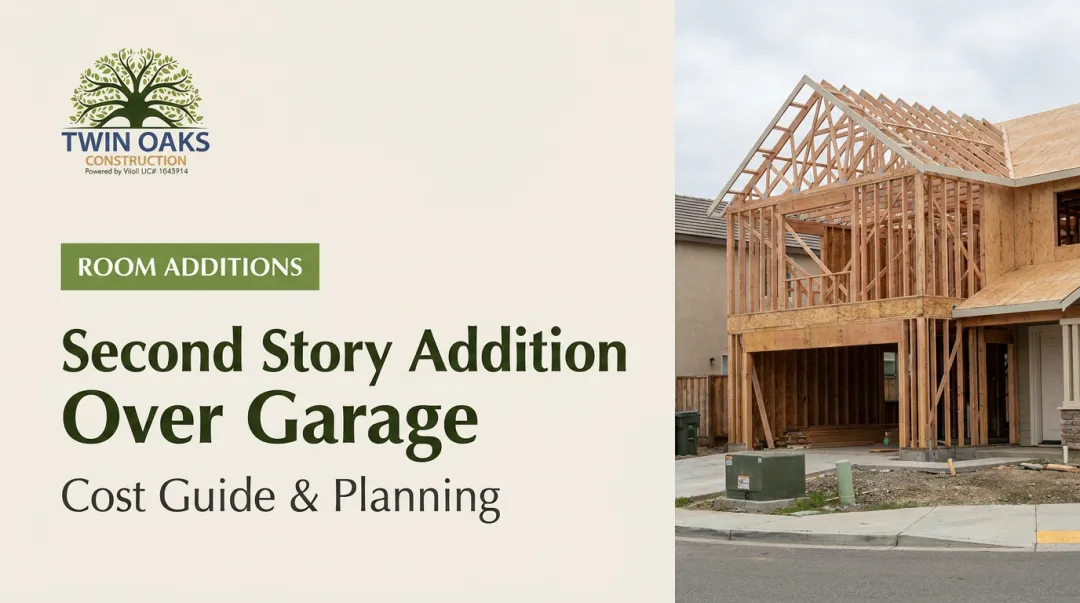
- Realistic for a bedroom or two without bathroom plumbing; over-garage builds fit this range
- Difficult to achieve for a full-footprint addition in California
Mid-Range: $175,000–$350,000
- Full or partial addition with one bathroom, mid-grade finishes, and a functional custom layout
- Upgraded windows and some custom cabinetry included at this tier
- Best suited for growing families adding 2–3 rooms with a working bathroom
Premium / High-End: $350,000–$1,000,000+
- Full second story with multiple bathrooms, possible kitchenette, and luxury finishes throughout
- Custom design with premium flooring and fixtures
- Suited for major home transformations or maximizing resale value in competitive markets
According to HomeGuide, full second floors on 2,000 sq ft homes regularly reach $400,000–$1,000,000 in high-cost states like California.
Key Factors That Affect the Cost of a Second Story Addition
Square footage sets the baseline, but the real cost drivers are structural, regulatory, and design-related. Each one adds complexity — and its own line to the budget.
Type and Scope of Addition
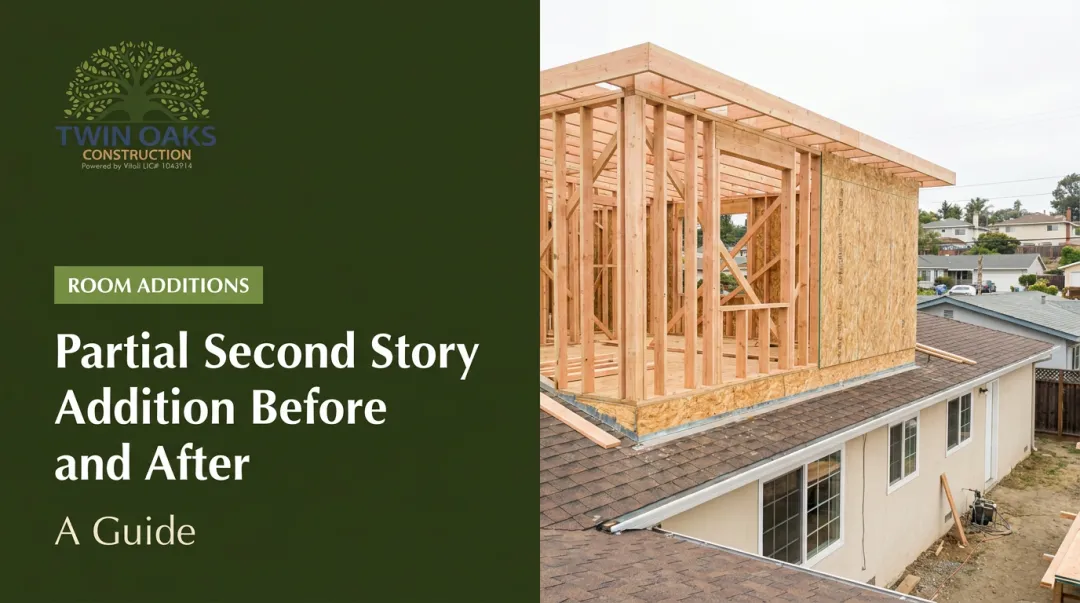
A full addition spans the entire first-floor footprint, which means removing the entire roof and rebuilding it higher. A partial addition — over a garage, one wing, or a rear section — preserves more of the existing structure and generally costs less in total (though not always less per square foot).
The scope choice affects:
- How long the project takes
- How much structural reinforcement is needed
- Whether you can stay in the home during construction (rarely possible for full additions)
Size, Shape, and Footprint
Square footage is the baseline multiplier. But irregular shapes, non-rectangular footprints, or additions that don't align cleanly with the first-floor layout require custom framing — which adds both labor hours and material waste. Simple rectangles are cheaper to build than L-shapes or stepped designs.
Foundation and Structural Work
Most single-story homes weren't engineered to carry a second floor. Before any framing begins, a structural engineer must assess whether the existing foundation, walls, and framing can handle the added load.
Common structural costs include:
- Foundation reinforcement: $2,000–$20,000
- Geotechnical report: $1,000–$5,000 (required when soil capacity is uncertain)
- Load-bearing wall modifications: $9,000–$15,000
- Steel beam installation: $100–$400 per linear foot
- New staircase: $1,000–$5,000
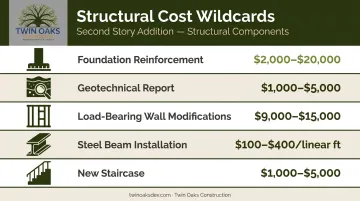
The structural condition of the existing home — not the size of the new addition — is often what separates a manageable project from an expensive one.
Materials and Finish Quality
Materials account for a large share of any addition budget. The gap between builder-grade and premium choices is substantial:
| Category | Budget Option | Premium Option |
|---|---|---|
| Flooring | Laminate or basic hardwood | Wide-plank engineered hardwood |
| Windows | Standard vinyl | Clad wood or fiberglass |
| Roofing | Asphalt shingles | Tile or premium architectural shingles |
| Fixtures | Builder-grade | Custom or designer selections |
A full floor of premium selections can add $40,000–$80,000 over builder-grade equivalents on a mid-size addition.
Labor, Permits, and Professional Fees
Labor alone can represent 20–40% of total renovation cost, and in Southern California, BLS wage data shows LA metro construction wages running about 20.4% above the national average. That premium compounds across every trade on the job.
Key professional fees to budget separately:
- Architect: 5–20% of construction cost
- Structural engineer: $2,000–$8,500, or 1–5% of construction cost
- General contractor markup: 10–20% of project cost
- Trade subcontractors: Plumber, electrician, HVAC — each scoped separately
Permit fees in LA and Ventura Counties are valuation-based, not flat-rate. Both LA County and Ventura County calculate fees from application costs, combination permit issuance fees, and per-square-foot trade fees. There's no single permit number that applies to all projects.
Get a project-specific permit estimate after your plans are drawn. Twin Oaks Construction manages permitting and planning coordination as part of every room addition project, so you're not piecing together the process on your own.
Second Story Addition Cost Breakdown
The total cost extends well beyond framing and finishes. Homeowners who budget only for construction are regularly caught off guard by the surrounding costs.
| Cost Category | What's Included | Typical Range |
|---|---|---|
| Design & pre-construction | Architect fees, structural engineer, blueprints, plan review | $8,000–$25,000 |
| Construction (core build) | Demolition/roof removal, framing, roofing, insulation, drywall, windows, siding, staircase | Largest single line item — priced per sq ft |
| Mechanical system upgrades | HVAC expansion/replacement ($5,000–$22,000), electrical panel upgrade ($1,200–$4,000), plumbing rough-in for bathrooms ($18,000–$47,000 when included) | Often overlooked in initial budgets |
| Permits and inspections | Building, electrical, plumbing, mechanical — valuation-based in LA/Ventura | $3,000–$12,000+ |
| Temporary housing | LA short-term rentals run $1,713–$4,344/month; Ventura options from $2,514+/month | Budget $3,400–$17,000+ for a 2–4 month displacement |
| Contingency buffer | Unexpected structural issues, permit revisions, material cost changes | 15–20% of total estimated cost |
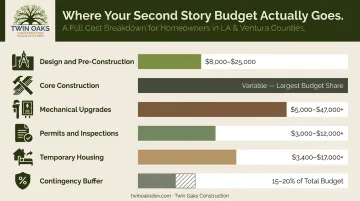
A full second-story addition requires complete roof removal — which makes the home uninhabitable, sometimes for months. A family of four renting a two-bedroom in the LA area for three months is looking at $8,000–$13,000 before storage costs, pet fees, or deposits. That's why temporary housing belongs in the budget from day one.
Types of Second Story Additions
Not all second story additions are built the same way. The type you choose affects total cost, timeline, and how much your daily life gets disrupted during construction.
| Addition Type | Typical Cost Range | Best For |
|---|---|---|
| Full addition (entire footprint) | $400,000–$1,000,000+ | Maximum space gain; homes with room for a complete transformation |
| Partial addition (one wing or section) | $100,000–$300,000 | Adding 1–3 rooms without rebuilding the whole roofline |
| Over-garage addition | $60,000–$200,000+ | Least expensive true second-story option when garage structure supports the load |
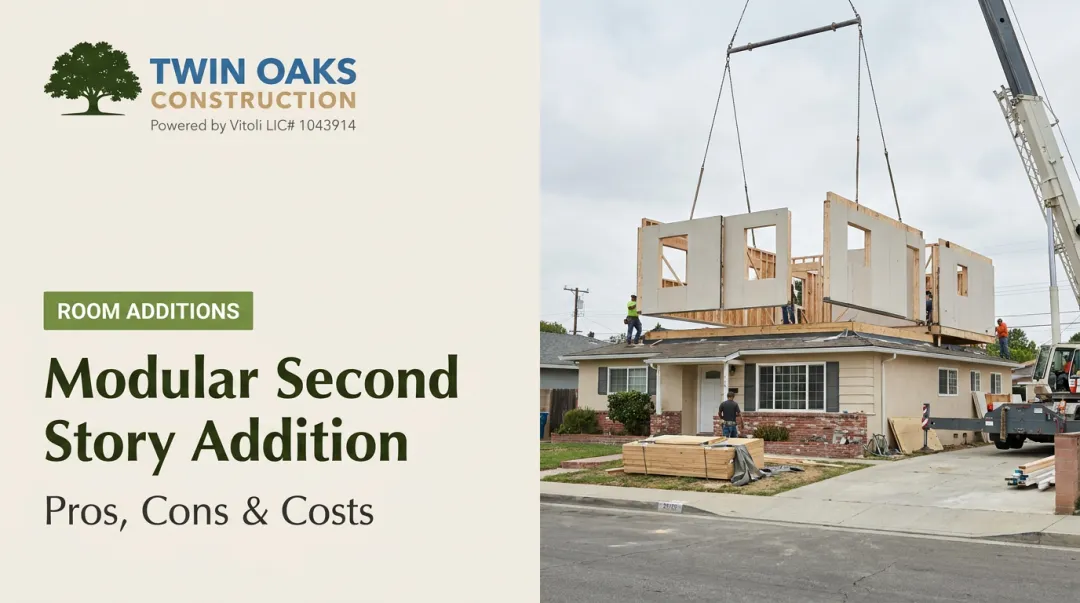
| Modular/prefab | Varies | Cost savings possible, but limited availability and local permitting requirements in CA complicate most builds |
For homes in LA and Ventura Counties — where lot sizes are often constrained and setbacks limit ground-floor expansion — partial and over-garage additions are frequently the most practical starting point. They require less structural intervention and keep construction disruption more contained.
The right type depends on:
- How much space you actually need
- What your lot and zoning allow
- The existing structural condition of the home
- Your budget ceiling
An experienced contractor can assess feasibility before any money changes hands, so you're not locked into an addition type that doesn't work for your home.
How to Budget Smartly — and What Most Homeowners Get Wrong
The Sticker Shock Problem
The per-square-foot figure is the most visible number in any cost guide. It's also the most misleading when used in isolation. Homeowners anchor to it, multiply it by their desired square footage, and arrive at a number that leaves out:
- Structural engineering and foundation work
- Architect and design fees
- Permit costs and plan check fees
- Mechanical system upgrades
- Temporary housing
- A contingency buffer
This Old House recommends setting aside 10–15% above the contractor estimate for unexpected costs. For second story additions in LA and Ventura — where structural unknowns, permitting corrections, and displacement costs are real risks — 15–20% is more defensible.
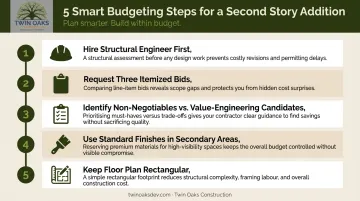
The Smart Budgeting Checklist
Before signing any contract:
- Hire a structural engineer before getting contractor quotes — their assessment shapes everything else, including what's feasible
- Request at least three itemized bids covering structure, MEP, finishes, and fees (not ballpark numbers)
- Decide upfront which features are non-negotiable and which can be value-engineered if costs run high
- Use standard finishes in hallways, utility areas, and secondary rooms — they won't be noticed, but the savings will be
- Keep the floor plan rectangular — every jog, bump-out, or angled corner adds custom framing costs
Build Up vs. Build Out
Ground-floor additions typically cost less per square foot and cause less construction disruption. But they require available yard space, setback compliance, and lot coverage headroom — constraints that eliminate the option for many LA and Ventura homeowners whose lots are already built close to their limits.
Building up uses the existing footprint, avoids expanding the foundation outward, and often works where building out won't. The tradeoff is greater structural complexity and a longer displacement period.
Neither choice is universally cheaper. The right answer depends on your specific lot, your home's structural condition, and what your zoning allows.
That complexity is exactly why local expertise matters. A contractor who knows LA and Ventura permitting — what triggers corrections, which structural approaches reviewers flag, how displacement timelines actually run — can prevent costly surprises. Twin Oaks Construction has been navigating those specifics for over 20 years, handling room additions across both counties from initial assessment through final walkthrough.
Frequently Asked Questions
How much does a second story addition cost?
Most homeowners spend between $100,000 and $300,000, at roughly $100–$300 per square foot for standard work. Complex full additions or premium builds in California markets can reach $500,000–$1,000,000+. Size, addition type, materials, and local labor rates all move that number significantly.
Is it cheaper to add a second story or build out?
Ground-floor additions generally cost less per square foot and involve less disruption. However, they require available lot space and setback compliance — factors that rule them out for many urban and suburban LA and Ventura properties where building up is the only practical option.
Will adding a second story increase my home's value?
It adds square footage and utility, but the financial return is typically partial. The 2025 Cost vs. Value report for Los Angeles shows midrange primary suite additions recouping roughly 31.9% of cost at resale. The bigger benefit is often the space gained and the avoided cost and disruption of relocating.
How long does it take to add a second story to a house?
Partial additions typically take 3–6 months; full second story additions run 6–12 months from design through completion. Permitting, structural assessment, and construction scope all affect the schedule, and LA County's review timelines can add lead time before construction begins.
Do I need permits to add a second story to my house?
Yes — always. Second story additions require building permits along with electrical, plumbing, and mechanical permits. Work completed without permits creates legal liability, complicates future home sales, and may require expensive remediation to bring into compliance.
Do I have to move out during a second story addition?
In most cases, yes. A full addition requires complete roof removal, exposing the interior and making the home unsafe to occupy. Depending on project scope, displacement can last from several weeks to several months, so plan housing arrangements before construction starts.