
The honest answer is that bathroom remodels have two timelines: active construction days and total project duration from first planning meeting to final walkthrough. Most homeowners budget for the first and get blindsided by the second. Pre-construction alone — design finalization, permits, and material ordering — routinely adds 4–10 weeks before a single tile gets pulled.
This guide breaks down every phase with realistic timeframes, so you know exactly what to expect.
Key Takeaways
- A cosmetic refresh takes 1–3 weeks of construction; a mid-range remodel runs 3–6 weeks; a full gut renovation takes 6–12+ weeks
- Pre-construction adds 4–10 weeks to your total timeline before construction begins
- Permits and inspections — especially in LA and Ventura Counties — are the most common source of unexpected delays
- Finalizing all material selections before demolition starts is the single most effective way to stay on schedule
How Long Does a Bathroom Remodel Take? Timeline by Scope
The confusion about timeline usually comes from conflating construction days with total project duration. A mid-range remodel might take four weeks of active construction — but when you factor in design decisions, permit review, and material lead times, your total elapsed time is closer to three months.
Here's what realistic construction timelines look like by scope:
Cosmetic Refresh (1–3 Weeks of Construction)
Scope: painting, vanity swap, new fixtures, updated lighting, and flooring — no plumbing relocation.
This moves quickly for several reasons:
- No permit delays for purely cosmetic work in most jurisdictions
- Fewer trades involved (no plumber or electrician for rough-in)
- Stock materials are available immediately at local suppliers
This scope works well for powder rooms or bathrooms that function fine but look dated. If the layout works, a cosmetic refresh delivers strong visual impact with minimal disruption.
Mid-Range Remodel (3–6 Weeks of Construction)
Scope: replacing all major fixtures — tub, shower, toilet, vanity — in their existing locations, new tile throughout, updated electrical.
Even without relocating plumbing, disconnecting and reconnecting it adds time. Trades must also sequence in a strict order: plumber completes rough-in → electrician runs circuits → tile setter works floor and walls → drywaller closes everything up. Each trade can only start after the previous one finishes and passes inspection.
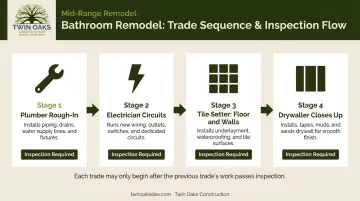
This is the most common remodel type for homeowners across LA and Ventura Counties. The sequencing is manageable, but inspection holds between phases are where timelines slip.
Full Gut Renovation (6–12+ Weeks of Construction)
Scope: everything down to the studs — new layout, relocated drains, custom shower builds, window additions or modifications.
The number of specialized trades grows — and each one needs careful coordination:
- Structural framing and rough plumbing relocation
- Custom glass fabrication and waterproofing specialists
- Finish carpenters and tile setters working in sequence
Master bathrooms almost always fall into this category.
Houzz's 2025 U.S. Bathroom Trends Study, which surveyed 1,737 U.S. homeowners, distinguishes major bathroom remodels as a distinct project category — a scope classification that aligns with the full gut renovation range above. That's why the sections ahead break down each phase — permitting, material lead times, and sequencing — so you can map a realistic total timeline before the first trade sets foot on site.
The Pre-Construction Phase: What Happens Before Demo Day
Most homeowners think of their remodel as starting on demolition day. In reality, a well-managed project is already weeks into its timeline before any tool touches a wall.
A realistic pre-construction phase runs 4–10 weeks, depending on project complexity. Rushing this phase doesn't save time — it causes expensive mid-construction stops when materials haven't arrived or permits aren't cleared.
Design Finalization and Material Selection
Every product must be selected before demolition is scheduled. Contractors cannot book trades around unknown materials — a tile setter won't commit to a start date if the tile hasn't been ordered.
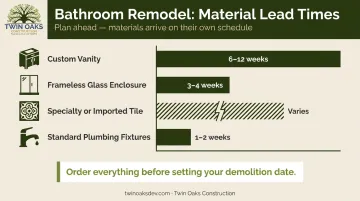
Lead times for common items:
- Custom bathroom vanities: 6–12 weeks to manufacture, longer if materials are backordered, per a 2025 cabinetry supplier benchmark
- Frameless glass shower enclosures: 3–4 weeks is the industry-standard lead time, according to MY Shower Door
- Specialty or imported tile: varies — confirm with your supplier before scheduling demo
Order everything before setting a demolition date. The sequence to work through: tile → plumbing fixtures → vanity → lighting → hardware → mirrors.
Pulling Permits in LA and Ventura Counties
Permit requirements depend on what you're changing:
- No permit needed (typically): painting, flooring, cabinet swaps, fixture-for-fixture replacements with no wall changes
- Permit required: any plumbing relocation, electrical circuit changes, structural modifications, or new penetrations into existing walls
In the City of Los Angeles, LADBS/PermitLA allows a combined electronic permit for basic bathroom repair and replacement work, provided there are no wall or opening changes and no new plumbing or electrical penetrations.
Work that goes beyond that scope requires processing through an LADBS Construction Services Center.
For Ventura County cities, timelines vary by municipality:
- Simi Valley: Non-structural bathroom remodels take up to 1 week for review; projects requiring plan check can run 5–10 business days for initial review
- Oxnard: Express permits allow up to 3 working days, with same-day processing as a goal for qualifying work
Inspections in LADBS jurisdiction can be scheduled for the next business day when requested by 3:00 PM through AIRS or 2:00 PM via phone — but that scheduling window applies to each inspection milestone, not just once.
Failing to pull required permits creates real problems: failed inspections, mandatory demolition of finished work, and liability issues when you sell the property.
Hiring a Contractor and Signing a Contract
Knowing your permit requirements upfront also shapes who you hire — a contractor unfamiliar with your city's process can add weeks to the timeline. Plan for 1–3 weeks to complete this step properly:
- Get multiple bids — at least three, ideally from contractors who've worked in your specific city (permit processes vary)
- Review credentials — verify license, insurance, and past bathroom remodel examples
- Level the bids — confirm each bid covers the same scope before comparing prices
- Sign a contract that specifies scope, payment schedule, and a realistic construction timeline
Twin Oaks Construction has handled bathroom remodels across LA and Ventura Counties for over 20 years, managing permit coordination, trade scheduling, and material timing as part of every project from day one.
The Construction Phase: A Realistic Week-by-Week Breakdown
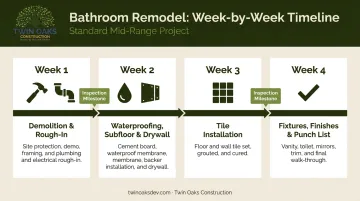
The sequence of trades in a bathroom remodel is fixed — each phase must be completed and inspected before the next can begin. Here's how a standard mid-range project typically unfolds:
Week 1: Site Protection, Demolition, and Rough-In
- Protective coverings go down on floors, walls, and access corridors
- Demolition removes old fixtures, tile, and exposed surfaces — typically half a day to one full day for a standard bathroom
- Rough-in plumbing and electrical begins once walls are open: new supply lines, drain pipes, and circuits are run
- End-of-week milestone: rough-in inspection must pass before walls can be closed — scheduling the inspector can take several days even when the work is ready
Week 2: Waterproofing, Subfloor, and Drywall
- Subfloor height is set (critical for proper tile installation)
- Waterproof membranes are installed in the shower enclosure
- Drywall repairs or replacement follows
- Shower pan installation and flood test occur this week — under California Plumbing Code Section 408.7.5, shower receptors must be tested for watertightness before tile is set
Waterproofing is where the most consequential decisions happen. Moisture damage behind tile isn't visible for months — sometimes years — and by the time it appears, repairs typically cost several times what proper installation would have. Ask your contractor specifically which membrane system they're using and why.
Week 3: Tile Installation
Tile work is typically the most labor-intensive single phase of a bathroom remodel. The full process — substrate and backer installation, mortar application, setting tiles, grouting, and sealing — takes more time than most homeowners expect. Rushing it produces uneven grout lines, cracked tiles at grout joints, and repairs that cost far more than the time saved.
A few things that affect duration:
- Small-format tiles (mosaic, penny tile) require significantly more time per square foot than large-format tiles
- A complex custom shower can consume an entire week on its own
- Substrate flatness requirements for large-format tile (maximum 1/4-inch deviation per 10 feet, per TCNA guidance) add preparation time
Week 4: Fixtures, Finishes, and Punch List
- Plumber returns to install faucets, showerheads, toilet, and sink
- Electrician completes light fixtures, outlets, and exhaust fan
- Vanity installation and cabinet hardware
- Painting and trim work
- Final punch list: superintendent and homeowner walk through together, documenting any items needing correction
Minor punch list items typically resolve within 1–3 days. Back-ordered components, such as a specific faucet finish or a frameless glass panel, can extend this if they weren't confirmed in advance.
Factors That Can Push Your Timeline Past the Estimate
Experienced contractors build contingency into their schedules because surprises are a normal feature of remodeling — particularly in older homes common throughout LA and Ventura Counties. Experienced contractors build contingency into their schedules because surprises are a normal feature of remodeling — particularly in older homes common throughout LA and Ventura Counties. Three factors cause the most delays:
Hidden structural and water damage: Once walls open, contractors frequently find issues invisible during the initial walkthrough — water-damaged framing behind shower walls, outdated wiring that doesn't meet current code, or mold requiring remediation. Contractors must fully address these before new work can continue. Remediation alone can add one to three weeks depending on severity.
Inspection scheduling: While LADBS offers next-business-day inspection scheduling when requests are submitted by posted deadlines, each inspection milestone requires a separate scheduling event. Multiple inspections across a project — rough plumbing, rough electrical, waterproofing flood test — means multiple hold points where the contractor is waiting rather than working.
Material delays and mid-project design changes: According to a 2022 Nationwide homeowner survey, 50% of homeowners worried about material delays and 45% about having to swap materials due to availability. Changing a design decision mid-project — moving a showerhead, switching tile — requires rework and new orders, pushing the finish date back a week or more.
How to Keep Your Bathroom Remodel on Schedule
The contractor manages trades and logistics. But homeowners have more influence over the timeline than most realize.
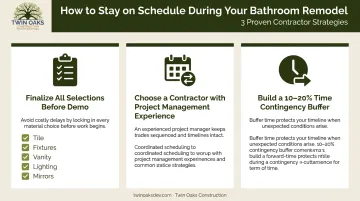
Make every selection before demolition begins. Contractors cannot schedule trades around unconfirmed materials — delays in ordering a single tile or fixture can push back every trade that follows. Have every product selected, ordered, and delivery-confirmed before the first tool is lifted:
- Tile (and grout color)
- Plumbing fixtures
- Vanity
- Lighting
- Mirrors and hardware
Choose a contractor with proven project management. The right contractor pre-schedules trades in sequence, follows up on deliveries, and flags problems before they stop work. Twin Oaks Construction has handled bathroom remodels across LA and Ventura County for over 20 years, and clear communication at every stage is a core part of how they run projects — so homeowners know what's happening and what comes next.
Build a realistic contingency buffer. Add 10–20% to any time estimate, particularly for older homes or full gut renovations. NAHB guidance recommends a 10% cost contingency for unforeseen issues — the same logic applies to schedule. Expecting surprises, rather than being blindsided by them, keeps the project calmer when something does come up.
Frequently Asked Questions
How long should it take a contractor to remodel a bathroom?
Active construction runs 1–3 weeks for a cosmetic refresh, 3–6 weeks for a mid-range fixture replacement, and 6–12+ weeks for a full gut renovation. Add 4–10 weeks for design, permits, and material ordering, and total project duration typically lands between 2–4 months from first planning meeting to final walkthrough.
What is the most time-consuming part of a bathroom remodel?
Tile installation is typically the longest single construction phase, especially for custom showers with mosaic or penny tile. Permit scheduling can also create unexpected wait time at multiple inspection milestones throughout the project.
Can I use my bathroom during the remodel?
For a full remodel, the bathroom is completely out of service for the duration of construction. If it's your only bathroom, plan for alternative access — a second bathroom in the home, a gym membership, or temporary arrangements with family nearby.
What causes bathroom remodels to go over the estimated timeline?
The most common causes are hidden water damage found during demolition, back-ordered materials, permit scheduling delays, and design changes made after construction starts. Thorough pre-construction planning addresses most of these before they become problems.
Does the size of the bathroom affect how long the remodel takes?
Size primarily affects the tile and finishing phases — more square footage means more installation time. But scope has a larger impact than size. Whether plumbing is relocated, whether it's a gut renovation down to the studs — those decisions drive duration more than the room's square footage.
How far in advance should I start planning a bathroom remodel?
Start at least 2–3 months before your desired construction date. Custom vanities take 6–12 weeks to manufacture, frameless glass runs 3–4 weeks, and permit review adds time on top of contractor selection — all of which need to be resolved before demolition begins.