The honest answer is that kitchen remodel timelines vary widely. A cosmetic refresh can wrap up in a few weeks. A full structural gut renovation can take six months or more from the first design meeting to final sign-off. Understanding why that gap exists — and where the time actually goes — is what separates homeowners who plan well from those who get caught off guard.
This article breaks down realistic timelines by project scope, walks through the three phases of a remodel, and identifies the factors most likely to push your project off schedule.
Key Takeaways
- A cosmetic kitchen refresh (paint, hardware, backsplash) takes 2–6 weeks; a full structural remodel takes 3–6 months from design to completion
- Most delays happen in pre-construction, not during active building — plan accordingly
- Custom cabinet lead times run 4–9 weeks — order immediately after design is finalized
- Permits are required for plumbing, electrical, gas, and structural work in both LA and Ventura Counties
- Locking in every material decision before demolition is the single most effective way to stay on schedule
How Long Does a Kitchen Remodel Take?
Kitchen remodels typically range from 3 weeks to 6 months — but that's total calendar time from project kickoff to completion, not just the days workers are on-site. According to HomeAdvisor, active construction typically runs 6–10 weeks, while the full planning-to-completion timeline stretches to roughly 4 months for most projects.
There are three scope categories, each with a meaningfully different timeline:
Small-Scale Remodel: 2–6 Weeks
Qualifies as small-scale if it's cosmetic only — meaning no layout changes, moved plumbing, or structural work. This includes:
- Cabinet refinishing or painting
- New backsplash installation
- Countertop swap (same footprint)
- Appliance upgrades (same locations)
- Hardware and lighting replacements
If all materials are on hand before work begins, a skilled crew can complete this scope in two to three weeks. Add a week or two for material procurement and you're looking at the high end of this range.
Medium-Scale Remodel: 6–12 Weeks
This category covers projects where the layout stays intact but the kitchen gets a full material refresh. Common scope items include:
- New cabinet installation (stock or semi-custom)
- Updated appliances (same locations)
- New flooring throughout
- Minor layout adjustments that don't touch plumbing or gas lines
The extended timeline versus a cosmetic refresh comes from two things: cabinet lead times and the added installation sequence complexity.
Full Kitchen Remodel: 3–6 Months
Structural changes push a project into this category. That includes:
- Moving or removing walls
- Relocating plumbing or gas lines
- Upgrading electrical service or adding circuits
- Custom cabinetry with modified dimensions
- Any change to the kitchen's footprint
Angi's 2026 kitchen remodel guide puts full remodels with layout reconfiguration at 8–12 weeks of active construction — and when you factor in pre-construction planning, permit processing, and material lead times, the total calendar range reaches 3–6 months.
The Two-Clock Problem
Most homeowners plan around the construction phase and underestimate everything around it. Active work may only run 4–8 weeks, yet the total project spans 4–5 months. That gap isn't dead time. It's design finalization, permit processing, material fabrication, and inspection scheduling. Knowing this upfront prevents the frustration of expecting a shorter timeline than your project actually requires.
The Kitchen Remodel Timeline: Phase by Phase
Every kitchen remodel moves through three phases: pre-construction, construction, and post-construction. Most delays occur in phase one — not because contractors are slow, but because the planning work is underestimated.
Pre-Construction Phase (Weeks 1–8+)
This phase includes three parallel tracks that all need to complete before demolition begins:
Design finalization (2–4 weeks): Includes finalizing layout, selecting all materials, and producing construction drawings. Any undecided item at this stage becomes a bottleneck later.
Permit acquisition (1–6+ weeks): LADBS (Los Angeles Department of Building and Safety) categorizes permits into Express, Counter Plan Check, and Regular Plan Check. Regular Plan Check — required for structural, plumbing, or electrical work — can take weeks depending on workload. LA and Ventura Counties both require permits for kitchen remodels. Submit early; waiting until design is fully polished before starting the permit process is one of the most common scheduling mistakes.
Material ordering: Custom and semi-custom cabinets from manufacturers like Dura Supreme carry a 4–6 week lead time (5–7 weeks for contemporary styles), while KraftMaid quotes 4–7 weeks depending on logistics and geography. This means cabinets must be ordered immediately after design is finalized — not after permits are approved. That's a weeks-long overlap many homeowners miss.
Construction Phase (Weeks 6–16+)
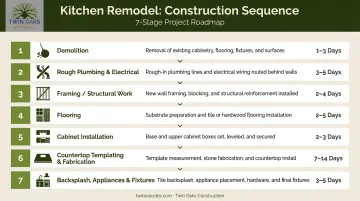
Once permits are in hand and materials are confirmed, construction follows a strict sequence:
- Demolition — 1–2 days for cosmetic projects; up to 1–2 weeks for full gut renovations
- Rough plumbing and electrical — 1–4 days; must be inspected and approved before walls close
- Framing or structural work — if walls were moved or openings created
- Flooring (typically installed before cabinets)
- Cabinet installation — typically 3–5 days for the physical install
- Countertop templating and fabrication — 2–6 weeks from consultation to installation
- Backsplash, appliances, fixtures, and hardware
Each trade — plumbers, electricians, tile installers — must work in sequence. Gaps between their schedules are where projects lose days. Managing that coordination is the primary job of a general contractor. Twin Oaks Construction's 20+ years working across LA and Ventura Counties means established subcontractor relationships — which directly closes those scheduling gaps.
Post-Construction Phase (1–2 Weeks)
After installation wraps, the project isn't done. This phase includes:
- Final city inspections for electrical, plumbing, and gas work
- Contractor walk-through and punch list creation
- Resolution of outstanding items — typically 1–10 days depending on complexity
- Client sign-off and final payment
Don't skip the punch list. This is your documented opportunity to identify anything that needs adjustment before the project officially closes.
Key Factors That Affect Your Kitchen Remodel Timeline
Structural Changes and Hidden Conditions
Moving a wall adds 1–3 weeks. Relocating a gas line or rerouting plumbing adds similar time, plus inspection holds. What's harder to predict: demolition regularly reveals conditions that require remediation before construction continues — water damage, outdated wiring, mold. These aren't rare edge cases. Budget time for at least one discovery, even if you hope for none.
Custom vs. Stock Materials
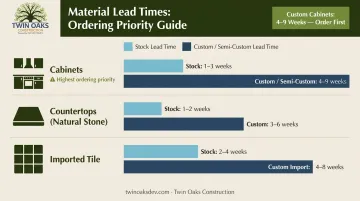
| Material | Stock Lead Time | Custom/Semi-Custom Lead Time |
|---|---|---|
| Cabinets | Days to 1 week | 4–9 weeks |
| Countertops (natural stone) | 2–4 weeks | 2–6 weeks (full project) |
| Imported tile | Variable | Variable (import-dependent) |
The TCNA's 2025 U.S. Ceramic Tile Market Update found that imports made up 72.4% of U.S. ceramic tile consumption in 2025. If your tile selection is imported, build in buffer for supply variability.
Permit Requirements in LA and Ventura Counties
In both jurisdictions, permits are required for work involving:
- Plumbing modifications or additions
- Electrical panel upgrades or new circuits
- Structural changes (load-bearing or non-load-bearing walls)
- Gas line modifications
Skipping permits carries serious consequences. The CSLB can assess civil penalties up to $8,000 per violation against contractors who fail to pull required permits. At the time of sale, unpermitted work must be disclosed under California DRE rules, and buyers — or their lenders — may require it to be corrected before closing.
Change Orders Mid-Construction
Any design change after demolition begins can cascade quickly. Common examples:
- Switching cabinet styles triggers revised drawings and a new lead-time window
- Adding an island after walls are open often requires permit revisions
- Changing an appliance model mid-project can force cabinet modifications
Every undecided item before demo becomes a potential delay during construction.
Common Kitchen Remodel Timeline Mistakes to Avoid
The clock starts before demolition. Many homeowners think the clock starts at demolition. In reality, the planning and permitting phase runs 4–8 weeks before a single wall comes down. Starting that phase late compresses everything that follows.
Locking in material selections too late. Even when a general contractor manages procurement, the homeowner's delayed choice — cabinet style, countertop material, appliance model — pushes back the entire ordering queue. Every undecided item is a bottleneck waiting to happen.
Changing scope once work has started. Mid-project scope changes are the most consistent cause of budget overruns and timeline extensions. Once walls are open, changes may require revised permits, re-sequenced trades, and new material orders. What seems like a small adjustment often adds 2–4 weeks to the schedule.
Avoiding these mistakes doesn't require a perfect plan — it requires an early one.
Tips to Keep Your Kitchen Remodel on Schedule
Most kitchen remodel delays are preventable. The common thread? Decisions made too late, materials ordered too slowly, and surprises that weren't anticipated. These five practices keep projects moving.
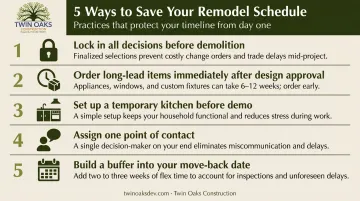
Lock in every decision before demolition starts. Finalize appliance models, cabinet style and dimensions, countertop material, backsplash, flooring, and all fixtures. Document everything in a specification sheet your contractor and all subcontractors can reference. Ambiguity on paper becomes delay in the field.
Order long-lead items as soon as design is approved. Prioritize in this order:
- Appliances (their dimensions drive cabinet layout)
- Custom or semi-custom cabinets
- Natural stone countertops or imported tile
If budget allows, place orders before permits are finalized to shrink the gap between permit approval and construction start.
Set up a temporary kitchen before demo begins. A microwave, mini-fridge, and temporary sink remove the pressure to rush completion. Rushing to finish without a functional kitchen leads to costly rework — mistakes that push your timeline back further.
Assign one point of contact on your end. When contractors receive conflicting instructions from multiple household decision-makers, work stops while everyone realigns. Designate one person to approve changes, sign off on decisions, and communicate with the project manager.
Build a buffer into your move-back date. Even well-run remodels encounter one or two unexpected days — a delayed appliance delivery, an inspection rescheduled by the city. Planning to move back into your kitchen one week after the projected completion date reduces stress and prevents pressure-driven shortcuts.
Frequently Asked Questions
How long does it take to remove and replace a kitchen?
Removing and replacing a kitchen takes 3–8 weeks for active construction alone, depending on whether the layout changes, what materials are used, and how complex the installation sequence is. This does not include pre-construction planning, permit processing, or material lead times.
What is the fastest a kitchen remodel can realistically be done?
Purely cosmetic updates — painting cabinets, replacing hardware, adding a backsplash, swapping appliances — can be completed in 2–3 weeks if all materials are on hand before work begins. Any structural or plumbing work extends this minimum significantly.
How long will I be without a functional kitchen during a remodel?
Most mid-range remodels keep the kitchen fully out of commission for 4–8 weeks during active construction. The total project timeline is longer, but that pre-construction phase happens before work begins on-site.
What causes most kitchen remodel delays?
The top three causes are late material orders (especially custom cabinets), mid-project design changes, and permit processing delays. Unexpected structural or plumbing issues discovered during demolition are also a frequent source of additional time.
Do kitchen remodels in Los Angeles require permits?
Yes. Most kitchen remodels in LA County require permits for work involving plumbing, gas lines, electrical, or structural modifications. Your contractor should be familiar with LADBS and Ventura County requirements to keep inspections on schedule.
How long does kitchen cabinet installation take?
Physical cabinet installation takes 3–5 days on-site. However, ordering, manufacturing, and delivering custom or semi-custom cabinets adds 4–9 weeks to the overall timeline, which is why cabinet orders need to be placed early in the planning phase.