Introduction
For homeowners in LA and Ventura Counties, the math on moving has become brutal. Larger homes in the same neighborhood often cost $200,000–$400,000 more than what you'd net from selling — before accounting for moving costs, closing fees, and higher mortgage rates. Meanwhile, families keep growing, remote work demands a dedicated office, and aging parents need a place nearby.
A second story addition over an existing garage addresses all three without a move. It converts the existing above-garage footprint into livable square footage without touching your yard, triggering lot-line complications, or requiring a new foundation.
But costs vary dramatically — from $25,000 for a basic bonus room to $230,000+ for a full ADU — and that range isn't arbitrary. Room type, structural condition, garage size, and LA/Ventura County permitting complexity all pull the final number in different directions. This guide breaks down every cost category so you can enter the planning process with accurate numbers.
Key Takeaways
- Cost ranges from $25,000 (basic bonus room) to $230,000+ (full ADU with kitchen, bath, and separate entrance)
- LA and Ventura County labor rates run 20–50% above national averages — a significant local cost factor
- Structural upgrades are the single biggest wildcard — budget $5,000–$30,000+ before finishes
- Plumbing alone runs $8,000–$35,000 if you're including a bathroom
- Budget a 15–20% contingency — LA and Ventura projects routinely hit unexpected costs
How Much Does a Second Story Addition Over a Garage Cost?
There's no single price for this project. A homeowner adding a simple office above a solid 2-car garage faces a fundamentally different scope than someone building a permitted ADU with a kitchen, bathroom, laundry hookups, and a separate entrance. Treating those as the same project is where budgets fall apart.
What makes LA and Ventura Counties particularly expensive: BLS occupational wage data shows LA-area construction laborers earn $29.00/hr versus $23.77/hr nationally, and carpenters earn $36.00/hr versus $29.77/hr nationally. That labor premium compounds across every phase of the project.
Here's how costs break down by room type:
Basic Bonus Room (No Plumbing)
Typical range: $25,000–$80,000 ($100–$200 per sq. ft.)
What's included: framing, insulation, drywall, flooring, windows, and a single-zone mini-split for climate control. No wet areas, no plumbing rough-in.
Best for: home offices, playrooms, gyms, or flex spaces. This tier offers the strongest value-to-complexity ratio — lower structural demands, simpler permits, and no plumbing coordination.
Bedroom Suite or Primary Suite
Typical range: $75,000–$150,000 ($200–$350 per sq. ft.)
Adding a bathroom changes everything. Plumbing rough-in alone runs $3,000–$20,000, and a full upstairs bathroom totals $8,000–$35,000 once you account for venting, fire-rated assemblies, and waterproofing.
Connecting new drains to the existing main stack often means opening walls in the main house. Electrical panel upgrades are also common at this tier, since new bathroom circuits frequently push older panels past capacity.
Best for: families adding a dedicated guest room, teen suite, or primary suite without displacing existing living space.
Full In-Law Suite or ADU
Typical range: $150,000–$230,000+ ($300–$500+ per sq. ft.)
This is a complete dwelling: kitchenette, full bathroom, laundry hookups, independent HVAC, and a separate entrance. It must comply with California ADU regulations and local zoning requirements in LA or Ventura County.
California's ADU law (strengthened by SB 13 and AB 2221) has made above-garage ADUs easier to permit and build. ADUs under 750 sq. ft. are exempt from impact fees, and local agencies must act within 60 days of a completed application. Research from the Terner Center at UC Berkeley found average ADU costs of $167,000 statewide and $148,000 in Los Angeles, though project type and scope vary widely.
Best for: housing aging parents, accommodating long-term guests, or generating rental income.
Key Factors That Affect the Cost of a Second Story Garage Addition
Square footage is only one variable. These structural and logistical factors shape the actual bottom line, and overlooking any of them is the most common cause of mid-project budget overruns.
Structural Condition of the Existing Garage
Most garages are engineered to support a roof, not the dead and live loads of a habitable floor above. That gap between the two standards requires a structural engineer to quantify before any design work begins.
Common interventions and their costs:
| Structural Work | Typical Cost Range |
|---|---|
| Structural engineer assessment | $344–$776 (full project fees up to $8,500) |
| Foundation underpinning | $10,000–$30,000 |
| Steel I-beam installation | $1,000–$20,000 total |
| Floor joist replacement | $4,000–$12,000 |
| Framing repairs/upgrades | $20–$60 per sq. ft. |
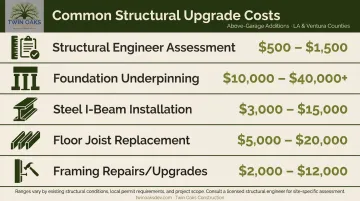
Replacing 2×4 studs with 2×6, installing steel beams across wide garage spans, and designing a stiff floor system to prevent bounce are non-negotiable when they're needed, and they add real cost before you spend a dollar on finishes.
Garage Size and Room Type
Footprint determines your square footage ceiling:
- 1-car garage: ~240 sq. ft.
- 2-car garage: ~360–500 sq. ft.
- 3-car garage: ~700+ sq. ft.
Smaller garages carry a higher cost-per-square-foot because fixed costs — stairs, windows, HVAC, permits — apply regardless of size. A staircase costs the same whether the space above is 240 sq. ft. or 500 sq. ft., so that fixed expense gets divided across fewer square feet on a 1-car garage.
Whether the room includes plumbing remains the single biggest price-shifting variable. A bathroom addition alone (rough-in, fixtures, venting, tile, and connecting to the main stack) can add $15,000–$35,000 to an otherwise straightforward project.
Location, Labor, and Permitting in LA and Ventura Counties
Southern California's labor market is a structural cost driver, not a minor budget footnote. The BLS wage gap between LA-area carpenters ($36.00/hr) and the national average ($29.77/hr) compounds across thousands of labor hours on a project of this size.
Permitting in both counties involves multiple review departments. Key components include:
- Structural, electrical, and mechanical reviews — each with separate sign-off requirements
- ADU projects — routed through a separate review track in both LA and Ventura Counties
- Ventura County fees — application fees plus plan review at 85% of the building permit fee, plus technology surcharges
- LADBS (LA) — uses a valuation-based calculator, so fees scale with project cost and scope
Permit fees across both counties typically range from a few hundred dollars for simpler projects to well over $2,500 for complex additions.
Non-negotiable: permitted work is the only work that's legal, insurable, and reflected in your home's appraised value.
Complete Cost Breakdown of a Second Story Garage Addition
A contractor quote typically covers labor and materials — but a complete project budget spans four distinct categories, each with its own cost range and timing.
Structural and foundation work:
- Engineer assessment, foundation reinforcement, wall framing upgrades, floor system design
- Range: $5,000–$30,000+ depending on existing conditions
Construction and finishing labor:
- Framing, roofing, siding, insulation, drywall, flooring, painting, windows
- Per NAHB's 2024 construction cost data, interior finishes represent roughly 24% of total cost, framing 16.6%, and major system rough-ins 19.2%
These proportions serve as useful benchmarks, though NAHB figures reflect new construction rather than additions specifically.
Systems and utilities:
- Mini-split HVAC (standard for above-garage spaces): $3,000–$8,000 installed for a single-zone system
- Electrical (new circuits, potential panel upgrade): varies by existing capacity
- Plumbing (if applicable): $8,000–$35,000 for a full bathroom upstairs
Professional and permit fees:
- Architect or designer: $2,400–$14,000
- Structural engineer: $344–$2,500+
- Building permits: varies by jurisdiction and valuation
- Post-construction inspection: $296–$424
Account for all four before signing a contract. Engineering, design, and permits are the categories most often skipped in early planning — and the ones that tend to generate the biggest budget surprises later.
Adding a Room Above a Garage vs. Other Space Solutions
Building above an existing garage has one significant financial advantage over a ground-floor addition: no new foundation. Foundation installation runs $4,000–$15,000 for basic slabs and significantly more for complex footings.
Structural reinforcement still offsets some of those savings, particularly when the existing garage foundation or framing is marginal.
How it compares to a detached ADU:
| Factor | Above-Garage Addition | Detached ADU |
|---|---|---|
| No new foundation needed | ✅ | ❌ |
| Privacy / separation | Limited | Full |
| Layout flexibility | Constrained by footprint | More flexible |
| Typical total cost | $150K–$230K+ (full ADU) | ~$180K average |
| Yard space impact | None | Yes |
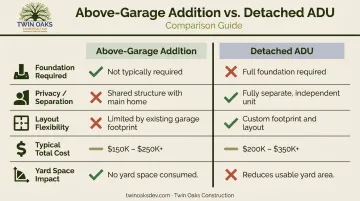
For LA and Ventura County homeowners on smaller lots — where carving out 400+ sq. ft. of yard space for a detached structure isn't realistic — building above the garage often represents the most practical path to meaningful square footage. Still, those prioritizing rental income or full tenant privacy may find a detached ADU worth the added complexity and cost.
How to Budget Wisely for a Second Story Garage Addition
Start with a Structural Assessment
No estimate is reliable until a structural engineer has looked at the existing garage walls, foundation, and floor spans. What they find sets the true cost baseline. Without that assessment, any number you get from a contractor is speculative — and probably low.
Build In a 15–20% Contingency
This buffer accounts for what demolition and construction routinely reveal: deteriorated framing, undersized electrical panels, foundation conditions that didn't show up on a visual inspection. The LA/Ventura market's project complexity makes this buffer more necessary, not less.
Match Room Type to Budget
If plumbing isn't essential to the project's purpose, don't add it. A well-finished bonus room or bedroom without a bathroom delivers strong livable square footage without the cost and complexity of a full suite. The JLC 2024 Cost vs. Value Report for Los Angeles puts the cost recouped on a midrange primary suite addition at 61.3% — solid, though actual returns vary by neighborhood and execution. Simpler rooms that serve a clear functional need often deliver comparable appraised value at a lower total cost.
Work with a Contractor Who Knows This Market
Those budget decisions only hold if the contractor executing the work knows this market. Permitting in LA and Ventura Counties isn't generic. The departments involved, the inspection sequence, the structural documentation required — these vary by jurisdiction and project type. A contractor without that specific experience adds time and cost through revisions and delays that an experienced local team avoids.
Twin Oaks Construction has handled room additions and ADU projects across both counties for over 20 years, including navigating the permitting, structural, and design coordination that makes these projects complex. If you're weighing options on a second story garage addition, the team at Twin Oaks can assess what your specific garage and property actually require — and give you a realistic number to plan around.
Frequently Asked Questions
How much does it cost to build a second story above a garage?
Costs range from $25,000 for a basic bonus room with no plumbing to $230,000+ for a full ADU with a kitchen, bathroom, and separate entrance. Room type and structural upgrades are the two primary variables that determine where your project lands in that range.
Is it cheaper to build a second story or a ground-floor addition?
Building above the garage avoids new foundation costs, which run $4,000–$15,000+ for a slab alone — making it often more cost-effective per square foot than a ground-floor addition. However, structural reinforcement on the existing garage can offset some of that savings depending on current conditions.
Can you add a second story to an existing garage?
Most garages can support a second story, but structural reinforcement is almost always required. A structural engineer must evaluate the foundation, wall framing, and floor system capacity before design work begins — this step cannot be skipped.
Do I need a structural engineer for a second story garage addition?
Yes — for two reasons. First, it's required for permit approval in both LA and Ventura Counties. Second, garages are not designed to carry habitable loads above, and engineering plans define the required upgrades — without them, permitting isn't possible and cost estimates are unreliable.
How long does it take to build a second story above a garage?
Expect 4–9 months from design through construction completion. A basic bonus room at the lower end; a full ADU at the higher end. California law requires local agencies to review completed ADU applications within 60 days, but design development and permitting preparation add to that window before the review period begins.
Does adding a room above a garage increase home value?
Yes — adding livable square footage is a proven driver of appraised value. The JLC 2024 Cost vs. Value Report for LA shows a midrange primary suite addition recoups approximately 61.3% of project cost in resale value. ADUs also offer rental income potential that factors into overall property value separate from standard appraisal.