Introduction
You love your neighborhood, your kids' school district, the coffee shop two blocks away. But you've outgrown your home. Building up — adding a second story — is often the option homeowners overlook.
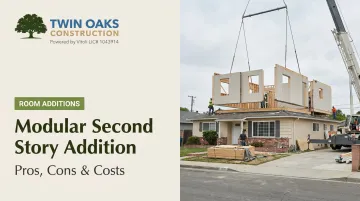
A modular second story addition offers LA and Ventura County homeowners a way to nearly double their living space without losing their yard, their zip code, or their sanity during construction. A new second floor is built in a factory, shipped to your property, and set by crane — often in a single day.
"Faster and less disruptive" doesn't automatically mean "cheaper" in Southern California. According to Angi's 2026 Los Angeles data, full second-story additions in LA average $681,600, with complex projects reaching $1,000 per square foot.
Modular construction can improve cost predictability and compress timelines. It doesn't, however, eliminate the structural, permitting, and seismic challenges that drive costs in this market.
This guide covers how modular second-story additions work, what they actually cost in LA and Ventura Counties, and the honest trade-offs you need to weigh before committing.
Key Takeaways
- Modular second-story additions are factory-built and crane-set, offering faster timelines and more predictable costs than stick-built
- A structural assessment must come first — your foundation and framing must support the added load before any design begins
- Factory module costs run $100–$200 per square foot; total LA-area project costs often reach $500,000 to over $1,000,000
- Southern California's seismic requirements, permitting complexity, and labor rates push costs to the higher end nationally
- Local code expertise — especially for seismic and zoning compliance — directly affects whether your project gets approved and stays on budget
What Is a Modular Second Story Addition?
Instead of framing a new floor piece by piece on your property, modular construction moves roughly 80–90% of the work into a climate-controlled factory. Pre-built sections — called modules — are constructed off-site, trucked to your home, and lifted into place by crane.
The result looks identical to traditional construction once complete — and per NAHB guidelines, modular units must meet the same state and local building codes as site-built homes — not a separate, lower standard.
Modular vs. Stick-Built: The Core Difference
In traditional stick-built construction, every piece of framing goes up on your property, exposed to weather and scheduling gaps. Modular construction reverses that entirely:
| Factor | Modular | Stick-Built |
|---|---|---|
| Where work happens | 80–90% in factory | 100% on-site |
| Weather exposure | Minimal | Significant |
| Schedule predictability | Higher | More variable |
| Mid-build changes | Not possible after production starts | Possible, with cost impact |
| Timeline | Often ~half of stick-built | Longer on-site phase |
One common misconception: modular means lower quality. In practice, modular units must be engineered to survive transportation and crane installation — requirements that often make them structurally stronger than typical site-framed construction.
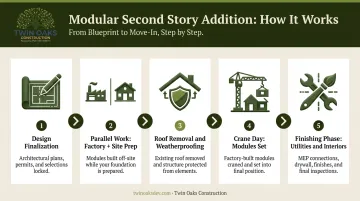
From Factory to Your Roof: The Process
Understanding the sequence helps set realistic expectations for your project timeline:
- Design finalization — Floor plan, finishes, and structural details locked in before factory production begins
- Parallel work — Factory builds the modules while your site is prepped simultaneously
- Roof removal — Existing roof comes off; temporary weatherproofing goes on
- Crane day — Modules are lifted and set in hours, not weeks
- Finishing phase — Utility connections (HVAC, electrical, plumbing), interior finishes, and exterior blending completed on-site
Key Benefits of a Modular Second Story Addition
Speed and Reduced Exposure
The biggest practical advantage is time — specifically, the amount of time your home sits with the roof off. In stick-built construction, that exposure window stretches over weeks. With modular, crane day takes hours and the structure is weather-tight within 1–2 days of installation.
Because factory production and site preparation happen simultaneously, the overall project typically takes roughly half the time of a comparable stick-built addition — a real difference for families temporarily displaced during construction.
Cost Predictability (With Caveats)
Modular locks in material and labor costs at the factory stage before production begins. A McKinsey analysis of modular construction found it can reduce costs by up to 20% and accelerate schedules by 20–50% in suitable projects — though those figures reflect broad construction data, not a controlled study of residential second-story additions specifically.
What's well-supported: the factory portion of your budget is predictable. The variable costs in LA and Ventura County come from site work — structural reinforcement, seismic upgrades, permitting, crane logistics, and utility tie-ins. Those don't disappear with modular construction.
Customization Options
Modular doesn't mean cookie-cutter. Homeowners typically choose from:
- Primary bedroom suites with private bathrooms
- Additional bedrooms for growing families
- Home offices or dedicated flex space
- Bonus rooms or media rooms
- Custom window placement and roofline details
The design phase allows for real architectural integration — matching siding, rooflines, and exterior finishes to the existing structure. Twin Oaks Construction handles this coordination across LA and Ventura Counties, ensuring the addition reads as original rather than tacked on.
Preserved Yard Space and Long-Term Value
A second story adds significant square footage without consuming any yard. On smaller LA lots where a ground-level build-out simply isn't an option, that's often the deciding factor.
That said, going up instead of out doesn't automatically translate to resale returns. The 2025 Zonda/JLC Cost vs. Value Report for Los Angeles shows a midrange primary suite addition recoups roughly 31.9% of its cost at resale. The stronger case is for homeowners planning to stay 5+ years — the payoff is in livability, not guaranteed profit at closing.
What Does a Modular Second Story Addition Cost?
Baseline vs. All-In: Understanding the Gap
The factory-built module itself typically runs $100–$200 per square foot, covering framing, insulation, windows, and standard finishes. That number sounds manageable until you add everything else.
In LA and Ventura Counties, the all-in project cost for a modular second story addition ranges from $500,000 to over $1,000,000 depending on scope, structural complexity, and finish level.
Cost Breakdown: What You're Actually Paying For
Beyond the module cost, expect to budget for:
- Structural engineering assessment — Typically $344–$776 for basic assessments; complex second-story engineering runs higher
- Foundation and framing reinforcement — Highly variable; foundation repair nationally averages $5,176 with a range of $2,225–$8,135, but second-story structural work can exceed this significantly
- Roof removal and temporary weatherproofing — Required before modules are set
- Building permits — City of LA fees are valuation-based; plan check alone equals 90% of the building permit fee
- Crane rental — Roughly $300–$1,500 per hour depending on crane class and duration
- Utility connections — HVAC, electrical, and plumbing integration on-site
- Contractor and labor fees — For site prep, finishing, and project management
- Contingency — Budget 10–20% above your total estimate for surprises
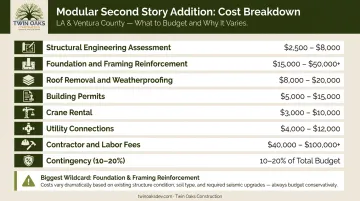
The single biggest wildcard is structural reinforcement. If your existing foundation or framing needs upgrades before the second story can be supported, those costs can substantially change your total budget.
What Costs Look Like in LA and Ventura Counties
Those cost variables hit harder in Southern California than almost anywhere else in the country. Regional factors driving up project totals include:
- Seismic code requirements — California's building standards require additional engineering for lateral loads
- High labor rates — Union and skilled trade wages in LA are well above national averages
- Complex permitting — Multiple layers of review, especially in HPOZ zones, hillside areas, and coastal zones
For context: Angi benchmarks show LA second-story additions averaging $198,800 for partial additions, with full second stories averaging $681,600 — and costs reaching $160–$600 per square foot depending on complexity. Modular's efficiency advantage doesn't erase these regional cost drivers; it primarily reduces costs on the factory-built portion, not the site work.
Adding just a primary suite or two bedrooms costs less overall than a full second floor, though the per-square-foot cost tends to stay similar either way. Scope, more than anything else, determines your final number.
Challenges and Cons to Know Before You Build
Structural Feasibility Is the First Gate
Your home was designed to support one story. Before a single design decision is made, a licensed structural engineer must confirm whether your existing foundation and framing can carry the added load.
If they can't, you're looking at reinforcement — which adds cost and time. In some cases, the existing structure may make any second story impractical. This assessment should happen before you invest in designs or contractor quotes.
Crane and Site Access Requirements
Modular installation requires a large crane and delivery truck. Common obstacles in older LA neighborhoods include:
- Overhead power lines requiring temporary relocation
- Narrow streets that restrict crane positioning
- Trees, fencing, or neighboring structures limiting swing radius
- Long or angled driveways that complicate module delivery
Evaluate site access during the planning phase — not after you've signed a contract.
Zoning, Permits, and Local Regulations
A modular second story isn't exempt from local rules. In the City of LA, R1 zones cap building height at 33 feet (for roofs with 25%+ slope) and require specific front, side, and rear yard setbacks. HOA rules and HPOZ overlays add another layer of review.
Requirements vary by city and county across the LA/Ventura region. A contractor who already knows the local permitting landscape will avoid the delays and rework that come from learning it on your project — saving weeks, sometimes months, off your timeline.
Design Must Be Finalized Before Production Starts
Unlike stick-built framing, where a carpenter can adjust a wall mid-build, modular construction locks in the design before factory production begins. Changes after that point aren't possible. That constraint extends downward, too: your first-floor load-bearing wall layout directly limits where walls can be placed on the second level.
Plan to spend more time in the design phase than you might expect — decisions made early here can't be revisited once production starts.
Modular Second Story vs. Building Out: Which Makes More Sense?
Building up and building out solve the same problem differently. Here's how they compare:
| Factor | Build Up (Second Story) | Build Out (Ground Addition) |
|---|---|---|
| Yard impact | None — footprint preserved | Consumes yard equal to addition size |
| Cost per sq ft (LA) | $160–$600+ | $80–$200 nationally |
| Foundation required | No new foundation needed | New slab or foundation required |
| Best for | Small lots, valued outdoor space | Larger lots with room to expand |
| Structural complexity | Higher — existing structure must support load | Lower — new foundation starts fresh |
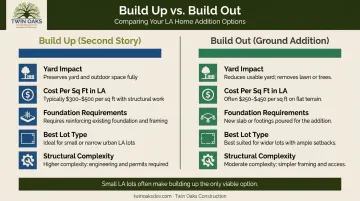
For most homeowners in LA with smaller lots, setback constraints, or yard they want to preserve, building up is the only realistic path to meaningful square footage gains.
Alternatives Worth Considering First
Before committing to a full second story, evaluate these lower-cost options:
- ADU construction — Can add a self-contained unit, often with rental income potential
- Garage conversion — Lower cost, no new foundation, good for a home office or guest suite
- Attic finishing — Works if headroom and framing allow; significantly less expensive than a full second story
Twin Oaks Construction handles both ADU construction and garage conversions, including full permitting support — a practical starting point if a full second story is more than your project requires.
Building up makes the most sense when your lot is small, your structural requirements are manageable, and you plan to stay in the home for 5+ years.
Getting Started: Planning Your Modular Second Story Addition in LA or Ventura County
Step 1: Structural Assessment — Before Anything Else
Don't start with contractor quotes or design consultations. Start with a licensed structural engineer who can assess whether your existing foundation, framing, and load path can support a second story. This assessment typically costs $344–$776 for standard work, though complex second-story evaluations may run higher. It's the only way to know if the project is feasible before spending real money on design.
Step 2: Check Zoning Before You Design
Before investing in floor plans, verify:
- Height limits for your specific zone (R1 vs. hillside vs. coastal)
- Front, side, and rear setback requirements
- HOA architectural restrictions if applicable
- HPOZ overlay requirements if your neighborhood qualifies
Requirements vary significantly across LA and Ventura County jurisdictions.
Step 3: Find the Right Contractor
That zoning complexity is exactly why contractor experience matters here. Look for a contractor who brings:
- Demonstrated experience with second-story additions specifically
- Working knowledge of LA and Ventura County permitting and seismic requirements
- Full project management from structural coordination through final finishing
- Crane logistics experience and established subcontractor relationships
Twin Oaks Construction has handled room additions across LA and Ventura Counties for over 20 years, with a design-build approach that covers structural coordination, permitting support, and finish work under one roof.
To schedule a free consultation, call (833) 621-7251 or visit twinoaksdev.com/contact.
Step 4: Get an Itemized Quote
When comparing contractors, insist on quotes that separate:
- Module cost (factory-built unit)
- Structural engineering and reinforcement
- Permitting and plan check fees
- Crane rental and installation
- Utility connections
- Finishing labor and materials
- Contingency (10–20%)
A single lump-sum number makes it impossible to compare bids or understand where your money is going.
Frequently Asked Questions
Can you add a second story to a modular home?
Yes — a second story can be added to an existing modular home, but it requires the same structural assessment as adding to any home. The existing modules must be rated to support the additional load, and a structural engineer should confirm feasibility before any design work begins.
How much does a modular second story addition cost?
The factory-built module typically starts at $100–$200 per square foot, but total project costs — including structural work, permits, crane, site prep, and finishing — commonly run $500,000 to over $1,000,000 in high-cost markets like LA and Ventura Counties.
Is it cheaper to add a second story or build out?
Ground-level additions generally cost less per square foot ($80–$200 nationally vs. $160–$600+ for a second story in LA). However, building out requires new foundation work and consumes yard space. On small LA lots with tight setbacks, building up is often the only practical option.
How long does a modular second story addition take?
Design and permitting typically take 2–4 months. Factory production and site prep happen simultaneously, crane installation completes in 1–2 days, and finishing adds several more weeks. Total timelines typically run half that of a comparable stick-built addition.
Do I need to move out during a modular second story addition?
Temporary relocation is generally required during at least the roof removal and crane installation phases for safety. The displacement window is shorter than with traditional construction, but budget for temporary housing during the critical installation period.
What rooms can a modular second story addition include?
Common configurations include a primary bedroom suite, additional bedrooms, a second bathroom, a home office, or a bonus flex room — and most combinations of the above are possible within a single addition.