
The biggest mistake most homeowners make isn't choosing the wrong tile or underestimating square footage. It's jumping into demolition, or signing with the first contractor they meet, before they have a real plan. That sequence reversal costs time, money, and a lot of unnecessary stress.
This guide covers everything you need to start smart: what a whole-house remodel actually involves, what it costs in the LA and Ventura County market, how to plan it step by step, the correct order of construction work, and how to find the right contractor for the job.
Key Takeaways
- A whole-house remodel covers structural, systems, and cosmetic work — not just surface updates
- In LA and Ventura Counties, costs run well above national averages — local labor rates and permit requirements drive that gap
- Planning, budgeting, and hiring a contractor all come before demolition starts
- Construction follows a fixed sequence — structural and systems work always precedes cosmetic finishes
- An experienced local contractor prevents costly surprises and keeps your project on schedule
What Is a Whole House Remodel?
A whole-house remodel is a comprehensive renovation that addresses most or all of a home's interior — and often the exterior. It goes well beyond cosmetic updates. According to NAHB's remodeling guidance, scope typically includes adding or reconfiguring space, upgrading fixtures, replacing windows and doors, and upgrading heating, cooling, and insulation systems.
That's distinct from a single-room refresh or a cosmetic update like painting and new hardware.
Whole-House Remodel vs. Gut Renovation
These terms get used interchangeably — they're related, but meaningfully different in scope and cost.
- Whole-house remodel: Renovates most or all of the home, but some existing structures may remain intact
- Gut renovation: Takes the home down to the studs — interior walls, doors, trim, cabinets, and fixtures are all removed, exposing the full structure
Sweeten defines a gut renovation as one that may also involve replacing the roof, windows, and exterior doors, and often consulting a structural engineer to move load-bearing walls. The distinction matters for budgeting and timeline: a gut renovation is more expensive and takes longer, but gives you more control over the final result.
Who Benefits Most From a Whole-House Remodel?
- Homeowners building their forever home who want systems, layout, and finishes done once and done well
- Families in a desirable neighborhood whose home needs major functional updates
- Buyers of fixer-upper properties who purchased below market value in exchange for needed work
- Homeowners combining a room addition or ADU with other planned upgrades, since bundling the work saves significantly compared to phasing it over years
How Much Does a Whole House Remodel Cost?
Cost is where most planning goes sideways. People anchor on national averages that don't apply to the California market.
National vs. LA Market Ranges
| Geography | Cost Per Square Foot | Notes |
|---|---|---|
| National (standard) | $15–$60/sq ft | General renovation baseline |
| National (high-end) | $150+/sq ft | Custom finishes and extensive work |
| Los Angeles (full home) | $125–$500+/sq ft | LA-specific, per Sweeten 2025 |
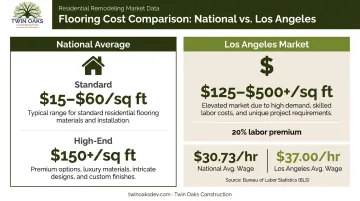
The gap between national and LA figures is real. BLS data shows construction and extraction workers in the LA metro earned a mean hourly wage of $37.00 versus $30.73 nationally in May 2024 — a 20% labor premium that pushes project costs higher.
Room-by-Room Cost Ranges
The national figures below from HomeAdvisor are planning baselines — LA market numbers run higher across every category:
- Kitchen: $14,500–$40,500 (national); LA budget kitchens start near $28,000, high-end near $85,000
- Bathrooms: $6,500–$28,000 (national)
- Living room: $5,000–$10,000 (national)
- Bedrooms: $1,500–$5,500 (national)
Kitchens and bathrooms consume the largest portion of a whole-house budget — plumbing, electrical, fixtures, and custom cabinetry concentrate costs in those two rooms.
Major Cost Drivers
- Home size and total square footage
- Extent of structural work (moving walls, replacing subfloors, beam work)
- Electrical and plumbing system upgrades
- Material and finish selections — the single biggest variable in budget swings
- Custom cabinetry or built-ins
- Permit and inspection fees
Budget for the Unexpected
NARI recommends building in a 10%–20% contingency for surprises that only appear once walls are opened — outdated wiring, mold, structural issues, failed plumbing. Treat it as a fixed line item, not a buffer you hope not to use.
The 2024 Houzz & Home Study found that 39% of renovating homeowners exceeded their initial budget, with project complexity and unexpected costs among the primary causes.
Financing Options
- Cash savings (avoids interest costs)
- Home Equity Line of Credit (HELOC)
- Construction loans (draw-based, releasing funds as work progresses)
- Renovation-specific financing programs
Talk to your lender before finalizing scope. In LA, HELOC limits are tied to your current equity position — knowing that ceiling early prevents committing to a scope you can't fund.
Where to Start: Your Step-by-Step Planning Checklist
Step 1: Clarify Your Goals
Before anything else, answer one question: are you remodeling for yourself or for resale?
These two goals lead to genuinely different decisions. A forever-home remodel prioritizes your personal preferences — the kitchen layout you've always wanted, the bathroom that fits how you actually live. A resale-focused remodel prioritizes cost-effective improvements with strong return on investment.
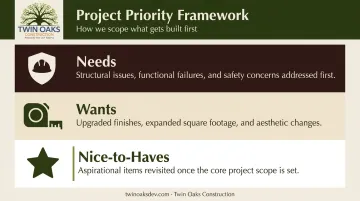
Write down every problem with your current home and every must-have for the remodeled version. Separating needs from wants early prevents scope creep later. A quick framework:
- Needs: Problems that must be solved (structural issues, functional failures, safety concerns)
- Wants: Improvements you'd make if budget allows (upgraded finishes, expanded square footage, aesthetic changes)
- Nice-to-haves: Aspirational items to revisit after core scope is set
Determine Your Design Vision
With your goals clarified, gather inspiration before your first contractor conversation — photos, layout ideas, design boards. This is also the right moment to think big.
Moving walls, reconfiguring floor plans, adding a room, or incorporating an ADU is far more cost-effective when planned upfront as part of a whole-house remodel than when tackled as separate projects later. Decide what's non-negotiable versus what you'd like if budget allows. That distinction guides every conversation from here forward.
Set a Realistic Budget
Online calculators give you a ballpark, not a working budget. A realistic budget comes from actual contractor estimates — and getting multiple estimates before finalizing scope is non-negotiable.
Your budget should include:
- Design and architecture fees
- Construction costs
- Permits and inspections
- Materials and finishes
- Temporary housing (if you'll need to vacate during construction)
- 10%–20% contingency
Select Your Designer or Design-Build Firm
Hire your designer or design-build firm before you hire a general contractor — ideally before you've finalized scope.
Two primary models exist:
- Standalone designer + GC: You sign two separate contracts and manage the relationship between them. More handoff points means more potential for miscommunication and cost surprises during construction.
- Design-build firm: Design and construction run under a single contract and one point of accountability. Cost estimates are integrated throughout the design process, so what you approve is closer to what you pay.
Twin Oaks Construction operates as a design-build firm, providing in-house architecture and design services alongside construction — handling projects from concept through completion across LA and Ventura Counties. Research from the Design-Build Institute of America found that design-build delivered projects significantly faster and with less cost growth than traditional design-bid-build approaches.
Secure Permits Before Construction Begins
In California, permits aren't optional. California Residential Code Section R105.1 requires permits for construction, alterations, demolition, and for installing or replacing electrical, gas, mechanical, and plumbing systems. LADBS confirms that building, electrical, plumbing, and mechanical/HVAC permits are all required for the corresponding work in the City of Los Angeles.
Plan for permit review time before scheduling construction:
- Ventura County: 4–5 weeks for new submittals, 2–3 weeks for resubmittals
- City of Ventura: 21 business days for electronic plan review
- City of Los Angeles: Regular plan check returned "within weeks" depending on workload; expedited review available for an additional fee
A qualified contractor handles permit applications as part of the project. Skipping permits creates legal liability and can complicate — or block — a future home sale. The California CSLB is explicit: failure to pull required permits exposes homeowners to additional liability and costs.
The Right Order of Work During a Whole House Remodel
The sequence of construction work isn't a preference — it's a code-required and logistically necessary order. Jumping ahead causes expensive rework.
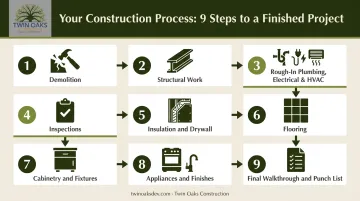
The Construction Sequence
- Demolition and debris removal — tear out what's being replaced, haul it away
- Structural work — walls, beams, subfloors; all layout changes happen here
- Rough-in of plumbing, electrical, and HVAC — the invisible infrastructure that determines how the home functions
- Inspections — required before walls are closed; no shortcuts
- Insulation and drywall
- Flooring
- Cabinetry and fixtures
- Appliances and finishes
- Final walkthrough and punch list
Why the Systems Phase Is the Most Important
The structural and systems phase is where layout changes happen and where all the infrastructure that determines how your home functions for decades gets installed.
Electrical panels, plumbing lines, and HVAC ductwork are invisible once the walls close — but they determine how livable the space actually is.
Cutting corners here, or using unqualified workers on rough-in work, produces the most costly long-term problems. This is not the phase to optimize for the cheapest bid.
Cosmetic Finishes: Where Homeowners See the Impact
Flooring, cabinetry, countertops, lighting, and paint are where your design vision becomes visible. One practical note: select all finishes early in the planning process. Supply chain delays on custom cabinetry or specialty tile can stall an entire project mid-construction while everything else waits.
The Final Walkthrough and Punch List
Before making final payment, complete a thorough walkthrough with your contractor. A punch list documents every incomplete or incorrect item — a scratched fixture, a door that doesn't close flush, grout that needs touching up. Nothing is too small to note.
The punch list is your contractual protection. Don't release final payment until every item on it is resolved.
How to Choose the Right Contractor for Your Whole House Remodel
The cheapest bid is rarely the right choice. A contractor who under-bids to win the job often makes up the difference through change orders, delayed schedules, or compromised materials.
What to Look for in a Contractor
- Valid California contractor's license — verify directly at cslb.ca.gov
- General liability and workers' compensation insurance — request a certificate before signing anything
- Proven experience with whole-house remodels — single-room experience doesn't automatically translate to managing a multi-month, multi-trade project
- Local references from similar-scale projects — ask for them and actually call
- Clear communication — if responses are slow or vague before the contract is signed, expect the same during construction
The Vetting Process
Before you commit:
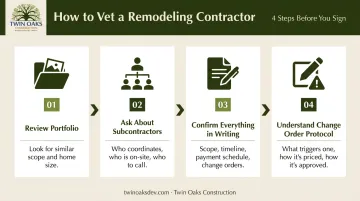
- Review the portfolio — look for completed projects similar in scope and home size to yours
- Ask how they manage subcontractors — who coordinates scheduling, who's on-site daily, who do you call if there's an issue
- Confirm all agreements are in writing: scope, timeline, payment schedule, and change order protocol
- Understand exactly how change orders work — what triggers one, how it's priced, and how it's approved
Everything should be in a signed contract before work begins. Verbal commitments don't hold up.
Working With Twin Oaks Construction
If you're vetting contractors in LA or Ventura Counties, Twin Oaks Construction is worth a close look. With over 20 years of experience in whole-house remodeling, kitchen and bathroom renovations, room additions, and ADU construction, they operate as a design-build firm — meaning one team handles the project from initial plans through final finishes.
That structure matters for a whole-house remodel. Fewer handoffs between design and construction means fewer gaps in communication and fewer surprises on-site.
To start planning your remodel, contact Twin Oaks Construction at (833) 621-7251 or request a free consultation at twinoaksdev.com/contact.
Frequently Asked Questions
Is $300,000 enough to renovate a house?
For many mid-size homes at a mid-range finish level, $300,000 can fund a comprehensive whole-house remodel. It may fall short for large homes, luxury finishes, or properties requiring significant structural work. In the LA and Ventura County market, where costs run $125–$500+ per square foot, that budget goes less far than in lower-cost regions.
What comes first in a whole house remodel?
Planning, budgeting, and hiring a contractor all come before physical work begins. Once construction starts, the sequence runs: demolition → structural work → plumbing, electrical, and HVAC rough-ins → inspections → insulation, drywall, and finishes.
How long does a whole house remodel take?
Angi reports whole-house renovations typically take 2–8 months; major structural changes or additions can push past a year. In California, permitting adds lead time — Ventura County's regular plan review alone runs 4–5 weeks.
Is it cheaper to renovate a house than to build new?
Generally yes — a gut renovation typically costs 20%–50% less than a full teardown and rebuild, according to NerdWallet. Homes with severe foundation, structural, or systems issues can close that gap significantly.
What is the most expensive part of a whole house remodel?
Kitchens and bathrooms consistently drive the highest costs due to the concentration of plumbing, electrical, and fixture work. Structural changes and full system replacements — electrical panel upgrades, new HVAC, complete replumbing — are also major cost drivers.
Do I need permits for a whole house remodel in California?
Yes. California law requires permits for structural work, electrical, plumbing, HVAC, and any additions. Skipping permits creates legal liability and can block a future home sale. A licensed contractor pulls all required permits as part of the project.