Introduction
Bathroom falls are among the most serious injury risks facing older adults at home. According to peer-reviewed research published in PMC, 17.3% of all injurious indoor falls occur in the bathroom — and bathroom falls are more than twice as likely to cause injury compared to falls in the living room. For context, falls caused roughly 3 million emergency department visits among adults 65 and older in 2021 alone.
Those numbers make a strong case for redesigning your bathroom — but the good news is it doesn't have to feel clinical. A senior-friendly remodel is a thoughtful redesign grounded in universal design principles: the idea that spaces built for a wide range of abilities work better for everyone. The result looks intentional and stylish, not medical.
This guide covers everything LA and Ventura County homeowners need to know — the specific modifications that matter most, realistic costs, how to phase the work, and how to keep it all looking beautiful.
Key Takeaways
- Grab bars and non-slip flooring are the highest-priority, lowest-cost first modifications
- Curbless showers eliminate the single highest fall-risk fixture in most homes
- Comfort-height toilets and lever fixtures reduce physical strain without looking institutional
- A senior-friendly remodel directly supports the 75% of adults 50+ who want to age in their own homes — at a fraction of assisted living costs
- A phased approach lets homeowners start with safety essentials now and plan structural changes later
Why Seniors Need a Dedicated Bathroom Remodel
The Physical Changes That Make Standard Bathrooms Dangerous
Three age-related changes turn an ordinary bathroom into a hazard:
- Reduced balance and muscle strength : wet floors and high tub entries demand stability most older adults no longer have
- Decreased vision : poor lighting and shiny reflective surfaces make depth and edges harder to judge
- Slower reaction times : a slip that a younger person recovers from instinctively becomes a fall
These changes don't happen overnight, which is why most bathrooms go unmodified until after an incident occurs.
The Financial Case for Aging in Place
AARP's 2024 survey found 75% of adults 50+ want to remain in their homes, and **72% of those planning modifications expect bathroom changes** like grab bars or non-slip tile. The numbers make a strong financial argument for acting proactively.
| Option | Cost |
|---|---|
| National median assisted living | $6,200/month ($74,400/year) |
| Accessible bathroom remodel (national average) | $8,400 one-time |
| Full senior bathroom remodel range | $2,700–$16,000 |
A well-executed remodel can delay or eliminate the need for assisted care — often recovering its full cost within the first year compared to monthly facility fees.
Start with a Phased Approach
Not every modification needs to happen at once. A practical sequence:
- Phase 1 (immediate, low cost): Grab bars, non-slip flooring, improved lighting, comfort-height toilet
- Phase 2 (planned, structural): Curbless shower conversion, doorway widening, vanity reconfiguration
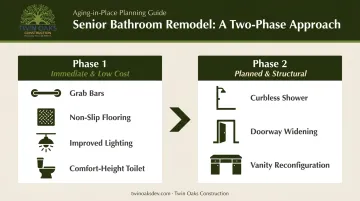
Starting with Phase 1 protects the homeowner now while Phase 2 gets budgeted and planned properly.
Core Safety Features Every Senior Bathroom Needs
Grab Bars
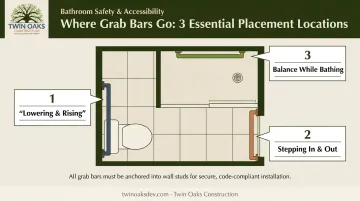
Grab bars are the single most impactful modification — but only when installed correctly. They must be anchored into wall studs or solid blocking, never into drywall alone. ADA standards require grab bars to withstand 250 lbs of force; quality brands like Delta and Moen rate their decorative bars at 500 lbs, twice that threshold.
Three essential placement locations:
- Beside the toilet — for lowering and rising
- At the shower entry — for stepping in and out
- Along the shower wall — for balance while bathing
Delta, Moen, and Kohler all offer decorative grab bars in brushed nickel, matte black, and oil-rubbed bronze — finishes that match standard bathroom hardware without looking institutional.
Comfort-Height Toilet
Standard toilets typically sit under 17 inches from floor to seat. Comfort-height (also called chair-height) models raise that to 17–19 inches, requiring significantly less leg and core strength to use safely.
Not ready to replace the toilet? A raised toilet seat or safety frame with armrests is a lower-cost interim option that installs in minutes and costs a fraction of a full replacement.
Lever-Style Fixtures and Doorway Hardware
Round knobs require grip-and-rotation — a motion that's genuinely difficult for anyone with arthritis or reduced hand strength. Lever-style handles on faucets, cabinet hardware, and doors solve this immediately and are ADA-compliant.
Doorway width guidance:
- 32 inches clear minimum for walker users (typically requires a 36-inch door)
- 36+ inches clear for wheelchair users
If your bathroom doorway is narrower than 32 inches, widening it belongs in Phase 2 planning.
Non-Slip Flooring
For wet bathroom floors, tile selection matters more than most homeowners realize. Key points:
- Avoid large-format polished or glossy tile — visually appealing, genuinely slippery when wet
- Choose matte, textured, or mosaic tile — more grout lines mean more grip surface
- Look for products meeting ANSI A137.1 wet DCOF standards for level interior wet spaces
- Eliminate loose bath rugs — they're a trip hazard; replace with rubber-backed non-slip mats
Lighting Upgrades
Aging eyes need significantly more light than younger ones — and take longer to adjust to darkness. A layered lighting approach addresses both:
- Overhead: LED recessed cans for bright, even illumination
- Vanity: Lighted mirrors eliminate facial shadows and dark corners
- Floor level: Motion-activated LED strips for safe nighttime navigation without finding a light switch
Motion-activated floor lighting is especially worth prioritizing. A middle-of-the-night trip to the bathroom — on dark tile, without glasses — is one of the most common fall scenarios. Eliminating that fumble for the light switch removes a real risk.
Shower Modifications: Curbless, Walk-In, and Accessible Options
The standard bathtub is the highest fall-risk fixture in most homes. Stepping 12–20 inches over a wet tub wall while fatigued is genuinely dangerous for anyone with reduced strength or balance. Here's how to address it.
Curbless (Zero-Threshold) Shower Conversion
A curbless shower keeps the floor completely level from bathroom into shower — no step, no threshold. The floor slopes gently toward a linear drain at ¼ inch per foot, which is both the ADA-referenced maximum slope and the standard plumbing code requirement.
Minimum recommended dimensions:
| Use Case | Dimensions |
|---|---|
| Seated/transfer shower | 36 × 36 inches |
| Walk-in with bench | 36 × 60 inches |
| Wheelchair roll-in access | 60 × 30 inches minimum (ADA) |
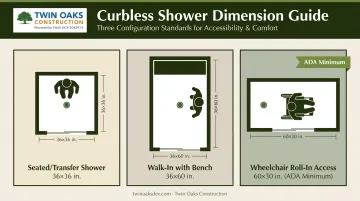
Done correctly, a curbless shower looks like a high-end design choice. Done incorrectly — with inadequate slope or poor drain placement — it creates pooling water and a new trip hazard. Proper waterproofing and slope execution demand contractor experience — poor execution on either creates the very hazards you're trying to eliminate.
For seniors who still want a soaking bath, a walk-in tub offers a different path.
Walk-In Tub as an Alternative
Walk-in tubs are worth considering for seniors who want to preserve a soaking bath. They feature a watertight door and a dramatically lower step-in height — some Kohler models advertise a 3-inch step-in versus the standard tub's 15–20 inches.
Key trade-offs to evaluate:
- Fill/drain time can leave the bather sitting in cooling water
- Scald prevention valves are essential — look for thermostatic controls and anti-scald stops
- Heated seats (available on premium models) address the cooling problem
Installed cost range: $4,000–$22,100, with an average around $13,100. Premium models with hydrotherapy features reach the higher end.
Shower Bench, Handheld Showerhead, and Thermostatic Valve
Three fixtures complete an accessible shower:
- Fold-down or built-in bench at 17–18 inches height for seated bathing
- Handheld showerhead on an adjustable slide bar — works for users standing or seated
- Thermostatic valve that locks in a set water temperature
That last item isn't optional for seniors. CDC data shows adults 65+ averaged 8,620 emergency department visits annually for nonfatal scald burns, and reduced temperature sensitivity makes accidental scalding a genuine risk. A thermostatic valve, combined with a water heater set below 120°F, closes that gap.
Flooring, Lighting, and Accessible Storage
Vanity and Counter Accessibility
Counter height for seated or wheelchair access should fall in the 30–34 inch range, with open knee space beneath the sink. Pull-out drawers outperform deep base cabinets — they eliminate the need to bend and reach. Eye-level shelving for daily-use items reduces overhead stretching.
Keep frequently used items between hip and shoulder height. Both overhead reaching and floor-level bending are common causes of balance loss in the bathroom.
Low-Maintenance Materials
The right material choices dramatically reduce cleaning effort — a practical win for seniors managing independently.
- Non-porous, stain-resistant tile and wall surrounds resist mold without scrubbing
- Anti-clog handheld showerheads simplify maintenance
- Frameless shower glass avoids the track cleaning that framed doors require
Less physical effort during upkeep means fewer awkward positions, and fewer opportunities for falls.
Making It Look Beautiful, Not Institutional
The most common objection to accessibility modifications: "I don't want my bathroom looking like a hospital room." Universal design addresses this head-on — these features look intentional because they are.
NAR reported in 2025 that 41% of remodeling professionals saw homeowners prioritizing accessibility modifications, with curbless showers, additional lighting, and built-in seating among the top requested features. The aesthetic is already mainstream — what was once considered a concession is now a design preference.
Specific finish choices that blend safety with style:
- Decorative grab bars in brushed nickel, matte black, or oil-rubbed bronze matching your other fixtures
- Matte or textured tile in warm neutral tones — looks like a deliberate design decision, happens to be slip-resistant
- Fold-down teak or painted shower benches that integrate naturally into the shower design
These choices also carry real resale weight. Curbless showers, comfort-height toilets, and lever fixtures are now standard in new construction and viewed as upgrades by buyers. In LA and Ventura County markets — where many homeowners are established, long-term residents thinking ahead — these features add appeal rather than stigma.
Cost, Budgeting, and Financing for Senior Bathroom Remodels
Realistic Cost Ranges
| Scope | National Range |
|---|---|
| Targeted accessibility upgrades | $2,700–$8,000 |
| Full accessible bathroom remodel | $8,400 average; up to $16,000 |
| General full bathroom remodel | $6,645–$17,638 |
LA and Ventura County projects will generally trend above national averages due to local labor rates and California permit requirements. Contact Twin Oaks Construction at (833) 621-7251 for a project-specific estimate tailored to your home and goals.
Financing and Assistance Options
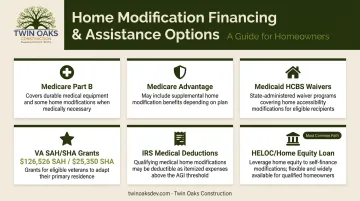
| Program | What to Know |
|---|---|
| Medicare Part B | Covers medically prescribed DME; generally does not cover elective remodeling |
| Medicare Advantage | Some plans offer supplemental benefits — verify your specific plan's Evidence of Coverage |
| Medicaid HCBS Waivers | May cover home modifications for eligible low-income seniors; varies by state |
| VA SAH/SHA Grants | FY2026 maximums: SAH $126,526 / SHA $25,350 for qualifying veterans |
| IRS Medical Deductions | Prescribed modifications may be partially deductible — consult a tax professional |
| HELOC / Home Equity Loan | Most common funding path for homeowners with existing equity |
The Long-Term Math
The median monthly cost of assisted living in the US runs around $4,500–$6,500, according to Genworth's annual Cost of Care Survey. A family spending $12,000 on a complete senior bathroom remodel can offset that expense in under two months of avoided care costs. That math makes accessibility upgrades one of the higher-return investments a homeowner can make heading into retirement.
Frequently Asked Questions
Does Medicare cover bathroom remodeling for seniors?
Original Medicare generally does not cover elective home modifications. Medicare Part B may cover certain medically prescribed durable medical equipment used at home. Medicare Advantage plans sometimes offer expanded supplemental benefits — check your specific plan's Evidence of Coverage to confirm what's included.
What does a $10,000 senior bathroom remodel include?
At this budget, targeted modifications are realistic: grab bar installation with proper wall blocking, a comfort-height toilet replacement, non-slip flooring, and improved lighting. A full curbless shower conversion typically requires a larger budget and is better planned as a separate phase.
Is a "senior bathroom remodel" just a regular remodel with different features?
Aging-in-place bathroom remodeling is a distinct category guided by universal design principles. It prioritizes specific safety modifications — curbless entry, grab bars, comfort-height fixtures, accessible storage — with the goal of preserving independence, not just updating appearances.
What's the most important first modification to make?
Grab bar installation at the toilet and shower, combined with non-slip flooring, addresses the two most common fall triggers immediately and at manageable cost. Start here before any structural changes.
Do grab bars need professional installation?
Yes. Grab bars must be anchored into wall studs or solid blocking to safely support 250+ lbs of force. Installation into drywall alone creates a serious injury risk — the bar can pull free exactly when it's needed most. Professional installation is strongly recommended.
How long does a senior bathroom remodel typically take?
Targeted modifications — grab bars, fixture swaps, lighting — may take a few days of actual work. A full curbless shower conversion or complete bathroom overhaul typically takes several weeks of construction, plus additional time for planning, material selection, and permitting. Twin Oaks Construction provides clear timelines during the free consultation so homeowners can plan accordingly.